


Views
Nothing Found
Sorry, no posts matched your criteria
News
First Issue of 2021’s Lloyd’s Maritime and Commercial Law Quarterly
The first issue of Lloyd’s Maritime and Commercial Law Quarterly for 2021 features the following private international law articles:
Adrian Briggs, “A Conflict of Comity in the Enforcement of Judgments”
Patrick Dunn-Walsh, “Insurance Litigation under the Recast Brussels Regulation”
Anthony Kennedy, “A Place to Start”
Myron Phua and Serena Seo Yeon Lee, “Taxonomising “Quasi-Contractual” Anti-suit Injunctions”
UK notifies that it considers the Brussels and Rome Convention to no longer apply to it
Steve Peers (University of Essex) has just published a series of Brexit-related documents on Twitter, two of which appear to confirm that by leaving the European Union, the UK also (believes to have) ceased to be a party to the 1968 Brussels Convention and the 1980 Rome Convention – which many have argued might revive between the UK and those EU Member States who are parties to them.
The two letters, sent by the UK Government to the Council of the EU, both contain the following paragraph:
The Government of the United Kingdom hereby notifies the Secretary-General of the Council of the European Union that it considers that the [Brussels Convention] / [Rome Convention] ceased to apply to the United Kingdom and Gibraltar from 1 January 2021, as a consequence of the United Kingdom ceasing to be a Member State of the European Union and of the end of the Transition Period.
Book published on access to and knowledge of foreign law – in search of suitable cooperation instruments
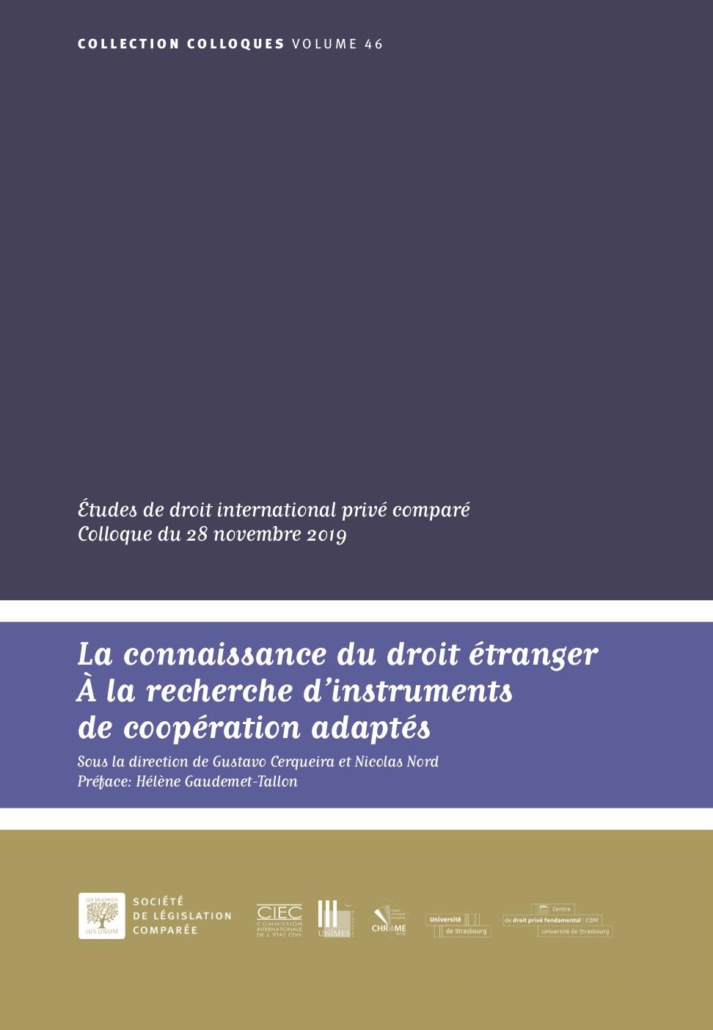
Gustavo Cerqueira, Nicolas Nord (dir.), La connaissance du droit étranger: À la recherche d’instruments de coopération adaptés. Études de droit international privé comparé, Préface : Hélène Gaudemet-Tallon, Paris : Société de législation comparée, coll. “Colloques”, vol. 46, 2020, 268 p. Click here.
The authors’ foreword reads as follows (English translation):
“On November 28, 2019, jurists from various backgrounds met at the french Cour de cassation in Paris to reflect on suitable instruments for international cooperation in establishing the content of foreign law.
This conference is in line with the work previously carried out within the Société de législation comparée on the subject of foreign law. In particular, it continues the reflections started at the conference concerning the controls on constitutionality and conventionality of foreign law, which was held on September 23, 2016 at the Cour de cassation. This event brought together academics and practitioners from several European, North and South American countries and resulted in the publication of a book in 2017 by the Society.
This approach is also part of the continuity of research carried out in other learned societies at the global or regional level.
The conference of November 28, 2019 confirmed the need for such reflection. On the one hand, all of the contributors affirmed the important place now given to foreign law in the settlement of disputes. This is due, among other things, to the growth of international family and business relationships, the growing demand for recognition of situations established abroad and the possibilities for those concerned to choose the applicable law. On the other hand, the participants attested to the increased role of different legal professions in the application of foreign law. While judges and civil registrars were more traditionally exposed to such a burden, notaries and lawyers in their dual mission of advice and drafting of acts are currently called upon to take into account or implement foreign law.
In this context, while it appears that European Union law is often at the origin of the involvement of these different actors in the application of foreign law, another, more recent phenomenon seems to increase occurrences of dealing with such a law: the extensive jurisdictional competition to which the European States are engaged because of Brexit. Indeed, Paris, Amsterdam, Brussels and other capitals are establishing courts and chambers specialized in international litigation and in the application of foreign law. This phenomenon is also spreading to major cities, either international, such as Frankfurt am Main or Hamburg, or regional, such as Saarbrücken, in Germany.
The stakes are crucial. The search for suitable instruments for a good knowledge of foreign law is essential for national laws in full legislative and jurisprudential evolution. Indeed, these changes specific to each system reinforce the need for access to reliable content of foreign law in order to guarantee the legal certainty of litigants, as well as to avoid civil liability of legal service providers or even fraud in manipulation of foreign solutions.
The research envisaged in this colloquium is unfolding, of course, in an environment in which there are formal and informal cooperation mechanisms, the effectiveness of which is only partial in the face of the complexity of the phenomena that cover the application of foreign law. Indeed, they were conceived to deal with a foreign law that supposed to be stable and simple and not shifting and plural in its sources. These mechanisms, not very visible, are also unknown to the practitioners themselves. Current discussions at European (EU) and international (Hague Conference) level attest to the urgency of thinking about responses in this area, using one or more relevant and effective instruments.
This is what the conference on knowledge of foreign law: in search of suitable cooperation instruments meant to answer. To this end, based on an indicative and non-exhaustive questionnaire, the issue of establishing an inventory was first raised, and then discussions ensued on the solutions adapted to the various requirements revealed both by the type of situation to be treated and by the category of professional involved. In this last respect, the needs of the judge and the notary were different, as were those of the registrar and the lawyer.
The adaptation was also considered in the light of the various questions specific to the original system. While the objective may a priori be to achieve the adoption of a general instrument with the widest possible geographical scope, it quickly appeared vain to try to favor such an approach at present. On the one hand, each profession has different needs, on the other hand, the level of development of the different systems compared is not the same. While some countries lag behind and struggle to adopt satisfactory rules in this area, others are at the forefront and therefore are not really in demand for a cooperation instrument whose usefulness does not seem obvious to them.
In this perspective, different paths for reflection have been explored. They range from the revitalization of old instruments to the creation of specialized institutions at internal, international or European level, including the establishment of specific mechanisms or the use of artificial intelligence. Such abundance shows the crucial nature of the issue and the vitality of the reflections carried out, but also the relevance of having debated it and the need to continue doing so.
In this sense, the next stage of this debate could be that of the opportunity of adopting a European regulation on the matter. In addition to the interest of such an instrument at the European level, it could serve as an impetus for other regional groups, such as Mercosur.” (our emphasis)
Prefaced by Professor emeritus Hélène Gaudemet-Tallon (Paris II Panthéon Assas), the book contains the following contributions (most of them in French).
Préface
Hélène GAUDEMET-TALLON
Avant-propos
Gustavo CERQUEIRA and Nicolas NORD
Introduction
Cyril NOURISSAT, Connaissance du droit étranger et coopération internationale : entre nécessité impérieuse et difficultés à surmonter
I. État des lieux
En France
La magistrature
François ANCEL, La connaissance du droit étranger. État des lieux – La magistrature
Cyril ROTH, Le droit étranger, irréductiblement inconnaissable : leçons tirées de la création d’une collection de lois exotiques
L’avocature
Dominique FOUSSARD, Le point de vue d’un avocat au Conseil d’État et à la Cour de cassation
Olivier BERG, L’avocat et le droit étranger : entre connaissance et représentation
L’état civil
Nicolas NORD, Le droit étranger devant l’officier de l’état civil. État des lieux
Dans le voisinage
Jochen BAUERREIS, La connaissance du droit étranger en Allemagne
Guillermo PALAO MORENO, La connaissance du droit étranger en Espagne
Pietro FRANZINA, La connaissance du droit étranger : cadre juridique et moyens disponibles en Italie
Lukas HECKENDORN URSCHELER, La connaissance du droit étranger en Suisse. Une multitude de moyens
En Amérique Latine
Gustavo Ferraz DE CAMPOS MONACO, La connaissance du droit étranger en Amérique
II. Solutions envisageables
Du point de vue des universitaires
Patrick KINSCH, La preuve de la loi étrangère par renvoi préjudiciel
Gustavo CERQUEIRA, Fondamentalisation du droit et justice prédictive. Deux phénomènes à prendre en compte pour la connaissance du droit étranger
Guillermo PALAO MORENO, La connaissance du droit étranger : évaluation de la situation en Espagne et propositions dans une perspective européenne
Maria Rosa LOULA, The challenges in accessing applicable foreign law and international cooperation in Brazil
Du point de vue des praticiens
Le magistrat
Jean-Noël ACQUAVIVA, Connaissance du droit étranger et coopération internationale. Solutions prospectives : l’opinion d’un juge
Le notaire
Jean-Louis VAN BOXSTAEL, La connaissance du droit étranger. Le point de vue d’un notaire
Du point de vue des institutions
Marie VAUTRAVERS, Le point de vue du Bureau du droit de l’Union, du droit international privé et de l’entraide civile, direction des affaires civiles et du Sceau, France
Rodrigo RODRIGUEZ, Knowledge of Foreign Law and the London Convention of 1968 – Council of Europe’s CDCJ
Wolfgang ROSCH, La connaissance du droit étranger et la Cour de justice de l’Union européenne
Nicolas NORD, La Commission Internationale de l’État Civil
Propos conclusifs
Françoise Monéger
Annexes
Questionnaire envoyé aux contributeurs
Programme du Colloque
Liste des contributeurs (auteurs, orateurs, et présidents des séances)
The full table of contents, the preface and the forewords are available here (in French).
More information: https://legiscompare.fr/ecommerce/fr/197-la-connaissance-du-droit-etranger-a-la-recherche-d-instruments-de-cooperation-adaptes