


Views
The Explosion of Private International Law in Asian Scholarship
The 21st century has witnessed a remarkable surge in academic scholarship on private international law in Asia. This is not to say that significant studies on the subject were absent before this period. However, in recent decades, Asian scholars have brought renewed vigour and depth to the field, establishing private international law as a critical area of legal inquiry on the continent.
A testament to this intellectual flourishing is Hart Publishing’s extensive series on private international law in Asia, featuring no fewer than 16 volumes with Professors Anselmo Reyes and Paul Beaumont as Series Editors. These works serve as a rich repository of comparative legal thought, offering valuable insights that extend far beyond Asia’s borders. Scholars and practitioners seeking inspiration from diverse jurisdictions will find these books to be an essential resource. Moreover, other publishers have also contributed to this growing body of literature, further amplifying Asia’s voice in the global discourse on private international law.
Having read and reviewed many of these works on the blog, I am continually struck by the depth of scholarship they offer. Each new book reveals fresh perspectives, reinforcing the notion that private international law is not merely a regional concern but a truly global conversation.
As someone deeply engaged with African private international law, I have found immense value in these Asian publications. The parallels between Asia and Africa—particularly in terms of legal pluralism and cultural diversity—make these studies both relevant and instructive. The cross-pollination of ideas between these regions has the potential to strengthen the development of private international law in both continents.
What is most striking about this surge in Asian scholarship is its outward-looking nature. No longer confined to internal discussions, private international law in Asia is now exporting ideas, influencing legal developments worldwide. This is a phenomenon that deserves both recognition and emulation. The rise of Asian scholarship in private international law is not just an academic trend—it is a pivotal force shaping the future of global legal thought.
The $24 Billion Judgment Against China in Missouri’s COVID Suit
This article was written by Prof. William S. Dodge (George Washington University Law School) and first published on Transnational Litigation Blog. The original version can be found at Transnational Litigation Blog. Reposted with permission.
On March 7, 2025, Judge Stephen N. Limbaugh, Jr. (Eastern District of Missouri) entered a default judgment for more than $24 billion against the People’s Republic of China and eight other Chinese defendants for hoarding personal protective equipment (PPE) during the early days of the COVID pandemic in violation of federal and state antitrust laws. The Eighth Circuit had previously held that the Foreign Sovereign Immunities Act (FSIA) barred most of Missouri’s claims but that the hoarding claim fell within the act’s commercial activity exception.
Missouri now has the judgment against China that it wanted. But Missouri may find that judgment hard to enforce. As discussed below, there appear to be significant procedural problems with the judgment that at least some defendants might raise. More broadly, the properties of foreign states and their agencies or instrumentalities are entitled to immunity from execution under the FSIA. Immunity from execution is broader than immunity from suit, and it is not clear that any of the defendants have property in the United States that can be used to satisfy the judgment. Read more
Trending Topics in German PIL 2024 (Part 1 – Illegal Gambling and “Volkswagen”)
At the end of each year I publish an article (in German) about the Conflict of Laws developments in Germany of the last twelve months, covering more or less the year 2024 and the last months of 2023. I thought it would be interesting for the readers of this blog to get an overview over those topics that seem to be most trending.
The article focuses on the following topics:
- Restitution of Money lost in Illegal Gambling
- Applicable Law in the Dieselgate litigation
- The (Non-)Valitidy of Online Marriages
- New German conflict-of-law rules regarding gender afiliation / identity
- Reforms in international name law
I will start in this post with the two first areas that are mainly dealing with questions of Rome I and Rome II while in my follow-up post I will focus on the three areas that are not harmonized by EU law (yet) and are mainly questions of family law.
News
Choice of Law in the American Courts in 2025
The thirty-ninth annual survey on choice of law in the American courts is now available on SSRN. The survey covers significant cases decided in 2025 on choice of law, party autonomy, extraterritoriality, international human rights, foreign sovereign immunity, adjudicative jurisdiction, and the recognition and enforcement of foreign judgments.
The cases discussed in this year’s survey address (among other things) the situs of cryptocurrency, exploding batteries in e-cigarettes, the sale of an antique military tank, the validity of an Urfi marriage ceremony, whether the Hague Service Convention prohibits email service on defendants in China, the enforcement of a Philippine forfeiture judgment, and claims of expropriation by German authorities during the Soviet occupation after World War II.
This annual survey was admirably maintained by Symeon Symeonides for three decades. The present authors are pleased to have extended this tradition.
Publication and Webinar: ELI Report on the EU Parenthood Proposal
Yesterday, the Project Report of the ELI Project “Enhancing Child Protection: Private International Law on Filiation and the European Commission’s Proposal COM/2022/695 final”
It contains constructive amendments to the original Commission’s Parenthood Proposal and intends to bring it more in line with the acquis and general considerations of EU PIL. Furthermore, it puts the best interest of the child in the focus of the analysis.
Recent Publication: Towards Universal Parenthood in Europe
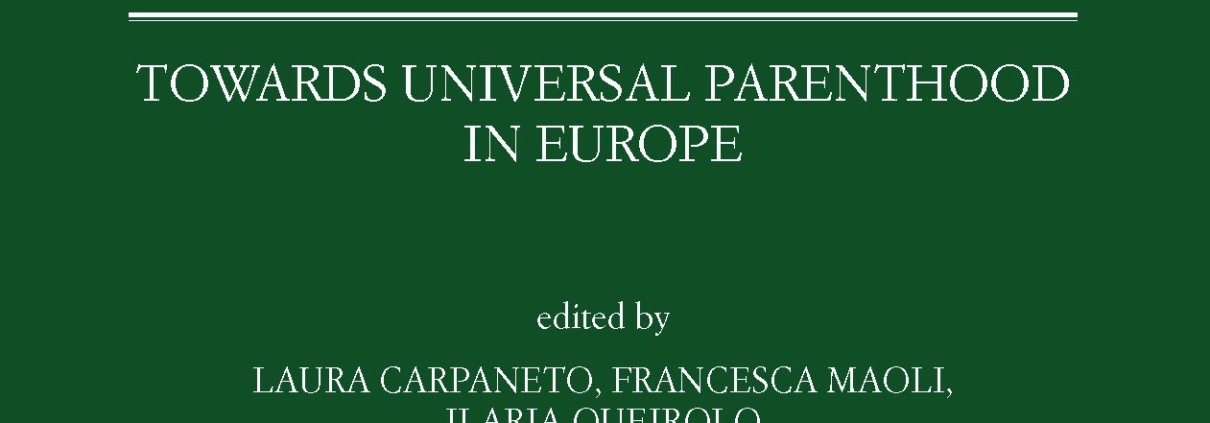
The recently published book Towards Universal Parenthood in Europe (Editoriale Scientifica, 2025), edited by Laura Carpaneto, Francesca Maoli, and Ilaria Queirolo, offers a timely and rigorous contribution to European private international law and family law scholarship.
This volume follows the convention reported at this blog here and likewise presents the results of the UniPAR – Towards Universal Parenthood in Europe project, an EU-co-funded research initiative that addresses some of the most complex legal challenges in cross-border parenthood. Bringing together expert authors from different universities across European Union, the book combines theoretical frameworks with practical insights into how parenthood is recognised and regulated across different Member States. Covering six EU jurisdictions (Spain, Belgium, Italy, Bulgaria, Croatia and Poland) the book provides comprehensive national reports and comparative analyses on key issues of jurisdiction, applicable law, adoption, recognition of decisions and birth certificates and judicial cooperation in parenthood matters. The contents are available here.
This scholarly work advances the debate on the need for coherence in legal frameworks governing parentage and family relationships in European Union, especially in contexts involving cross-border mobility, assisted reproductive technologies and the recognition of family statuses across Member States. The final conclusions and recommendations serve both academic and policy audiences, offering structured reflections on legislative gaps and potential paths towards harmonised rules in EU private international law.This is an essential resource that deepens understanding of the legal implications of cross-border parenthood and strengthens the foundation for future legislative reform in European Union.