


Views
Can a Seat Court Injunct a Foreign Non-Party to an Arbitration? Singapore High Court clarifies in Alphard Maritime v Samson Maritime (2025) SGHC 154
This guest post is posted on behalf of Kamakshi Puri, Senior Associate at Cyril Amarchand Mangaldas, Delhi, India, and dual-qualified lawyer (India and England and Wales).
The Singapore High Court recently clarified the scope of the court’s jurisdiction over foreign non-parties to the arbitration. In an application to set aside two interim injunctions, in Alphard Maritime Ltd. v Samson Maritime Ltd. & Ors. (2025) SGHC 154,[1] the court held that the the seat per se did not confer jurisdiction against non-parties to an arbitration, and that jurisdiction would first have to be established through regular service-out procedures before the seat court could grant an injunction against a non-party.
AI in Arbitration: Will the EU AI Act Stand in the Way of Enforcement?
This guest post was written by Ezzatollah Pabakhsh, Master’s Student at the University of Antwerp
The European Union has taken an unprecedented step by regulating artificial intelligence (AI) through the EU AI Act, which is the world’s first comprehensive legal framework for AI governance. According to Recital 61, Article 6(2) and Annex III, 8(a), AI tools used in legal or administrative decision-making processes—including alternative dispute resolution (ADR), when used similarly to courts and producing legal effects—are considered high risk. These tools must comply with the strict requirements outlined in Articles 8 through 27. Read more
Clearly Inappropriate Down Under: Isaacman v King [No 2] and the Outer Limits of Long-Arm Jurisdiction
By Dr Sarah McKibbin, University of Southern Queensland
The Supreme Court of New South Wales’ decision in Isaacman v King [No 2][1] is the kind of case that tempts one to say ‘nothing to see here’, and yet it richly rewards a closer look. On a conventional application of Voth v Manildra Flour Mills[2] — the leading Australian authority on forum non conveniens — Garling J stayed proceedings that attempted to litigate a New York relationship dispute in Sydney, being ‘well satisfied’ that the NSW Supreme Court was a clearly inappropriate forum.[3] The reasons, though brief by design,[4] illuminate the transaction costs of jurisdictional overreach,[5] show how the Voth framework handles an extreme set of facts, and offer a careful case study for empirical debates about Australian ‘parochialism’ in jurisdictional decision-making. Read more
News
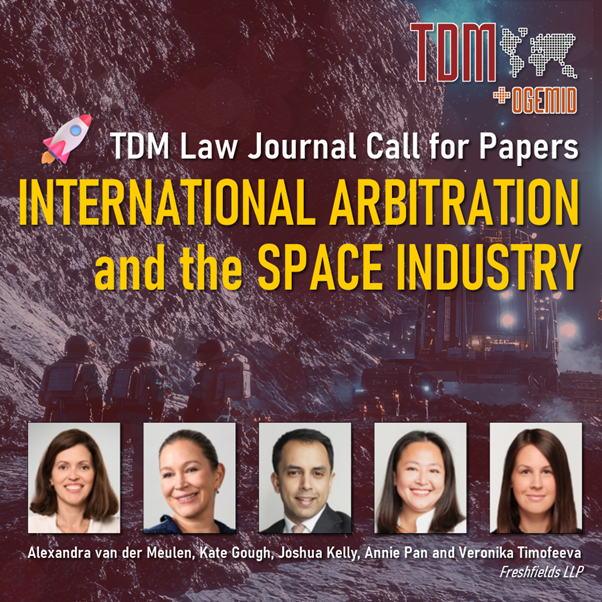
TDM Call for Papers: Special Issue on “International Arbitration and the Space Industry”
Transnational Dispute Management (TDM) has kindly shared the following Call for Papers with us.
We are pleased to announce a forthcoming Transnational Dispute Management (TDM, ISSN 1875-4120, www.transnational-dispute-management.com) special issue on “International Arbitration and the Space Industry.”
This Special Issue will be edited by Alexandra van der Meulen, Kate Gough, Joshua Kelly, Annie Pan and Veronika Timofeeva (Freshfields LLP).
14th International Forum on the e-APP: Registration open!
 The Permanent Bureau (PB) is pleased to announce that registration is now open for participation in the 14th International Forum on the electronic Apostille Programme (e-APP Forum), which will take place on Tuesday 12 and Wednesday 13 May 2026 in Marrakesh, Morocco. To be held for the first time in Africa, this edition of the e-APP Forum will be organised by the HCCH’s Regional Office for Africa, with the support of the Ministry of Justice of Morocco. The Forum will be conducted in English, French, and Arabic, with simultaneous interpretation provided.
Since its launch in 2006, the e-APP has become an integral part of the operation of the Apostille Convention. The e-APP has two electronic components: an e-Apostille and an e-Register, which, over the past twenty years, have been instrumental in ensuring the practical, effective, and secure operation of the Apostille Convention amid constant technological development.
The e-APP Forum gathers experts and stakeholders from around the world. The Forum will provide a unique international platform for governments, organisations, and the private sector to learn more about the benefits of the e-APP, to promote its effective implementation, and to discuss the latest developments in relation to the e-APP worldwide.
Interested persons should register via this form no later than Friday 1 May 2026, 5.00 p.m. (CEST). Participation in the Forum is free of charge. However, participants are required to make their own travel and hotel arrangements and cover all related costs if participating in person. Please note that in-person seats will be allocated on a first-come, first-served basis and will be confirmed via e-mail by the PB.
For more information on the e-APP Forum, please visit the dedicated page on the HCCH website. A draft Agenda is available on the HCCH website and will be updated as panellists are confirmed.
For further information on the Apostille Convention and the e-APP, please visit the Apostille Section of the HCCH website.
Call for papers – fourth edition of their Decolonial Comparative Law Workshop series
This post is posted on behalf of Kwamou FEUKEU Eva, Head of the Africa Centre of Expertise and Coordinator of Decolonial Comparative Law, Max-Planck-Institut für ausländisches und internationales Privatrecht
The Africa Centre of Expertise and the Max Planck Institute for Comparative and International Private Law have announced a call for papers for the fourth edition of their Decolonial Comparative Law Workshop series, to be held on 5–6 May 2027 in Douala in collaboration with the Fondation Afric’Avenir. This edition focuses on the theme “Decolonial Comparative Law and the Informal/Formal Economy,” asking scholars to rethink the distinction between formal and informal economies from a decolonial and comparative perspective. The workshop places particular emphasis on recognising the informal economy as a site of legality in its own right, foregrounding legal pluralism and context-specific practices. Contributions are encouraged on a wide range of topics, including microlending, alternative forms of value creation, labour rights in informal work, and indigenous and customary economies. Selected papers will be discussed in an interdisciplinary setting, with engagement from peers, scholars from fields such as anthropology, history, and economics, and practitioners and artists.
The deadline for paper submissions is 1 September 2026. Further details, including the full call for papers (available in English, French, Portuguese, Spanish, and Arabic), can be accessed here: https://www.mpipriv.de/2020710/decola-informal-formal-economy. An online information session for prospective applicants will be held on 18 March 2026 at 10:00 and 16:00 GMT, with registration available here: https://events.mpipriv.de/b?p=decola_and_the_informal_forma_leconomy_information_session. Following the workshop, an “Epupa School” (meaning “rainy season” in the Douala language) will take place from 10 to 12 May 2027 at the Fondation Afric’Avenir, offering scholars, students, and activists an opportunity to further engage with decolonial comparative approaches to the formal and informal economy.