


Views
Nothing Found
Sorry, no posts matched your criteria
News
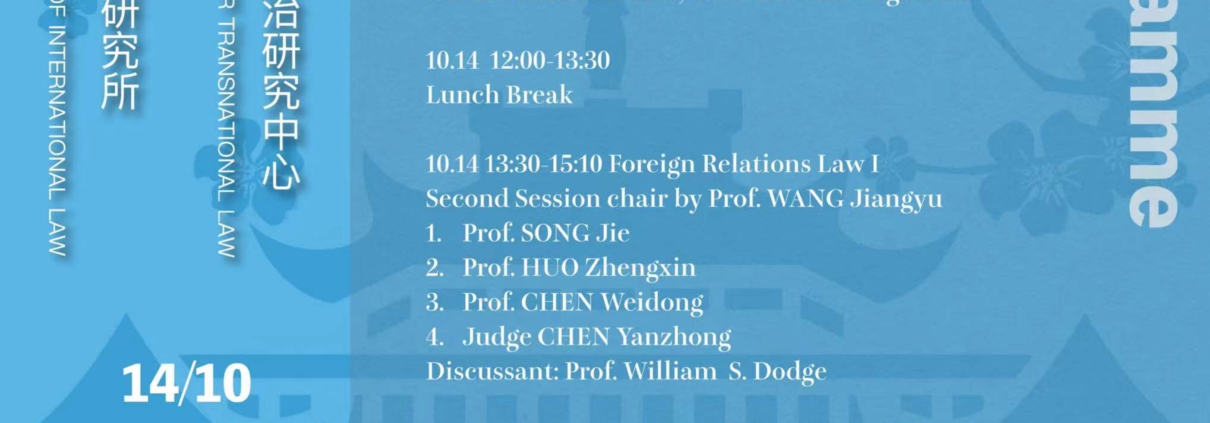
International Symposium on Legalisation of Foreign Relations in China
Legalisation of Foreign Relations in China, 14 Oct 2023, Wuhan University
Wuhan University and Fudan University are co-organising an International Symposium “Legalisation of Foreign Relations in China” (in English) on 14 Oct 2023. This symposium will discuss the two most important developments in Chinese law relating to foreign relations, i.e. the Foreign Relations Law and the Foreign State Immunities Law. Some presented articles will be published in the special session of the Chinese Journal of Transnational Law. This symposium will be held in person and online. Everyone is welcome. For more information and the program, please follow the event page. This event can be attended in-person or online. No registration is required.
INTERNATIONAL SYMPOSIUM ON LEGALISATION OF FOREIGN RELATIONS IN CHINA
Time: 9:30 am (Beijing time), 14 Oct 2023
Join the Zoom meeting
https://zoom.us/j/87645264148?pwd=xlbP90sgAmV0R4kFT6nkmxbL5nVlHA.1
Meeting ID: 876 4526 4148
Password: 032908
Virtual Workshop (in English) on October 10: Diego Fernández Arroyo on “Transnational Commercial Arbitration as Private International Law Feature”

On Tuesday, October 10, 2023, the Hamburg Max Planck Institute will host its 37th monthly virtual workshop Current Research in Private International Law at 11:00-12:30 (CEST). Diego P. Fernández Arroyo (Sciences Po Law School) will speak, in English, about
Transnational Commercial Arbitration as Private International Law Feature
A significant part of private international law (PrIL) disputes is nowadays solved by means of arbitration. At the same time, the range of arbitrable issues has been growing up for decades. Consequently, arbitration is no longer ignored by PrIL scholars, who, nevertheless, hesitate about how to deal with it. Many of them are only attracted by the fact that arbitral tribunals are often confronted to ordinary problems of determining the law applicable to a particular issue. Through the lens of this classical-PrIL approach, they identify sometimes conflict-of-law rules in arbitration instruments. Without denying any interest to this option, we will try to provide a more comprehensive view, starting by revising the very respective notion of arbitration and PrIL as well as their interaction, and concluding to challenge the excessive role played by the seat of the arbitration.
The presentation will be followed by open discussion. All are welcome. More information and sign-up here.
If you want to be invited to these events in the future, please write to veranstaltungen@mpipriv.de.
Out Now: Choice of Law and Recognition in Asian Family Law
A book edited by Anselmo Reyes, Wilson Lui, and Kazuaki Nishioka on Choice of Law and Recognition in Asian Family Law has just been published in the Hart Studies in Private International Law -Asia.
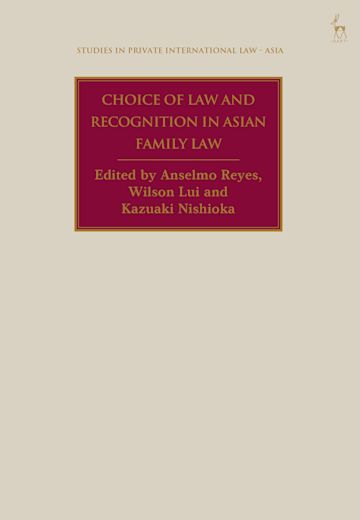
The blurb read as follows:
This thematic volume in the series Studies in Private International Law – Asia outlines the general choice of law and recognition rules relating to family matters of 15 Asian jurisdictions: Mainland China, Hong Kong, Taiwan, Japan, South Korea, Singapore, Malaysia, Vietnam, Cambodia, Myanmar, the Philippines, Indonesia, Thailand, Sri Lanka and India. The book examines pressing questions and proposes ways in which their systems may be reformed. A concluding chapter considers the extent to which Asian cross-border family law systems can and should be harmonised.
The book provides a comprehensive analysis of cross-border family law challenges, including child surrogacy, child abduction, the recognition of same-sex unions, the recovery of maintenance, and the regulation of intercountry adoption. These are among the matters now testing Asian institutions of private international law and acting as forces for their modernisation.
With contributions by leading Asian private international law experts, the book proposes necessary reforms for each of the jurisdictions analysed as well as for Asia as a whole.