


Views
The Justice Initiative Frankfurt am Main 2017
Written by Prof. Dr. Dres. h.c. Burkhard Hess, Executive Director Max Planck Institute Luxembourg for Procedural Law
Against the backdrop of Brexit, an initiative has been launched to strengthen Frankfurt as a hot spot for commercial litigation in the European Judicial Area. On March 30, 2017, the Minister of Justice of the Federal State Hessen, Ms Kühne-Hörmann, organized a conference at which the Justice Initiative was presented. More than 120 stakeholders (lawyers, judges, businesses) attended the conference. The original paper was elaborated by Professors Burkhard Hess (Luxembourg), Thomas Pfeiffer (Heidelberg), Christian Duve (Heidelberg) and Roman Poseck (President of the Frankfurt Court of Appeal). Here, we are pleased to provide an English translation of the position paper with some additional information on German procedural law for an international audience. The proposal has, as a matter of principle, been endorsed by the Minister of Justice. Its proposals are now being discussed and shall be implemented in the next months to come. The paper reads as follows: Read more
Paris, the Jurisdiction of Choice?
 On January 17th, the President of the Paris Commercial Court (Tribunal de commerce) inaugurated a new international division.
The new division, which is in fact the 3rd division of the court (3ème Chambre), is to be staffed with nine judges who speak foreign languages, and will therefore be able to assess evidence written in a foreign language. For now, the languages will be English, German and Spanish, as one juge speaking Spanish and two speaking German are currently on the court.
In an interview to the Fondation de droit continental (Civil law initiative), the President of the Court explained that the point was to make French justice more competitive and attract international cases. It also made clear that France was following Germany’s lead, where several international divisions were established in 2009 in Hamburg and Cologne.
French Commercial Courts
It should be pointed out to readers unfamiliar with the French legal system that French commercial courts are not staffed with professional judges, but with members of the business community working part-time at the court (and for free). In Paris, however, many of these judges work in the legal department of their company, and are thus fine lawyers.
Also, French commercial courts (and French civil courts generally) virtually never hear witnesses, so the issue of the language in which they may address the court does not arise.
Some issues
So, the new international division will be able to read documents in several foreign languages. However, nothing suggests that parties or lawyers will be able either to speak, or to write pleadings, in any other language than French. Lawyers arguing these cases will still need to file their pleadings in French, and thus to translate them in English beforehand for their clients. Furthermore, the interview of the Court’s President seems to suggest that using a foreign language will not be a right for the parties. Quite to the contrary, it seems that it will not be possible if one of the parties disagrees, and demands documents be translated in French.
Will that be enough to attract additional commercial cases to Paris?
I wonder whether introducing class actions in French civil procedure would have been more efficient in this respect.
For the full interview of the Court’s President, see after the jump.
News
Out Now: Treatment of Foreign Law in Asia
A book edited by Kazuaki Nishioka on Treatment of Foreign Law in Asia has just been published in the Hart Studies in Private International Law -Asia.
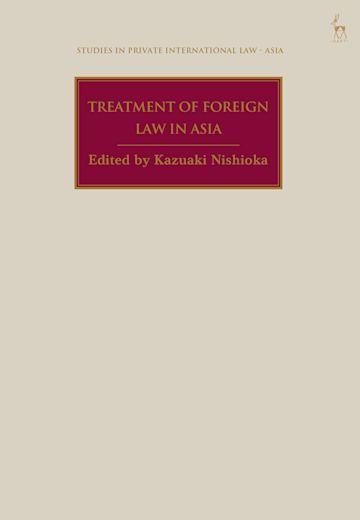
The blurb read as follows:
How do Asian courts ascertain, interpret, and apply a foreign law as the law governing the merits of the case? What should judges do if parties do not raise or disagree on the content of foreign law? This thematic volume in the Studies in Private International Law – Asia series analyses the treatment of foreign law before judicial authorities, that is, how the courts of Asian states deal with the proof of foreign law in court litigation involving cross-border elements.
The individual chapters cover 15 Asian jurisdictions: Mainland China, Hong Kong, Taiwan, Japan, South Korea, Singapore, Malaysia, Vietnam, Cambodia, Myanmar, the Philippines, Indonesia, Thailand, Sri Lanka, and India.
The Introduction and Conclusion examine similarities and differences in the approaches taken by the 15 Asian states with a view to assessing the extent to which those approaches are consistent or different from each other. The book also puts forward suggestions for harmonising differing approaches, especially between Asian common law and civil law states.
The book is a one-stop reference guide on the treatment of foreign law in Asia and will be indispensable to judges, practitioners, and scholars not just in Asia, but worldwide.
Out Now: Internationales Privat- und Prozessrecht in Lateinamerika by Jürgen Samtleben
Jürgen Samtleben just published a collection of his work on the PIL of Latin America; he kindly shared the following announcement with us:
Jürgen Samtleben has authored numerous articles over the years on private international law and international civil procedure in Latin America. These contributions have now been updated and systematically organized into a single volume, thereby offering a unique overview of the conflict of laws in Latin American countries. The collection of articles in German, Spanish and English is supplemented by a comprehensive volume containing the relevant statutory materials in their original language as well as in German translation.
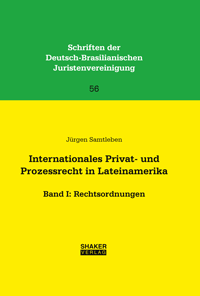
The indices of volume I (‘Rechtsordnungen’) and volume II (‘Gesetzestexte’) can be found here and here. More information is available here.
New article published in African Journal of International and Comparative Law
A new conflict of laws article was just published today on the African Journal of International and Comparative Law. It is titled: CSA Okoli, A Yekini & P Oamen, “The Igiogbe Custom as a Mandatory Norm in Conflict of Laws: An Exploration of Nigerian Appellate Court Decisions.”
The abstract reads as follows:
Under the Igiogbe custom of the Bini Kingdom of Edo State Nigeria, the eldest surviving son exclusively inherits the ancestral home of his deceased father. This custom is a mandatory norm in conflict of laws. Litigation on the custom has been described as a matter of life and death. There is a widely shared view among academic writers, practitioners, and judges that this customary law is absolute. Contrary to this popular view, this work argues that the Igiogbe custom can be displaced by statute and other customary or religious laws. To substantiate this position, this article examines all the reported appellate court decisions on the Igiogbe custom and other connected principles. It is often taken for granted that every Bini man is subject to customary law, thereby leading to the overriding application of the Igiogbe custom. Recent developments in case law suggest otherwise. There is a conflict of personal law question that is often ignored in most litigation concerning the Igiogbe. Careful consideration of this question can potentially lead to the application of other systems of succession law (statutory, religious, and other customary laws) other than the Igiogbe custom. Besides, these conflict of laws techniques and constitutional human rights norms can be used to strike the appropriate balance between competing interests and reasonable legitimate expectations of the deceased and their heirs.