


Views
Equality of the parties in investment arbitration – public international law aspects
Written by Silja Vöneky, University of Freiburg
Note: This blogpost is part of a series on „Corporate social responsibility and international law“ that presents the main findings of the contributions published in August Reinisch, Stephan Hobe, Eva-Maria Kieninger & Anne Peters (eds), Unternehmensverantwortung und Internationales Recht, C.F. Müller, 2020.
I. Introduction
1. The question of the status of transnational corporations in investment arbitration is of central importance for the division of spheres of responsibility, for the pursuit and enforcement of values, and thus for the bases of legitimation of the international legal order today.
2. The promotion of foreign direct investments and the deepening of economic cooperation between States to promote economic development with the common welfare objective of increasing the prosperity of the peoples of the contracting States parties has been the legitimating basis of the ICSID Convention, which is central to investment protection under international law, and of the bilateral investment protection agreements.
3. Investment protection law, as part of public international law – from its basis and purpose – should not be understood as a departure from a state-centered international order.
4. From the point of view of international law, the following questions have to be answered: What are the implications for the investment protection regime and investment arbitration as its core
a) if the triad justifying economic globalization (foreign private investment – promotion of economic development – promotion of prosperity) loses its persuasiveness as a paradigm for its justification in a normative sense, and
b) if a discourse of delegitimization prevails that accuses profit-oriented transnational corporations in their role as investors of irresponsible conduct, which is incompatible with the public welfare, and States of enabling this conduct to the detriment of their own population by means of international treaties establishing investment arbitration?
5. The aim to align investment treaties with the principle of sustainable development can be seen by the reforms initiated by States, groups of States, and the United Nations Conference on Trade and Development; besides, this aim should have an impact on already existing investment treaties and investment arbitration as far as it is coherent with international law.
II. Transnational corporations as equal parties under international law within the framework of investment arbitration
6. A necessary condition for the equality of the host State and an investing foreign corporation as parties is that both by consent agree to arbitration in respect of a legal dispute directly related to an investment, i.e. that the State, which is a contracting party to the ICSID Convention and a subject of international law, besides ratifying the convention additionally gives its written consent (Art. 25 (1), Art. 36 (2) ICSID Convention), which has a threefold function (legitimating element, transformative element and constitutive element).
7. For various reasons, the procedural equality of the host State and the transnational corporations within the framework of a concrete arbitration procedure is justified and thus legitimate with regard to the international legal order as a whole. In particular, it complies with the principle of fair trial and the rule of law as enshrined in international law.
8. The principle of the equality of the parties does not preclude that transnational corporations are given preferential access to arbitration on the basis of international treaties and that arbitration is open only to transnational corporations.
9. The principle of the equality of the parties is inter alia observed during the composition of an arbitral tribunal if the judges are appointed by both parties in the same manner and each judge fulfils criteria which plausibly ensure impartiality. However, the appointment by the parties is not a necessary condition for the equality of the parties.
10. Questions about how to implement the principle of the equality of the parties arise in the arbitral proceedings themselves, in particular with regard to the possibility that several investors seek to bring their claims against the same host State, with regard to the admissibility of a counterclaim by the host State, with regard to the admissibility of “amicus curiae briefs” (third person submissions), with regard to the so-called equality of arms, and with regard to the problem of safeguarding confidentiality interests (in particular State secrecy).
11. Questions of the applicable law within the scope of the merits, such as the possibility of the host State to invoke justifications under international law (e.g. necessity) and the principles of interpretation of the investment protection agreements, are not considered to be questions of the principle of the equality of the parties.
III. (Un)justified unequal treatment to the detriment of transnational corporations as parties with regard to corruption problems
12. The decisions of arbitral tribunals, which deny their jurisdiction or the admissibility of the investor claim if the defendant host State asserts corruption, are convincing (only) with regard to limited types of cases.
13. The lack of jurisdiction of the tribunal or the inadmissibility of the investor’s claim does not seem to be justified even if the transnational corporation’s act of corruption made the investment possible in the first place: The contrary reasoning in investment arbitration decisions, based inter alia on the wording of bilateral investment treaties, the scope of the host State’s consent and/or a violation of fundamental general principles (such as, inter alia, the so-called “clean hands” principle, the “international public policy” or “transnational public policy”, or the principle that no one shall profit from his/her own wrong) is not convincing for various reasons .
14. The same is true even more – in accordance with recent investment arbitration decisions – if the foreign investor acted corruptly after the investment had already been initiated in the host State.
15. Instead, corruption should be taken into account in the decision on the merits of a case in accordance with the objectives and principles of the international legal order in such a way that central values of investment protection are not disproportionately undermined, but nevertheless relevant disadvantages arise for transnational corporations if they engage in acts of corruption abroad for or during investments. This can be achieved if the amount of investors compensation is reduced for example by a multiple of the sum of the corruption.
16. When considering acts of corruption in the merits of a case, the arbitral tribunal should therefore consider the distribution of responsibility, the pursuit and enforcement of global values, and the bases of legitimacy of the current international legal order, also taking into account the state’s anti-corruption obligations, in particular as enshrined in anti-corruption conventions and human rights treaties.
IV. Concluding remarks
17. The procedural equality of host States and transnational corporations within the framework of an investment arbitration procedure has no implications on the status of transnational corporations in the international legal order as a whole; other views, which argue that transnational corporations are (full or partial) subjects of international law in a normative sense, exceed the – de lege lata – narrowly limited equality.
18. The risks associated with a normative enhancement of transnational corporations in the international legal order present another argument against the view that corporations are (full or partial) subjects of international law. These risks are hinted at in the delegitimization discourse, which grants profit-oriented companies less influence in the international legal order of the 21st century.
19. Even without the status as subjects of international law, transnational corporations can be bound by norms of international law (international law in the narrow sense and so-called soft law). The UN Guiding Principles for the Business and Human Rights are, inter alia, of particular relevance.
20. If – with good reasons – foreign direct investments by transnational corporations continue to be promoted via international law as a means of increasing prosperity in the participating States for the benefit of the respective population, the public-good orientation of international investment arbitration tribunals should be further developed, on the one hand, by reforming the constitutional aspects of the arbitral procedure, and, on the other hand, by further focusing their jurisprudence on public-good aspects including the proportionate protection of responsible investments.
Full (German) version: Silja Vöneky, Die Stellung von Unternehmen in der Investitionsschiedsgerichtsbarkeit unter besonderer Berücksichtigung von Korruptionsproblemen – Unternehmen als völkerrechtlich gleichberechtigte Verfahrensparteien?, in: August Reinisch, Stephan Hobe, Eva-Maria Kieninger & Anne Peters (eds), Unternehmensverantwortung und Internationales Recht, C.F. Müller, 2020, pp. 339 et seq.
Equality of the parties in investment arbitration – private international law aspects
Written by Stefan Huber, University of Tübingen
Note: This blogpost is part of a series on „Corporate social responsibility and international law“ that presents the main findings of the contributions published in August Reinisch, Stephan Hobe, Eva-Maria Kieninger & Anne Peters (eds), Unternehmensverantwortung und Internationales Recht, C.F. Müller, 2020.
1. In investor-state arbitration, one has to distinguish between arbitral proceedings which are initiated on the basis of a contract concluded between the investor and the host state, on the one hand, and arbitral proceedings which are initiated on the basis of a bilateral investment treaty, on the other hand. In the latter case, there is no arbitration agreement in the traditional sense. This entails a unilateral right of the investor to initiate arbitral proceedings. Granting the host state the right to bring a counterclaim might compensate this asymmetry up to a certain degree.
2. Whether the host state has the right to bring a counterclaim, depends on the dispute settlement mechanism provided for in the bilateral investment treaty. For future investment treaties, it is recommended to grant the host state such a right. When the investor introduces arbitral proceedings on the basis of such a treaty, the investor usually declares his consent with the entire dispute settlement clause. If, at this moment, the investor expressly excludes the right of the host state to bring a counterclaim which is provided for in the bilateral investment treaty, there is no correspondence between the declaration of the host state and the declaration of the investor to submit the dispute to arbitration. Consequently, if the host state refuses to participate in the arbitral proceedings on such a basis, the arbitral tribunal does not have jurisdiction to decide the case.
3. The subject matter of treaty-based investor-state arbitration generally concerns regulatory measures of the host state. This makes a considerable difference in comparison to commercial arbitration, which focuses on the interests of private actors. This difference entails different procedural principles, primarily as far as questions of confidentiality and transparency are concerned.
4. There are, however, procedural principles of particular importance, which reflect the cornerstones in a system based on the rule of law in its substantive sense and require, as such, observance in all types of proceedings independently of the subject matter. The principle of equality of arms is one of these principles. Tribunals shall ensure that both parties are in an equal position to present their case. If there is a systemic superiority of one group of parties, tribunals have to be particularly vigilant and, if necessary, to intervene proactively in order to compensate factual inequality.
5. The principle of equal treatment of the parties is not only to be respected within one and the same proceeding. Treating two types of party – states on the one hand and investors on the other – differently in general, i.e. not just in a specific proceeding, would likewise amount to a violation of this principle. If certain questions concerning the burden and standard of proof arise in one procedural situation typically in the interest of the host state and in another procedural situation typically in the interest of the investor, the tribunals should deal with those questions in the same manner.
6. Investments which are in conformity with the law as far as their object is concerned, but which are corruption-tainted due to corruption that took place when the investment was made lead to discussions about the content of international public policy. Against this background, there would appear to be a practice for tribunals to deny jurisdiction or admissibility of the arbitral proceedings in cases concerning corruption-tainted investments. Actually, this leads to a denial of justice. International public policy, however, does not require such an approach. A comparison with the treatment of corruption cases in commercial arbitration shows this very clearly. The circumstances of the individual cases are too manifold; a one-fits-all solution construed at the level of jurisdiction or admissibility is not convincing. The arbitral tribunals should rather undertake a comprehensive analysis on the basis of the applicable substantive rules of law in order to take into account the particular circumstances of each individual case. State interests can be properly respected via mandatory rules and international public policy.
Full (German) version: Stefan Huber, Die Stellung von Unternehmen in der Investitionsschiedsgerichtsbarkeit (unter besonderer Berücksichtigung von Korruptionsproblemen) – Unternehmen als gleichberechtigte Verfahrensparteien?, in: August Reinisch, Stephan Hobe, Eva-Maria Kieninger & Anne Peters (eds), Unternehmensverantwortung und Internationales Recht, C.F. Müller, 2020, pp. 303 et seq.
Corona and Private International Law: A Regularly Updated Repository of Writings, Cases and Developments
by Ralf Michaels and Jakob Olbing
Note: This repository will stay permanent at www.conflictoflaws.net/corona.
Please send additions to olbing@mpipriv.de
Updated: November 08, 2021
The coronavirus has created a global crisis that affects all aspects of life everywhere. Not surprisingly, that means that the law is affected as well. And indeed, we have seen a high volume of legislation and legal regulations, of court decisions, and of scholarly debates. In some US schools there are courses on the legal aspects of corona. Some disciplines are organizing symposia or special journal issues to discuss the impact of the pandemic on the respective discipline.
For a time Private international law has been vividly discussing the relevance of the crisis for the field, and of the field for the crisis Private international law matters are crucial to countless issues related to the epidemic – from production chains through IP over possible vaccines to mundane questions like the territorial application of lockdown regulations.
Knowledge of these issues is important. It is important for private international lawyers to realize the importance of our discipline. But it is perhaps even more important for decision makers to be aware of both the pitfalls and the potentials of conflicts of law.
This site, which we hope to update continually, is meant to be a place to collect, as comprehensively as possible, sources on the interaction of the new coronavirus and the discipline. The aim is not to provide general introductions into private international law, or to lay out sources that could be relevant. Nor is this meant to be an independent scholarly paper. What we try to provide is a one-stop place at which to find private international law discussions worldwide regarding to coronavirus.
For this purpose, we limit ourselves to the discipline as traditionally understood—jurisdiction, choice of law, recognition and enforcement, international procedure. Coronavirus has other impacts on transnational private law and those deserve attention too, but we want to keep this one manageable.
Please help make this a good informative site. Please share any reference that you have – from any jurisdiction, in any legislation – and we will, if possible, share them on this site. Please contact olbing@mpipriv.de
General
In the early beginning of the Pandemic, contributions from scholars, courts, international institutes and politicians where of a more general character as it was difficult to predict the scope and duration of the new situation.
The European Law Institute for example issued a set of Principles for the COVID-19 Crisis, covering a variety of legal topics such as Democracy (Principle 3) and Justice System (Principle 5) as well as Moratorium on Regular Payments, Force Major and Hardship, Exemption from Liability for simple Negligence (Principles 12 to 14). Ending with something everybody hopes for: Return to Normality (Principle 15).
The Secretary General of the Hague Conference recorded a short online message from his home addressing the most urgent topics. Ensuing, the Permanent Bureau developed a Toolkit for resources and publications relevant to the current global situation.
The university of Oxford‘s Blavatnik School of Government collects all measures by governments around the world in the “Coronavirus Government Response Tracker”.
A German journal is dedicated solely to the topic “COVID-19 and the Law”. The journal is interesting for academics and practitioners alike, since it publishes papers on specific COVID-19 related issues, as well as an extensive overview of German judgements.
An open access project by intersentia examines the COVID-19 legislation and its consequences in European states, bringing together contributions from over 85 highly regarded academics and practitioners in one coherent, open access resource.
Matthias Lehmann discusses the role of private international law on a number of issues – the impact of travel restrictions on transportation contracts, contract law issues for canceled events, canceled or delayed deliveries, but also liability for infections.
Online Workshops, Webinars and Conferences
In time of travel restrictions and social distancing the academic exchange is still active and sometimes more diverse than bevor, since people from all around the world come together, as the great number of workshops and symposiums that are held online shows.
Mid November (17 to 19), the Mexican Academy of Private International and Comparative Law discusses during its XLIV seminar among other topics the impacts of the pandemic on international family as well as aspects surrounding vaccines. participants will discuss in Spanish and the online participation is free of charge.
Contrary to the regular sessions of The Hague Academy of International Law’s Centre for Studies and Research, the upcoming edition is entirely online. The topic will be “Epidemics and International Law” and held from September 2020 to June 2021. The collective works will be published later by the Academy. You will find application and programme here.
The Minerva Center for Human Rights at Tel Aviv University hosted an international socio-legal (zoom-) workshop on 22-23 June 2021 to explore the impact of the Covid-19 crisis and its regulation on cross-border families. A call for papers expired on 28 February 2021.
Another series of events organized by the University of Sydney’s Centre for Asian and Pacific Law will regularly discuss topics such as social justice, civil rights, trade and investment in light of (post) pandemic developments. Of that series one webinar on the aftermath of the pandemic in the Asia-Pacific region focussed on commercial dispute resolution and issues related to private international law.
Marc-Philippe Weller discussed in a workshop on December 1, 2020 about “Nationalism, Territorialism, Unilateralism: Managing the Pandemic Through Private International Law?” if the measures enacted due to the pandemic may have an effect on the connecting factors in European private international law. He had a particular focus on the determination of habitual residence.
A comparative analysis of reactions in Japan and Germany on COVID-19 in private and public law with scholars from both jurisdictions was the topic of an online conference (mostly in German) on August 2020. Recordings of the presentations are online.
During a live youtube conference on July 23, 2020 Humberto Romero-Muci presented with several others his views on “Migrantes, pandemia y política en el Derecho Internacional Privado”. The video is still online.
A webinar organized by experts from MK Family Law (Washington) and Grotius Chamber (the Hague) discussed pertinent issues relating to international child abduction in times of COVID-19.
Matthias Lehmann presented his views on the application of force majeure certificates and overriding mandatory provisions n international contracts in an online-workshop on “COVID-19 and IPR/IZVR”.
Another webinar was held on “Vulnerability in the Trade and Investment Regimes in the Age of #COVID19”, which is available online, as part of the Symposium on COVID-19 and International Economic Law in the Global South.
The University of New South Wales held a talk on “COVID-19 and the Private International Law” in May, which you find on youtube.
As a follow-up of a webinar on PIL & COVID-19, Inez Lopez and Fabrício Polido give “some initial thoughts and lessons to face in daily life”
A group of Brazilian scholars organized an online symposium on Private International Law & Covid-19. Mobility of People, Commerce and Challenges to the Global Order. The videos are here.
The Organization of American States holds a weekly virtual forum on “Inter-American law in times of pandemic” (every Monday, 11:00 a.m., UTC-5h). One topic of many will be on “New Challenges for Private International Law” (Monday, June 15, 2020).
State Liability
Some thoughts are given to compensation suits brought against China for its alleged responsibility in the spread of the virus. One main issue here is whether China can claim sovereign immunity.
In the United States, several suits have been brought in Florida (March 12), Nevada (March 23) and Missouri (April 21) against the Peoples republic of China (PRC), which plaintiffs deem responsible for the uncontrolled spread of the virus, which later caused massive financial damage and human loss in the United States. Not surprisingly officials and scholars in China were extremely critical (see here and here).
But legal scholars, including Chimène Keitner and Stephen L. Carter, also think such suits are bound to fail due to China’s sovereign immunity, as do Sophia Tang and Zhengxin Huo. Hiroyuki Banzai doubts that the actions can succeed since it will be difficult to prove a causal link between the damages and the (in-) actions by the Chinese Gorvernment. Lea Brilmayer suspects that such a claim will fail since it would be unlikely, that a court will assume jurisdiction. The same conclusion is drawn by Angelica Bonfanti and Chimène Keitner after a thorough analysis of the grounds on which a liability of china could be based. An overview and detailed presentation of many class actions and suits filed by states can be found here.
Until now, only very little has happened concerning the American suits. Some suits where (voluntarily) dismissed or tossed. One suit against the PRC for damages amounting to $ 800 billion was ordered to be dismissed by the District Court, since the plaintiff failed to state a claim (James-El v the Peoples Republic of China (M.D.N.C. 2020) WL 3619870). For a general update on the lawsuits against the PRC from January 22, 2021 see here.
In an interview with a German newspaper Tom Ginsburg lays out the legal issues that will be faced, if the claims of state liability are brought in front of a German court. Fabrizio Marrella discusses the Italian perspective on that issue. Brett Joshpe analyzes more generally China’s private and public liability in the domestic and international framework.
A Republican Representative is introducing two House Resolutions urging the US Congress to waive China’s sovereign immunity in this regard; such a waiver has also been proposed by a Washington Post author. The claim has also found support by Fox News.
Interestingly, there is also a reverse suit by state-backed Chinese lawyers against the United States for covering up the pandemic. Guodong Du expects this will likewise be barred by sovereign immunity.
Martins Paparinskis shares the concerns about a successful litigation against foreign states. However, he suggests to change the law of state responsibility fundamentally to be prepared for further international catastrophes such as the current pandemic.
In the UK, the conservative Henry Jackson Society published a report suggesting that China is liable for violating its obligations under the International Health Regulations. The report discusses ten (!) legal avenues towards this goal, most of them in public international law, but also including suits in Chines, UK and US courts (pp 28-30). Sovereign immunity is discussed as a severe but not impenetrable barrier.
Contract Law
Both the pandemic itself and the ensuing national regulations impede the fulfilment of contracts. Legal issues ensue. An overview of European international contract law and the implications of COVID-19 is given here and here. Two chapters of the book “La pandemia da COVID-19. Profili di diritto nazionale, dell’Unione Europea ed internazionale” edited by Marco Frigessi di Rattalma are dedicated to jurisdiction and applicable law in contract matters.
The UNIDROIT Secretariat has released a Note on the UNIDROIT Principles of International Commercial Contracts and the COVID-19 health crisis.
Bernard Haftel highlights three different techniques to apply COVID-19 legislation to an international contract: as lex contractus, as lois des police and through consideration within the applicable law.
Gerhard Wagner presents COVID caused defaults under the aforementioned ELI principles.
If a contracting party is unable to perform its contractual obligations, incapacity to perform can be based on force majeure or hardship. Some contributions suggest to apply for force majeure certificates which are offered by most countries, for example by China, Russia. How such a certificate can influence contractual obligations under English and New York Law is shown by Yeseung Jang. The German perspective is given by Philip Reusch and Laura Kleiner. Further the South Korean, French and the Common Law perspective on force majeure have been published. Bruno Ancel compares the French and American approach. The difficulty to implement appropriate force majeure clauses in a contract is shown by Matteo Winkler.
Drawing from recent cases and experiences Franz Kaps analyses the difficulties in the operation within ICC force majeure clauses and suggests how “state-of-the-art force majeure clauses” should be constructed to include an international pandemic.
Victoria Lee, Mark Lehberg, Vinny Sanchez and James Vickery go beyond force majeure implications on contracts in their expert analysis.
William Shaughnessy presents issues which might occur in international construction contracts.
Another crucial aspect is the application of overriding mandatory rules on international contracts. Ennio Piovesani discusses whether Italian decree-laws enacted in view of the pandemic can operate as overriding mandatory rules and whether that would be compatible with EU law. So does Giovanni Zarra on international mandatory rules. Aposotolos Anthimos adds the Greek perspective, Claire Debourg the French to the discussion.
The applicability of self-proclaiming mandatory provisions in Italian law in respect to package travels in general and the Directive (EU) 2015/15 on package travel in particular, is discussed by Fabrizio Marongiu Buonaiuti.
Matthias Lehmann considers more broadly possible private international law issues and responses under European law. José Antonio Briceño Laborí and Maritza Méndez Zambrano add the Venezuelan view.
The crisis hits in particular global value and production chains. Impacts are discussed by Tomaso Ferando, by Markus Uitz and Hemma Parsché and by Anna Beckers, though neither focuses specifically on private international law.
Caterina Benini explains a new Italian mandatory rule providing a minimum standard of protection for employees.
Klaus Peter Berger and Daniel Behn in their historical and comparative study on force majeure and hardship, highlight that such remedies are quite regular to find and fit to distribute the risk emanating from such a crisis evenly.
CISG
The CISG has long been of very little importance in international contract law but now is subject to many discussions. André Janssen and Johannes Wahnschaffe dedicate a detailed analysis to exemptions from liability and cases of hardship under the CISG.
Performance on advance purchase agreements on delivering the COVID-19 vaccines, have been a major political debate recently. While asking which law is applicable on such contracts Ben Köhler and Till Maier-Lohmann suspect, that if CISG is in fact the applicable law, the consequences would be far reaching and could be the very first time the CISG enters the “global centre stage”. Unfortunately, a Belgian court deciding over a claim by the EU against AstraZeneca for the delivery of doses of vaccines, did not even consider the application of the CISG.
Corporate Law
If the questions of purchasing COVID-19 vaccines shifts to buying the entire company the issue at hand becomes more political. Arndt Scheffler analyses the situation in which a foreign investor tries to purchase a company, which is crucial for the domestic battle against the pandemic and the search for a vaccine.
Employment Law
Closed borders and practically everybody working from has its impact on employment law.
In export-oriented economies such as Germany, it is very common, that employees are posted abroad on a long-term basis. COVID-19 legislation shapes and influences the legal relation between employer and employee, but also between employee and host-country. Roland Falder and Constantin Franke-Fahle discuss these influences with particular attention to the question of the applicable law here.
Tort Law
Damages caused by an infection are mostly subject to tort law but can also arise in a contractual relation. Focusing on the applicable law on non-contractual liability Rolf Wagner explains, that sometimes damages can be claimed both, as contractual and as non-contractual. He stresses that as the substantive law on damages caused by an infection is still to evolve, applying foreign law is a particular challenge.
An extensive overview about the law applicable to damages caused by an COVID-19 infection under Indian international tort law is given by Niharika Kuchhal, Kashish Jaitley and Saloni Khanderia. Khanderia published a second article, concerning the need of a codification of Indian conflict of laws on tort in respect of a foreseeable surge in international tort proceedings, caused by the pandemic.
General implications of the coronavirus on product liability and a possible duty to warn costumers, without specific reverence to conflict of laws.
In Austria, a consumer protection association is considering mass litigation against the Federal State of Tyrolia and local tourist businesses based on their inaction in view of the spreading virus in tourist places like Ischgl. A questionnaire is opened for European citizens. Matthias Weller reports.
Florian Heindler discusses how legal measures to battle the virus could be applicable to a relevant tort case (either as local data or by special connection), by analyzing the hypothetical case of a tourist who gets infected in Austria.
Jos Hoevenars and Xandra Kramer discuss the potential of similar actions in the Netherlands under the 2005 Collective Settlement Act, WCAM.
Family Law
Implications also exist in family law, for example regarding the Hague Abduction Convention.
In an Ontario case (Onuoha v Onuoha 2020 ONSC 1815), concerning children taken from Nigeria to Ontario, the father sought to have the matter dealt with on an urgent basis, although regular court operations were suspended due to Covid-19. The court declined, suggesting this was “not the time” to hear such a motion, and in any way international travel was not in the best interest of the child. For the discussion see here.
Further sspects of travel restrictions in international abduction cases are analysed by Gemme Pérez.
A general overview of abduction in times of corona was published by Nadia Rusinova. Another article by Nadia by her covers recent case law and legislation on remote child related proceedings which were conducted during the last weeks around the world. She also highlights, that COVID-19 measures can impact Article 8 ECHR.
Also cases of international surrogacy come into mind which are affected by COVID-19, as Mariana Iglesias shows.
Personal Data
The protection of personal data in transnational environments has always been a controversial topic in conflict of laws. Jie Huang shows, that due to COVID-19 existing tensions between the EU, the USA and China are reflected in their conflict of laws approach.
The European Commission published a “toolbox for the use of technology and data to combat and exit from the COVID-19 crisis”, which was an opportunity for some contributions on the GDPR and Tracing Apps.
Economic Law
The crisis puts stress on global trade and therefore also economic law. Sophie Hunter discusses developments in the competition laws of various countries (though with no explicit focus on conflict of laws issues).
A list of authors from around the world analyses the interrelation between “Competition law and health crises” in its international context in the current issue Concurrences.
Intellectual Property
Due to lockdowns and school closures, online work and teaching has exorbitantly increased but, as Marketa Trimble stresses, with little notion of transnational copyright issues.
To tackle those a prominently endorsed letter to the World Intellectual Property Organization, emphasizes the need to ensure that intellectual property regimes should support the efforts against the Coronavirus and should not be a hindrance.
Public Certification
In times of lockdown and closed borders notarization and public certification become almost impossible. Therefore, various countries have adjusted their legislation. You will find an overview here.
The electronic Apostille Program (e-APP)experiences a new popularity, as a considerable number of countries have implemented new components of the e-APP. For more information see here.
Dispute Resolution
In Dispute resolution two main questions are being discussed.
On the one hand the question of jurisdiction as such, for example for claims suffered within contractual or non-contractual relationships. Rolf Wagner gives the European and German perspective presenting the possible courts of jurisdiction under Brussel I Regulation (recast), the Lugano Convention and the German code of civil procedure.
In a recent case by the Supreme Court of Queensland (AUS), the court examined the impact of COVID-19 on a foreign jurisdiction clause. You can find Jie Huang’s comments on the decision here.
One the other hand, it is being discussed to what extend the requirement of physical presence in courts can conform with social distancing and travel restrictions. As a more drastic reaction some courts suspended their activities except for urgent matters all together. Developments in Italy are discussed here, developments in English law here.
On the other hand, another possibility is the move to greater digitalization, as discussed comparatively by Emma van Gelder, Xandra Kramer and Erlis Themeli. The Hague Conference on Private International Law (HCCH) published a Guide to Good Practice on the Use of Video-Link under the 1970 Evidence Convention, discussed also with reference to Corona by Mayela Celis.
Using the pandemic, Gisela Rühl analyses why the potential of digitalization is so scarcely used in civil procedure and how it can be improved to serve the needs of a digital society.
Benedikt Windau analyses the German civil procedure and how international digital heraings could be possible within the existing law.
In litigation, virtual hearings become a prominent measure to overcame restrictions on physical presence. While in on some jurisdiction such hearings are possible, Luigi Malferrari discusses the question if such hearings should also be enabled before the CJEU.
Maxi Scherer takes the crisis as an opportunity to analyse virtual hearings in international arbitration. Complications and long-term effects of virtual arbitration are presented here. Mirèze Philippe however sees this development as a positive game changer not just in health aspect but also to protect the environment and saving time as well as travelling costs (further articles covering international arbitration and virtual hearings: here and here).
A very broad presentation of legislation in France, Italy and Germany in civil procedure, including cross border service and taking of evidence as well as its implications on international child abduction and protection, is given by Giovanni Chiapponi.
Jie Huang examines the case of substitute service under the Hague Service Convention during the pandemic in the case Australian Information Commission v Facebook Inc ([2020] FCA 531).
A US project guided by Richard Suskind collects cases of so-called “remote courts” worldwide.
The EU gives information about the “impact of the COVID-19 virus on the justice field” concerning various means of dispute resolution.
Gilberto A. Guerrero-Rocca analyses the impacts of COVID-19 on international arbitration in relation to the CISG.
Bibliography
General and Workshops
Blavantik School of Government, Coronavirus Government Response Tracker, https://www.bsg.ox.ac.uk/research/research-projects/coronavirus-government-response-tracker
Direito Internacional Privado & Covid19, Mobilidade de Pessoas, Comércio e Desafios da Ordem Global, Webinar 11-22 May 2020, https://www.sympla.com.br/webinar-direito-internacional-privado-e-covid-19__848906
Hague Conference on Private International Law (HCCH), HCCH Covid-19 Toolkit, 04 May 2020, https://www.hcch.net/en/news-archive/details/?varevent=731
Matthias Lehmann, Corona Virus and Applicable Law, EAPIL Blog, 16 March 2020, https://eapil.org/2020/03/16/corona-virus-and-applicable-law/
Inez Lopes, Fabrício Polido, Private International Law and the outbreak of Covid-19: Some initial thoughts and lessons to face in daily life, CoL Blog, 10 June 2020, https://conflictoflaws.net/2020/webinar-report-private-international-law-and-the-outbreak-of-covid-19-some-initial-thoughts-and-lessons-to-face-in-daily-life/
Secretariat for Legal Affairs, Organization of American States: Inter-American law in times of pandemic, Weekly virtual forum 11 May – 06 July 2020, http://www.oas.org/en/sla/virtual_forum.asp
Società italiana di Diritto internazionale e di Diritto dell’Unione europea, Forum “Covid-19, Diritto Internatzionale e Diritto dell’Unione Europea”, SIDIBlog, 24 March 2020, http://www.sidiblog.org/2020/03/24/forum-covid-19-diritto-internazionale-e-diritto-dellunione-europea/
State Liability
Hiroyuki Akiyama, US lawsuits seek to pin coronavirus blame on China: Allegations of negligence raise legal questions about responsibility, Nikkei Asian Review, 01 April 2020, https://asia.nikkei.com/Spotlight/Coronavirus/US-lawsuits-seek-to-pin-coronavirus-blame-on-China
Shira Anderson, Sean Mirski, An Update on the Coronavirus-Related Lawsuits Against China, Lawfareblog.com, 22 January 2021, https://www.lawfareblog.com/update-coronavirus-related-lawsuits-against-china-0
Angelica Bonfanti, La Cina è immune al COVID-19? Riflessioni sulle cause di risarcimento contro la Cina per i danni causati dalla pandemia negli Stati Uniti, SIDIBlog, 25 June 2020, http://www.sidiblog.org/2020/06/25/la-cina-e-immune-al-covid-19-riflessioni-sulle-cause-di-risarcimento-contro-la-cina-per-i-danni-causati-dalla-pandemia-negli-stati-uniti/
Stephen L. Carter, No, China Can’t Be Sued Over Coronavirus: Nation-states are immune from such lawsuits, Bloomberg Opinion, 24 March 2020, https://www.bloomberg.com/opinion/articles/2020-03-24/can-china-be-sued-over-the-coronavirus
C.D. Davidsmeyer, Strip China’s Sovereign Immunity and Sue for Damages Caused by Coronavirus, 03 April 2020, https://cddavidsmeyer.org/latest-news/
Guodong Du, Meng Yu, A Wuhan Lawyer Suing the U.S. Government Over COVID-19? In China, Legal Impediments May Surface, China Justice Observer, March 25 2020, https://www.chinajusticeobserver.com/a/a-wuhan-lawyer-suing-the-us-government-over-covid-19
Georg Fahrion, Reparationen für Coronavirus: “Soll China dem Rest der Welt einen Scheck über zehn Billionen Dollar ausstellen?”, SPIEGEL Online, 05 May 2020, https://www.spiegel.de/politik/ausland/corona-donald-trump-forder-entschaedigung-von-china-ohne-aussicht-auf-erfolg-a-5c6b7517-0ab6-4a14-b1a2-7f77b4c5b18a
Matthew Hernderson, Alan Mendoza, Andrew Foxall, James Rogers and Sam Armstrong, Coronavirus Compensation? Assessing China’s potential culpability and avenues of legal response, The Henry Jackson Society, April 2020, https://henryjacksonsociety.org/wp-content/uploads/2020/04/Coronavirus-Compensation.pdf
Brett Joshpe, Considering Domestic and International Frameworks for Analyzing China’s Potential Legal Liability in the Aftermath of COVID-19, SSRN 13 May 2020, https://papers.ssrn.com/sol3/papers.cfm?abstract_id=3598614
Chimène Keitner, To Litigate a Pandemic: Cases in the United States Against China and the Chinese Communist Party and Foreign Sovereign Immunities, 19 Chinese Journal of International Law 2020, 229-239, https://academic.oup.com/chinesejil/article/19/2/229/5890051
Chimène Keitner, Don’t Bother Suing China for Coronavirus, Just Security, 31 March 2020, https://www.justsecurity.org/69460/dont-bother-suing-china-for-coronavirus/
José Antonio Briceño Laborí, Maritza Méndez Zambrano, El Derecho Internacional Privado ante el COVID-19, Derecho y Sociedad Blog, March 2020, http://www.derysoc.com/especial-nro-3/el-derecho-internacional-privado-ante-el-covid-19/
Matthias Lehmann, Corona Virus and Applicable Law, EAPIL Blog, 16 March 2020, https://eapil.org/2020/03/16/corona-virus-and-applicable-law/
Fabrizio Marrella, La Cina deve risarcire i danni transnazionali da Covid-19? Orizzonti ad oriente, SIDIBlog, 17 May 2020, http://www.sidiblog.org/2020/05/17/la-cina-deve-risarcire-i-danni-transnazionali-da-covid-19-orizzonti-ad-oriente/
Hollie McKay, How China can be held legally accountable for coronavirus pandemic, Fox News Channel, 20 March 2020, https://www.foxnews.com/world/china-legally-accountable-coronavirus
Sean A. Mirski, Shira Anderson, What’s in the Many Coronavirus-Related Lawsuits Against China?, Lawfare-Blog, 24 June 2020, https://www.lawfareblog.com/whats-many-coronavirus-related-lawsuits-against-china
Frank Morris, The Coronavirus Crisis: Missouri Sues China, Communist Party Over The Coronavirus Pandemic, National Public Radio, 21 April 2020, https://www.npr.org/sections/coronavirus-live-updates/2020/04/21/840550059/missouri-sues-china-communist-party-over-the-coronavirus-pandemic?t=1587575581629&t=1589901982561
Martins Paparinskis, The Once and Future Law of State Responsibility, 114 American Journal of International Law2020, 618-626, https://www.cambridge.org/core/journals/american-journal-of-international-law/article/once-and-future-law-of-state-responsibility/9FC5FFFF27E3F7476D742B17146324D0
Missouri Attorney General Eric Schmitt, Missouri Attorney General Schmitt Files Lawsuit Against Chinese Government, 21 April 2020, https://ago.mo.gov/home/news/2020/04/21/missouri-attorney-general-schmitt-files-lawsuit-against-chinese-government
Zhong Sheng, U.S. practice to claim compensation for COVID-19 outbreak a shame for human civilization, People’s Daily Online, 03 May 2020, http://en.people.cn/n3/2020/0503/c90000-9686646.html
Zheng Sophia Tang and Zhengxin Huo, State immunity in global COVID-19 pandemic: Alters, et. al. v People’s Republic of China, et. al., CoL Blog, 21 March 2020, https://conflictoflaws.net/2020/state-immunity-in-global-covid-19-pandemic/
Marc A. Thiessen, China should be legally liable for the pandemic damage it has done, The Washington Post, 09 April 2020, https://www.washingtonpost.com/opinions/2020/04/09/china-should-be-legally-liable-pandemic-damage-it-has-done/
Xinhua, Commentary: Suing China for pandemic damage is nothing but political pandering, edited by Huaxia, Xinhua News, 03 April 2020, http://www.xinhuanet.com/english/2020-04/30/c_139021210.htm
Ng Yik-tung, Ho Shan, Sing Man and Qiao Long, Chinese Lawyers Sue U.S. Over ‘Coronavirus Cover-up’, edited by Luisetta Mudie, Radio Free Asia, 26 March 2020, https://www.rfa.org/english/news/china/wuhan-lawsuit-03262020122653.html
Contract Law
Bruno Ancel, Les contrats français et américains face au Covid – 19: un futur nimbé d’incertitude?, AJ Contrat 2020, 217
Apostolos Anthimos, Covid-19 and overriding mandatory provisions, CoL Blog, 15 April 2020, https://conflictoflaws.net/2020/italian-self-proclaimed-overriding-mandatory-provisions-to-fight-coronavirus/
Anna Beckers, Towards Constitutionalizing Global Value Chains and Corporations: The State of Exception and Private Law, Verfassungsblog, 08 April 2020, https://verfassungsblog.de/towards-constitutionalizing-global-value-chains-and-corporations/
Caterina Benini, The COVID-19 Crisis and Employment Contracts: the Italian Emergency Legislation on Dismissals, EAPIL Blog, 11 May 2020, https://eapil.org/2020/05/11/the-covid-19-crisis-and-employment-contracts-the-italian-emergency-legislation-on-dismissals/
Klaus Peter Berger, Daniel Behn, Force Majeure and Hardship in the Age of Corona: A Historical and Comparative Study, McGill Journal of Dispute Resolution, Forthcoming, https://papers.ssrn.com/sol3/papers.cfm?abstract_id=3575869
Claire Debourg, Covid-19 | Lois de police et ordonnances 2020, GIDE 7 May 2020, https://www.gide.com/fr/actualites/covid-19-lois-de-police-et-ordonnances-2020
Tomaso Ferando, Law and Global Value Chains at the Time of Covid-19: A Systemic Approach Beyond Contracts and Tort, EAPIL Blog, 20 March 2020, https://eapil.org/2020/03/20/law-and-global-value-chains-at-the-time-of-covid-19-a-systemic-approach-beyond-contracts-and-tort/
Claudia Galvis, Jose Moran and James O Brien, Coronavirus Outbreak: Global Guide to Force Majeure and International Commercial Contracts, Global Compliance News UG, 19 March 2020, https://globalcompliancenews.com/coronavirus-outbreak-global-guide-to-force-majeure-and-international-commercial-contracts/
Pascel Guiomard, La grippe, les épidémies et la force majeure en dix arrêts, Dalloz actualité, 4 March 2020, https://www.dalloz-actualite.fr/flash/grippe-epidemies-et-force-majeure-en-dix-arrets#.XyKXqXduKzl
Bernard Haftel, Le Covid-19 et les contracts internationaux, Recueil Dalloz 2020, 1040, Recueil Dalloz | Dalloz
Tony Dongwook Kang, Seong Soo Kim, COVID-19 and Force Majeure in Sales Transactions — South Korea, Bae, Kim & Lee LLC, Law Business Research, 06 March 2020, https://www.lexology.com/librar/detail.aspx?g=d07462e8-7b46-4b20-9b59-9855e3bdaeb5
Franz Kaps, The Second Wave of the COVID-19 Pandemic and Force Majeure, CoL Blog, 11 December 2020, https://conflictoflaws.net/2020/the-second-wave-of-the-covid-19-pandemic-and-force-majeure/
José Antonio Briceño Laborí, Maritza Méndez Zambrano, El Derecho Internacional Privado ante el COVID-19, Derecho y Sociedad, March 2020, http://www.derysoc.com/especial-nro-3/el-derecho-internacional-privado-ante-el-covid-19/
Victoria Lee, Mark Lehberg, Vinny Sanchez and James Vickery, Expert Analysis: COVID-19 Contract Issues Reach Beyond Force Majeure, Law360, 13 March 2020, https://www.law360.com/articles/1251749/covid-19-contract-issues-reach-beyond-force-majeure
Fabrizio Marongiu Buonaiuti, Le disposizioni adottate per fronteggiare l’emergenza coronavirus come norme di applicazione necessaria, in: Calzolaio, Ermanno/Maccarelli, Massimo/Pollastrelli, Stefano (eds.), Il diritto nella pandemia, 2020, pp. 235-256, http://eum.unimc.it/img/cms/Full%20text_Il%20diritto%20nella%20pandemia_a%20cura%20di_Calzolaio_Meccarelli_Pollastrelli.pdf
Pedro de Miguel Asensio, Medidas de emergencia y contratos internacionales, personal Blog, 27 April 2020, http://pedrodemiguelasensio.blogspot.com/2020/04/medidas-de-emergencia-y-contratos.html
Pedro de Miguel Asensio, Contratación internacional y COVID-19: primeras reflexiones, Personal Blog, 19 March 2020, http://pedrodemiguelasensio.blogspot.com/2020/03/contratacion-internacional-y-covid-19.html
Ekaterina Pannebakker, ‘Force majeure certificates’ issued by the Russian Chamber of Commerce and Industry, CoL Blog, 17 April 2020, https://conflictoflaws.net/2020/force-majeure-certificates-by-the-russian-chamber-of-commerce-and-industry/
Ennio Piovesani: Italian Self-Proclaimed Overriding Mandatory Provisions to Fight Coronavirus, CoL Blog, 19 March 2020, https://conflictoflaws.net/2020/italian-self-proclaimed-overriding-mandatory-provisions-to-fight-coronavirus/
Philip Reusch, Laura Klein, Distribution of risk in connection with coronavirus-related trade disruptions, Reuschlaw Legal Consultants, 2020, https://www.reuschlaw.de/en/news/distribution-of-risk-in-connection-with-coronavirus-related-trade-disruptions/
William J. Shaughnessy, William E. Underwood, Chris Cazenave, COVID-19’s Impact on Construction: Is There a Remedy? — Time Extension, Force Majeure, or More?, The National Law Review, 03 April 2020, https://www.natlawreview.com/article/covid-19-s-impact-construction-there-remedy-time-extension-force-majeure-or-more
Sophia Tang, Coronavirus, force majeure certificate and private international law, Coronavirus outbreak and force majeure certificate, CoL Blog, 01 March 2020, https://conflictoflaws.net/2020/coronavirus-force-majeure-certificate-and-private-international-law/
Markus Uitz, Hemma Parsché, Coronavirus – ein Praxisleitfaden bei Unterbrechung internationaler Lieferketten, Ecolex 273, no. 4, p. 273, 04 April 2020, https://rdb.manz.at/document/rdb.tso.LIecolex20200406
UNIDROIT Secretariat, Note on the UNIDROIT Principles of International Commercial Contracts and the COVID-19 health crisis, https://www.unidroit.org/89-news-and-events/2886-unidroit-releases-secretariat-note-on-the-unidroit-principles-of-international-commercial-contracts-and-covid-19
Gerhard Wagner, Corona Law, ZEuP 2020, 531, https://beck-online.beck.de/Dokument?vpath=bibdata%2Fzeits%2Fzeup%2F2020%2Fcont%2Fzeup.2020.531.1.htm&anchor=Y-300-Z-ZEUP-B-2020-S-531-N-1
Anton A. Ware, Jeffrey Yang, Yingxi Fu-Tomlinson, Timothy C. Smyth, What to Do When You Receive a Coronavirus-Related Force Majeure Notice, Coronavirus: Multipractice Advisory, Arnold & Porter Kaye Scholer LLP, 04 March 2020, https://www.arnoldporter.com/en/perspectives/publications/2020/03/what-to-do-when-you-receive-a-coronavirus
Matteo Winkler, Practical Remarks on the Assessment of COVID-19 as Force Majeure in International Contracts, SIDIBlog, 06 May 2020, http://www.sidiblog.org/2020/05/06/practical-remarks-on-the-assessment-of-covid-19-as-force-majeure-in-international-contracts/
Giovanni Zarra, Alla riscoperta delle norme di applicazione necessaria Brevi note sull’art. 28, co. 8, del DL 9/2020 in tema di emergenza COVID-19, SIDIBlog, 30 March 2020, http://www.sidiblog.org/2020/03/30/alla-riscoperta-delle-norme-di-applicazione-necessaria-brevi-note-sullart-28-co-8-del-dl-92020-in-tema-di-emergenza-covid-19/
CISG
André Janssen, Christian J. Wahnschaffe, Der internationale Warenkauf in Zeiten der Pandemie, EuZW 2020, 410-416, https://beck-online.beck.de/?vpath=bibdata/zeits/EUZW/2020/cont/EUZW.2020.410.1.htm
Ben Köhler, Global sales law in a global pandemic: The CISG as the applicable law to the EU-AstraZeneca Advance Purchase Agreement?, CoL Blog, 05 February 2021, https://conflictoflaws.net/2021/global-sales-law-in-a-global-pandemic-the-cisg-as-the-applicable-law-to-the-eu-astrazeneca-advance-purchase-agreement/
Till Maier-Lohmann, EU-AstraZeneca contract – applicability of the CISG?, CISG-Online, 01 February 2021, https://cisg-online.org/Home/international-sales-law-news/eu-astrazeneca-contract-applicability-of-the-cisg
Till Maier-Lohmann, EU v. AstraZeneca – both sides win but no side sides with the CISG?, CISG-online, 23 June 2021, https://cisg-online.org/Home/international-sales-law-news/eu-v.-astrazeneca-both-sides-win-but-no-side-sides-with-the-cisg
Corporate Law
Arndt Scheffler, Freundschaft, Meistbegünstigung und COVID-19-Impfstoff, RIW 2020, 499-506, https://online.ruw.de/suche/riw/Freundschaf-Meistbeguenstigun-un-COVI-1-Impfstof-ef50e2d3f3395df3ecf99c34a007fc68
Employment Law
Roland Falder, Constantin Frank-Fahler, Entsandte Arbeitnehmer im Niemandsland – Die Corona-Krise und ihre Auswirkungen auf die Auslandstätigkeit (am Beispiel der Vereinigten Arabischen Emirate), COVuR 2020, 184- 189, https://beck-online.beck.de/?vpath=bibdata/zeits/COVUR/2020/cont/COVUR.2020.184.1.htm
Tort Law
Florian Heindler, Schadenersatz mit Auslandsberührung wegen COVID-19 ZAK 2020/237 https://lesen.lexisnexis.at/_/schadenersatz-mit-auslandsberuehrung-wegen-covid-19/artikel/zak/2020/8/Zak_2020_08_237.html
Jos Hoevenaars and Xandra Kramer: Mass Litigation in Times of Corona and Developments in the Netherlands, CoL Blog, 22 April 2020, https://conflictoflaws.net/2020/mass-litigation-in-times-of-corona-and-developments-in-the-netherlands/
Saloni Khanderia, Kashish Jaitley, Niharika Kuchhal, The COVID pandemic: Time to ‘ramp-up’ India’s conflict of law rules in matters of tort?, CoL Blog, 14 April 2020, https://conflictoflaws.net/2020/the-covid-pandemic-time-to-ramp-up-indias-conflict-of-law-rules-in-matters-of-tort-by-kashish-jaitley-niharika-kuchhal-and-saloni-khanderia/
Saloni Khanderia, Identifying the applicable law in cross-border disputes on injuries caused by the covid-19 in India: a critical analysis, Commonwealth Law Bulletin, 09 March 2021, https://www.tandfonline.com/doi/full/10.1080/03050718.2021.1894957
Schnader Harrison Segal & Lewis LLP, Product Liability and Tort Law Implications of the COVID-19 Crisis, JD Supra, 02 April 2020, https://www.jdsupra.com/legalnews/product-liability-and-tort-law-94866/
Verein zum Schutz von Verbraucherinteressen (Verbraucherschutzverein), Class Action: Corona-Virus-Tyrol questionnaire, 2020, https://www.umfrageonline.com/s/f1fb254
Verein zum Schutz von Verbraucherinteressen (Verbraucherschutzverein), Sammelaktion Corona-Virus-Tirol, 2020, https://www.verbraucherschutzverein.at/Corona-Virus-Tirol/
Rolf Wagner, Anwendbares Recht für zivilrechtliche Schadensersatzansprüche aufgrund von Virusinfektionen, COVuR 2020, 738-743, https://beck-online.beck.de/Dokument?vpath=bibdata%2Fzeits%2Fcovur%2F2020%2Fcont%2Fcovur.2020.738.1.htm&anchor=Y-300-Z-COVUR-B-2020-S-738-N-1
Matthias Weller, Cross-border Corona mass litigation against the Austrian Federal State of Tyrol and local tourist businesses?, CoL Blog, 02 April 2020, https://conflictoflaws.net/2020/cross-border-corona-mass-litigation-against-the-austrian-federal-state-of-tyrol-and-local-tourist-businesses/
Family Law
Pamela Cross, Recent case: Hague Convention case under COVID-19 court protocols, Luke’s Place, 31 March 2020, https://lukesplace.ca/case-law-hague-convention-case-under-covid-19-court-protocols/
Mariana Iglesias, Un tema polémico: La espera de los bebés que nacieron en Ucrania durante la cuarentena reaviva el debate por el alquiler de vientres, Calrín, 06. June 2020, https://www.clarin.com/sociedad/espera-bebes-nacieron-ucrania-cuarentena-reaviva-debate-alquiler-vientres_0_932tbfYvo.html
Gemma Pérez, ¿Puede el COVID-19 tener efectos en materia de sustracción internacional de menores?, Diario Jurídico, 27 April 2020, https://www.diariojuridico.com/puede-el-covid-19-tener-efectos-en-materia-de-sustraccion-internacional-de-menores/
MK Family Law (Washington), Grotius Chambers (The Hague), COVID-19 and International Child Abduction: Pertinent Issues, CoL Blog, Webinar 08 April 2020, https://conflictoflaws.net/2020/webinar-on-covid-19-and-international-child-abduction/
Nadia Rusinova, COVID-19 and the Right to Respect for Family Life under Article 8 ECHR, EAPIL Blog, 1 June 2020, https://eapil.org/2020/06/01/the-interplay-between-covid-19-and-the-right-to-respect-for-family-life-under-article-8-echr/
Nadia Rusinova, Child abduction in times of corona, CoL Blog, 16 April 2020, https://conflictoflaws.net/2020/child-abduction-in-times-of-corona/
Nadia Rusinova, Remote Child-Related Proceedings in Times of Pandemic – Crisis Measures or Justice Reform Trigger?, CoL Blog, 30 April 2020, https://conflictoflaws.net/2020/remote-child-related-proceedings-in-times-of-pandemic-crisis-measures-or-justice-reform-trigger/
Personal Data
Stergios Aidinlis, The EU GDPR in Times of Crisis: COVID-19 and the Noble Dream of Europeanisation, EuCML 2020, 151-165, https://beck-online.beck.de/?vpath=bibdata%2fzeits%2fEUCML%2f2020%2fcont%2fEUCML%2e2020%2e151%2e1%2ehtm
Jie (Jeanne) Huang, COVID-19 and Applicable Law to Transnational Personal Data: Trends and Dynamics, Sydney Law School Research Paper No. 20/23, https://papers.ssrn.com/sol3/papers.cfm?abstract_id=3570178
Claudia Sandei, Tracing Apps, Digital Health and Consumer Protection, EuCML 2020, 156-161, https://beck-online.beck.de/?vpath=bibdata%2fzeits%2fEUCML%2f2020%2fcont%2fEUCML%2e2020%2e156%2e1%2ehtm#FNA19
Economic Law
Sophie Hunter, Competition Law and COVID 19, CoL Blog 09 April 2020, https://conflictoflaws.net/2020/competition-law-and-covid-19/
Frédéric Jenny et. al., Competition law and health crisis, Concurrences 2020, 24, https://www.concurrences.com/en/review/issues/no-2-2020/on-topic/competition-law-and-health-crisis-en
Intellectual Property
Marketa Trimble, COVID-19 and Transnational Issues in Copyright and Related Rights, IIC – International Review of Intellectual Property and Competition Law 51 (2020), 40.
Public Certification
Ralf Michaels, Notarization from abroad in times of travel restrictions, CoL Blog 22 May 2020, https://conflictoflaws.net/2020/notarization-from-abroad/
Dispute Resolution
Giovanni Chiapponi, Judicial cooperation and coronavirus: the law must go on, Judicium, 23 May 2020, http://www.judicium.it/judicial-cooperation-and-coronavirus-the-law-must-go/
Giovanni Chiapponi, The Impact of Corona Virus on the Management of Judicial Proceedings in Italy, EAPIL Blog, 13 March 2020, https://eapil.org/2020/03/13/the-impact-of-corona-virus-on-the-management-of-judicial-proceedings-in-italy/
Mayela Celis, Useful reading in times of corona and just released: The Guide to Good Practice on the Use of Video-Link under the HCCH 1970 Evidence Convention, CoL Blog, 17 April 2020, https://conflictoflaws.net/2020/useful-reading-in-times-of-corona-and-just-released-the-guide-to-good-practice-on-the-use-of-video-link-under-the-hcch-1970-evidence-convention/
European Union, Impact of the COVID-19 virus on the justice field, The European e-Justice Portal, 2020, https://e-justice.europa.eu/content_impact_of_the_covid19_virus_on_the_justice_field-37147-en.do
Emma van Gelder, Xandra Kramer and Erlis Themeli, Access to justice in times of corona, CoL Blog, 07 April 2020, https://conflictoflaws.net/2020/access-to-justice-in-times-of-corona/
Gilberto A. Guerrero-Rocca, Arbitraje internacional al ‘rescate’ de la CISG en tiempos del COVID-19, CIAR Global, 21 April 2020, https://ciarglobal.com/arbitraje-internacional-al-rescate-de-la-cisg-en-tiempos-del-covid-19/
Horacio Grigera Naón, Björn Arp, Virtual Arbitration in Viral Times: The Impact of Covid-19 on the Practice of International Commercial Arbitration, https://www.wcl.american.edu/impact/initiatives-programs/international/news/covid-19/virtual-arbitration-in-viral-times-the-impact-of-covid-19-on-the-practice-of-international-commercial-arbitration/
Hague Conference on Private International Law (HCCH), Guide on Use of Video-Link under Evidence Convention, 16 April 2020, https://www.hcch.net/en/news-archive/details/?varevent=728
Jie (Jeanne) Huang, RCD Holdings Ltd v LT Game International (Australia) Ltd: Foreign jurisdiction clauses and COVID-19,CoL Blog, 17 February 2021, https://conflictoflaws.net/2021/rcd-holdings-ltd-v-lt-game-international-australia-ltd-foreign-jurisdiction-clauses-and-covid-19/
Jie (Jeanne) Huang, Australian Information Commission v Facebook Inc: Substituting the Hague Service Convention during the Pandemic?, CoL Blog 11 Juli 2020, https://conflictoflaws.net/2020/australian-information-commission-v-facebook-inc-substituting-the-hague-service-convention-during-the-pandemic/
Alex Lo, Virtual Hearings and Alternative Arbitral Procedures in the COVID-19 Era: Efficiency, Due Process, and Other Considerations, Contemporary Asia Arbitration Journal, Special Issue on “COVID-19 and International Dispute Settlement, 2020, 85, https://heinonline.org/HOL/Page?handle=hein.journals/caaj13&id=&collection=journals&div=8
Luigi Malferrari, Corona-Krise und EuGH: mündliche Verhandlungen aus der Ferne und in Streaming? EuZW 2020, 393-395, https://beck-online.beck.de/?vpath=bibdata%2fzeits%2fEUZW%2f2020%2fcont%2fEUZW%2e2020%2e393%2e1%2ehtm
Aygun Mammadzada, Impact of Coronavirus on English Civil Proceedings: Legislative Measures During Emergency and Potential Outcomes, EAPIL Blog, 13 May 2020, https://eapil.org/2020/05/13/impact-of-coronavirus-on-english-civil-proceedings-legislative-measures-during-emergency-and-potential-outcomes/
Philippe Mirèze, Offline or Online? Virtual Hearings or ODR?’, Kluwer Arbitration Blog, 26 April 2020, http://arbitrationblog.kluwerarbitration.com/2020/04/26/offline-or-online-virtual-hearings-or-odr/
Gisela Rühl, Digitale Justiz, oder: Zivilverfahren für das 21. Jahrhundert, JZ 2020, 809-817 https://www.mohrsiebeck.com/artikel/digitale-justiz-oder-zivilverfahren-fuer-das-21-jahrhundert-101628jz-2020-0245?no_cache=1
Maxi Scherer, Remote Hearings in International Arbitration – and What Voltaire Has to Do with It ?, Kluwer Arbitration Blog, 26 May 2020, http://arbitrationblog.kluwerarbitration.com/2020/05/26/remote-hearings-in-international-arbitration-and-what-voltaire-has-to-do-with-it/?doing_wp_cron=1594296650.8850700855255126953125
Mark L. Shope, The International Arbitral Institution Response to COVID-19 and Opportunities for Online Dispute Resolution, Contemporary Asia Arbitration Journal, Special Issue on “COVID-19 and International Dispute Settlement, 2020, 67, https://heinonline.org/HOL/Page?handle=hein.journals/caaj13&id=&collection=journals&div=8
Richard Susskind, Remote Courts Worldwide, Society for Computers and Law, 27 March 2020, https://remotecourts.org/
Rolf Wagner, Internationale und örtliche Zuständigkeit für zivilrechtliche Schadensersatzansprüche aufgrund von Virusinfektionen, COVuR 2020, 566-573, https://beck-online.beck.de/Dokument?vpath=bibdata%2Fzeits%2Fcovur%2F2020%2Fcont%2Fcovur.2020.566.1.htm&anchor=Y-300-Z-COVUR-B-2020-S-566-N-1
Benedikt Windau, Kann der „anderer Ort“ i.S.d. § 128a Abs. 1 ZPO auch im Ausland sein? zpoblog.de, 14 April 2021, https://www.zpoblog.de/videokonferenz-verhandlung-grenzueberschreitend-anderer-ort-%C2%A7-128a-zpo-ausland/
News
Call for abstracts: TEGL Conference Re-imagining Law for Sustainable Globalization: Navigating Uncertainty in a Globalized Era – 16-17 December 2024
A call for abstracts has been launched for the TEGL (Transformative Effects of Globalisation in Law) Conference entitled “Re-imagining Law for Sustainable Globalization: Navigating Uncertainty in a Globalized Era”, which will take place on 16-17 December 2024. For more information, click here.
Interested persons may submit a paper proposal abstract, a panel proposal abstract or an abstract to participate in the PhD session. Abstracts should be no more than 500 words. A short bio (of max. 200 words) should also be included. Both documents should be submitted by 15 September 2024 by using the following link.
As stated on its website, the topics are the following:
The conference focuses on the four TEGL research streams: 1) Constitutionalism and Subjects of Globalization; 2) Economic Law and Globalization’s Infrastructures; 3) Courts, Science and Legitimacy; 4) National and Regional Institutions as Global Actors. It, therefore, welcomes submissions on a wide variety of topics. For reference, specific questions include but are not limited to:
- How does law produce socio-economic inequalities in the context of uncertainty and across various areas?
- How can existing categories of law be rethought in different areas to reduce these inequalities and the resulting sense of uncertainty?
- How does law constrain or regulate uncertainties within global value chains, exploring its role in shaping and responding to crises in this interconnected world?
- How does law guarantee or contribute to uncertainty in international economic exchanges, encompassing trade and investment?
- How effective are legal mechanisms in mitigating uncertainties arising from the current climate crisis? Discuss how the law can contribute to sustainable solutions.
- What is the role of law in empowering or disempowering individuals facing socio-economic inequalities and exploring potential legal reforms to address disparities?
- How does the law address humanitarian concerns during the conflict, considering its effectiveness and proposing innovative solutions?
- What role do principles play in risk regulation/environmental/climate change litigation (before international/EU/national courts)?
- What role do experts play in decision-making and courts, and what role do NGOs/public interest litigation play?
- What is the role of science and its legitimacy in courts?
- How does uncertainty affect legal coherence and migration governance, and can uncertainty be considered a ‘governance strategy?’
- How to regulate and control in times of uncertainty.
- Proportionality in times of uncertainty.
- What role should law play in navigating uncertainty in the digital age, including in platform regulation (e.g., the political economy of platforms, AI utilization in content moderation, design of platform interfaces, access to datasets), automated decision-making, digitization of lawmaking and the use of AI in courtrooms (Robot judge, natural language processing and automation in law).
This event is organized within and supported by the Sector Plan TEGL and the Globalization and Law Network of Maastricht University. For inquiries, please contact glawnet-fdr@maastrichtuniversity.nl.
TEGL research project is a collaboration between the law faculties of Maastricht University, Open Universiteit NL, Tilburg University and the University of Amsterdam. More information is available here.
The Hague Academy of International Law Centre for Studies and Research 2025: “Artificial Intelligence and International Law”
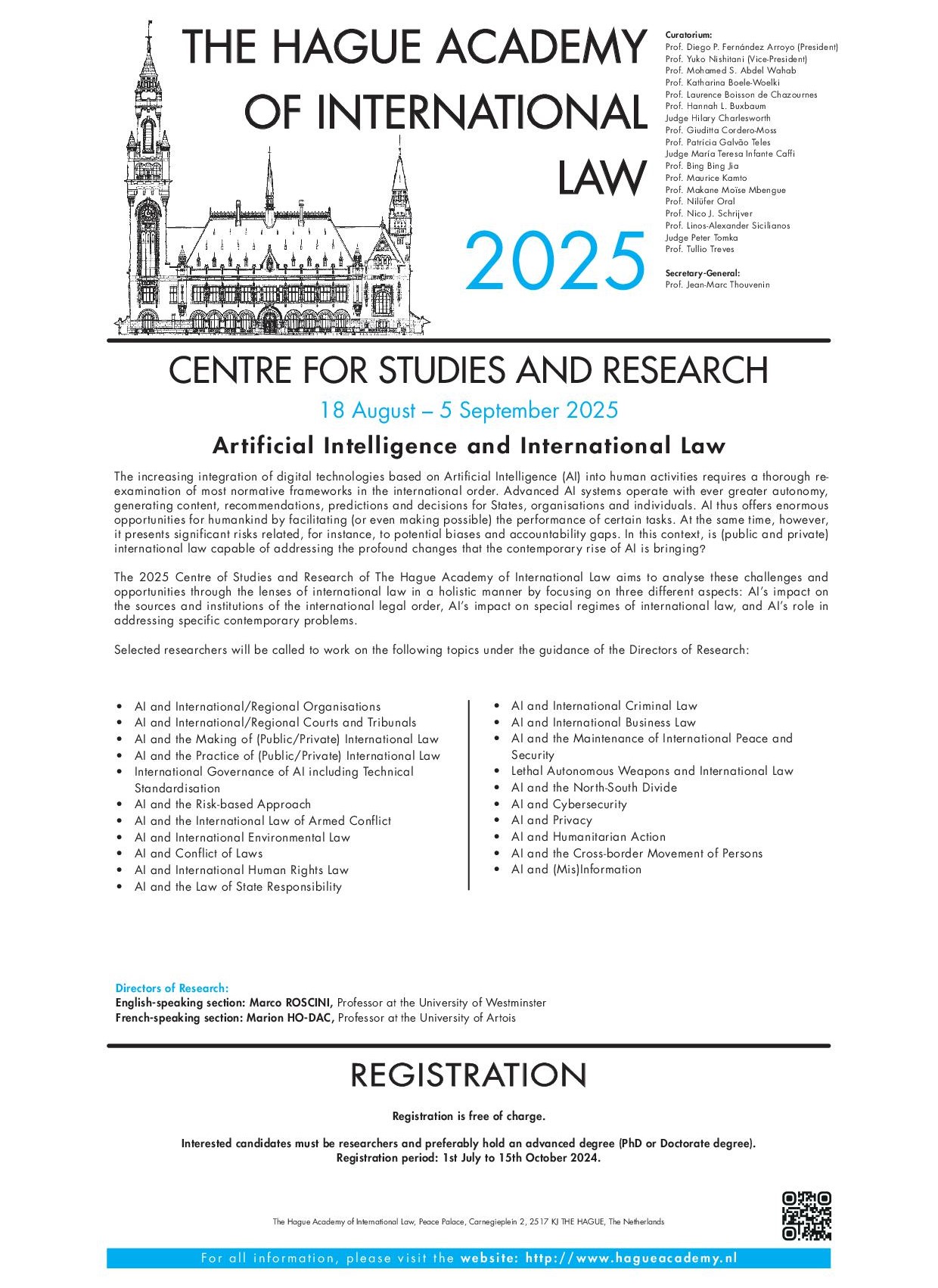
As recently highlighted by contributions on this blog, new technologies have a significant impact on the development of the law. Hence, the Curatorium of the Hague Academy of International Law has chosen for the the 2025 edition of the Centre for Studies and Research (18 August – 5 September 2025) to focus on the emerging topic of “Artificial Intelligence and International Law“. This year, the selected researchers will be work under the guidance of the Directors of Research, Marion Ho-Dac (Université d’Artois) for the French-speaking section as well as Marco Roscini (University of Westminster) for the English-speaking section.
Interested candidates must be researchers and preferably hold an advanced degree (PhD or Doctorate degree). Registration for the 2025 Centre is open from 1 July to 15 October 2024 via the institution’s own Online Registration Form.
The Academy describes the scope of its 2025 Programme as follows (emphasis added to highlight passages of specific interest to col.net readers):
The increasing integration of digital technologies based on Artificial Intelligence (AI) into human activities requires a thorough re-examination of most normative frameworks in the international order. Advanced AI systems operate with ever greater autonomy, generating content, recommendations, predictions and decisions for States, organisations and individuals. AI thus offers enormous opportunities for humankind by facilitating (or even making possible) the performance of certain tasks. At the same time, however, it presents significant risks related, for instance, to potential biases and accountability gaps. In this context, is (public and private) international law capable of addressing the profound changes that the contemporary rise of AI is bringing?
The Centre of Studies and Research 2025 of The Hague Academy of International Law aims to analyse these challenges and opportunities through the lenses of international law in a holistic manner by focusing on three different aspects: AI’s impact on the sources and institutions of the international legal order, AI’s impact on special regimes of international law, and AI’s role in addressing specific contemporary problems.
Selected researchers will be called to work on the following topics under the guidance of the Directors of Research:
- AI and International/Regional Organisations
- AI and International/Regional Courts and Tribunals
- AI and the Making of (Public/Private) International Law
- AI and the Practice of (Public/Private) International Law
- International Governance of AI including Technical Standardisation
- AI and the Risk-based Approach
- AI and the International Law of Armed Conflict
- AI and International Environmental Law
- AI and Conflict of Laws
- AI and International Human Rights Law
- AI and the Law of State Responsibility
- AI and International Criminal Law
- AI and International Business Law
- AI and the Maintenance of International Peace and Security
- Lethal Autonomous Weapons and International Law
- AI and the North-South Divide
- AI and Cybersecurity
- AI and Privacy
- AI and Humanitarian Action
- AI and the Cross-border Movement of Persons
- AI and (Mis)Information
For further information on the HAIL 2025 Centre and the Academy in general, please consult the HAIL Homepage or refer to the attached PDF Programme.
Two Interesting Recent Articles related to Private International Law
Williams C Iheme, “The Overdependence of African Courts and Businesses on English Law and Forum:
The Negative Repercussions on the Development of African Legal and Economic Systems” (2024) 15 Pravni Zapisi, pp. 151-190
The uncritical transplantation of English law by Anglophone-African legislators and judges, and their failure to sufficiently adapt English legal concepts to suit the idiosyncratic socioeconomic conditions in Africa, arguably contribute to the perpetuation of English law’s hegemony therein. It is argued that the overdependence on English law and courts by African businesses in resolving contractual disputes
is not necessarily due to any alleged stellar qualities of the former, but largely due to the over-marketing of the English legal system’s competence by its apologists. The analysis uses piquant examples to elicit some adverse effects of using/overreliance on the English law and forum by African businesses in resolving contractual disputes.
To reposition from the lengthened shadow of English law, Anglophone African legislators, judges and legal scholars, must craft autochthonous legal processes that suit Africa’s tastes and socioeconomic milieu.
Georgia Antonopoulou, “Forum Marketing in International Commercial Courts?” (2024) Oxford Journal of Legal Studies
Forum selling is a legal term used to describe the practices of courts and judges, geared towards attracting cases, such as increasing the predictability of judgments or speeding up trials. However, do courts also go beyond forum selling to attract cases? Taking international commercial courts as its focus, this article explores how these courts market themselves to attract cases and coins the term ‘forum marketing’. It demonstrates that the courts’ recent establishment, coupled with their voluntary jurisdiction, creates a compelling context, which encourages them to engage in forum marketing. The article argues that forum marketing is not merely a byproduct of the competition in commercial dispute resolution, but a powerful mechanism with deeply persuasive, normative and, effectively, structuring properties. Forum marketing is central to disseminating and reinforcing a pro-business approach in civil justice, consequently setting the stage for procedural inequality and a one per cent procedure.