


Views
Corporate responsibility and private (international) law
Written by Giesela Rühl, University of Jena/Humboldt-University of Berlin
Note: This blogpost is part of a series on „Corporate social responsibility and international law“ that presents the main findings of all contributions published in August Reinisch, Stephan Hobe, Eva-Maria Kieninger & Anne Peters (eds), Unternehmensverantwortung und Internationales Recht, C.F. Müller, 2020.
1. Corporate social responsibility has been the subject of lively debates in private international law for many years. These debates revolve around the question of whether companies domiciled in countries of the Global North can be held liable for human rights violations committed by foreign subsidiaries or suppliers in countries of the Global South (so-called supply chain liability).
2. According to the majority view in the public international law literature, companies are not, at least not directly bound by human rights. Although numerous international law instruments, including the UN’s 2011 Guidelines for Business and Human Rights (Ruggie Principles), also address companies, liability for human rights violations is, therefore, a matter of domestic law.
3. The domestic law applicable to liability for human rights violations must be determined in accordance with the provisions of (European) private international law. Direct recourse to the lex fori, in contrast, is not possible. The legal situation in Europe is, therefore, different from the United States where actions which are brought on the basis of the Alien Tort Claims Act (ATCA) are governed by US-American federal (common) law.
4. Claims for human rights violations committed abroad will usually be claims in tort. Under (European) private international law it is, therefore, the law of the place where the damage occurs (Article 4(1) Rome II Regulation) and, hence, foreign law which governs these claims. Exceptions apply only within narrow limits, in particular if domestic laws can be classified as overriding mandatory provisions (Article 16 Rome II Regulation) or if application of foreign law violates the ordre public (Article 26 Rome II Regulation).
5. In addition to tort law, claims for human rights violations may also be based on company law, namely when directors are directly held liable for torts committed by a foreign subsidiary. According to the relevant private international law provisions of the Member States these claims are governed by the law of the (administrative or statutory) seat of the foreign subsidiary. As a consequence, claims in company law are also subject to foreign law.
6. The fact that (European) private international law submits liability for human rights violations to foreign law is very often criticized in the private international law literature. Claiming that foreign law does not sufficiently protect the victims of human rights violations, a number of scholars, therefore, attempt to subject liability claims de lege lata to the domestic law of the (European) parent or buyer company.
7. These attempts, however, raise a number of concerns: first, under traditional (European) private international law, substantive law considerations do not inform the determination of the applicable law. Second, the wish to apply the domestic law of a European country is mostly driven by the wish to avoid poorly functioning court systems and lower regulatory standards in countries of the Global South. Neither of these aspects, however, has anything to do with the applicable tort or company law. Regulatory standards, for example, are part of public law and, therefore, excluded from the reach of private international law. Finally, the assumption that the domestic law of the (European) parent or buyer company provides more or better protection to the victims of human rights violations does not hold true de lege lata. Since parent and buyer companies are legally independent from their foreign subsidiaries and suppliers, parent and buyer companies are only in exceptional cases liable to the victims of human rights violations committed abroad by their foreign subsidiaries or suppliers (legal entity principle or principle of entity liability).
8. The difficulties to hold (European) parent and buyer companies de lege lata liable for human rights violations committed by their foreign subsidiaries or suppliers raises the question of whether domestic laws should be reformed and their application ensured via the rules of private international law? Should domestic legislatures, for example, introduce an internationally mandatory human rights due diligence obligation and hold companies liable for violations? Proposals to this end are currently discussed in Germany and in Switzerland. In France, in contrast, they are already a reality. Here, the Law on the monitoring obligations of parent and buyer companies (Loi de vigilance) of 2017 imposes human rights due diligence obligations on bigger French companies and allows victims to sue for damages under the French Civil Code. The situation is similar in England. According to a Supreme Court decision of 2019 English parent companies may, under certain conditions, be held accountable for human rights violations committed by their foreign subsidiaries.
9. The introduction of an internationally mandatory human rights due diligence obligation at the level of national law certainly holds a number of advantages. In particular, it may encourage companies to take measures to prevent human rights violations through their foreign subsidiaries and suppliers. However, it is all but clear whether, under the conditions of globalization, any such obligation will actually contribute to improving the human rights situation in the countries of the Global South. This is because it will induce at least some companies to take strategic measures to avoid the costs associated with compliance. In addition, it will give a competitive advantage to companies which are domiciled in countries that do not impose comparable obligations on their companies.
10. Any human rights due diligence obligations should, therefore, not (only) be established at the national level, but also at the European or – even better – at the international level. In addition, accompanying measures should ensure that the same rules of play apply to all companies operating in the same market. And, finally, it should be clearly communicated that all these measures will increase prices for many products sold in Europe. In an open debate it will then have to be determined how much the Global North is willing to invest in better protection of human rights in the Global South.
Full (German) version: Giesela Rühl, Unternehmensverantwortung und (Internationales) Privatrecht, in: August Reinisch, Stephan Hobe, Eva-Maria Kieninger & Anne Peters (eds), Unternehmensverantwortung und Internationales Recht, C.F. Müller, 2020, pp. 89 et seq.
Jurisdiction unbound: extraterritorial measures to ensure corporate responsibility
Written by Nico Krisch, Graduate Institute for International and Development Studies, Geneva
Note: This blogpost is part of a series on „Corporate social responsibility and international law“ that presents the main findings of all contributions published in August Reinisch, Stephan Hobe, Eva-Maria Kieninger & Anne Peters (eds), Unternehmensverantwortung und Internationales Recht, C.F. Müller, 2020.
1. The conceptual framework of jurisdictional boundaries in international law continues to be dominated by the principle of territoriality and its exceptions, even if calls for a reorientation have grown in recent years.
2. The principle of territoriality leads today to far wider jurisdictional claims than in the past, and its limits are being redefined through ‘territorial extensions’ in a number of areas.
3. These extensions are rarely questioned by states, and clear and consistent jurisdictional boundaries remain hard to define. Contestation arises primarily when states seek to use extraterritorial measures to counteract important policy choices of other states.
4. The result is a far-reaching overlap of different jurisdictional spheres which, if seen in conjunction with the multiple forms of transnational regulation existing today, leads to a multi-layered ‘jurisdictional assemblage’.
5. So far, there are no accepted rules governing the relationship of competing jurisdictional spheres in this assemblage. The effective exercise of jurisdiction depends, in large part, on the political and economic power of a country in a given issue area and market.
6. The wider options for action that result from this territorial extension allow for more effective responses to existing societal challenges, especially with a view to the provision of (national and global) public goods, albeit in a limited way.
7. The new jurisdictional regime accentuates hierarchies between countries, interferes with the autonomy of weaker states, and subverts the principle of sovereign equality. Yet under certain circumstances, it also allows actors in weaker states to compensate for their otherwise limited ability to hold multinational companies to account.
8. Existing procedural and substantive proposals only have limited promise for alleviating the tensions resulting from the power imbalance in the exercise of jurisdiction.
9. The territorial principle in the law of jurisdiction has always been sufficiently limited not to overly impede powerful states’ pursuit of their interests.
10. Territoriality today appears less as a principle of effective limitations than as the basis of different strategies and tactics through which states seek to hold mobile actors to account and through which they pursue their political aims in a global context.
Full (German) version: Nico Krisch, Entgrenzte Jurisdiktion: Die extraterritoriale Durchsetzung von Unternehmensverantwortung, in: August Reinisch, Stephan Hobe, Eva-Maria Kieninger & Anne Peters (eds), Unternehmensverantwortung und Internationales Recht, C.F. Müller, 2020, pp. 11 et seq.
Jurisdiction for claims against transnational companies for human rights violations
Written by Anatol Dutta, University of Munich
Note: This blogpost is part of a series on „Corporate social responsibility and international law“ that presents the main findings of the contributions published in August Reinisch, Stephan Hobe, Eva-Maria Kieninger & Anne Peters (eds), Unternehmensverantwortung und Internationales Recht, C.F. Müller, 2020.
1. The question of the reach of courts’ jurisdiction is highly significant for claims against transnational enterprises based on human rights violations or environmental damages abroad. It does not only determine the applicable law but also the access to a particular justice system.
2. Universal jurisdiction of national courts for human rights and environmental damages claims against enterprises cannot be established, neither on the basis of existing law nor from a legal policy perspective. Rather, such claims have to be handled under the traditional jurisdictional mechanisms.
3. From a global perspective, a remarkable shift regarding jurisdiction can be noted: Whereas the courts in the United States are increasingly limiting access to their justice system in cases with foreign elements, jurisdictional limits are no significant hurdle for human rights and environmental damages claims in the European Union.
4. Domestic enterprises can be sued at their seat. Yet, the forum non conveniens doctrine allows US courts – and perhaps soon English courts as well – to decline jurisdiction, also for human rights and environmental damages claims.
5. Yet, human rights and environmental damages claims against foreign enterprises can also only be brought under certain circumstances in the EU.
6. Claims against foreign enterprises for human rights violations and environmental damages abroad can only rarely be brought before domestic courts based on special jurisdiction related to specific subject matters, for example the jurisdiction for tort claims at the place where the harmful event occurred.
7. If human rights and environmental damages claims are simultaneously directed against a domestic enterprise, for example a mother company or a buyer company in the EU, at least partially, foreign subsidiaries and suppliers can be sued on the basis of special jurisdiction over multiple defendants which can be used strategically.
a) If foreign enterprises have their seat in a third State outside the European Union, the jurisdiction of the domestic courts over the foreign co-defendant is governed by the national law of the forum Member State.
b) However, the current trend to establish a separate liability of domestic enterprises, for example, by extending human rights and environment-related duties of care for the supply chain, could endanger this special jurisdiction over multiple defendants, which, on the other hand, could lose significance.
8. Extending the general jurisdiction at the domicile of the defendant by relying on a personal criterion different to the seat of the defendant enterprise is not a viable solution.
a) Today US courts refuse to exercise jurisdiction based solely on the foreign enterprise ‘doing business’ within the territory. In some EU Member States, for claims against foreign enterprises at least with a seat in a third State, exorbitant jurisdiction can be established, for example, based on assets of the foreign defendant enterprise within the territory.
b) At the most from a policy perspective, for claims against foreign subsidiaries of a domestic enterprise the introduction of an enterprise jurisdiction could be considered.
9. For claims against foreign enterprises jurisdiction of the domestic courts can often only be based on a forum necessitatis if proceedings cannot reasonably and effectively be brought or conducted abroad; the hurdles for such an exceptional jurisdiction are, however, high.
10. To hear human rights and environmental damages claims against enterprises lies within the powers of the domestic courts.
a) Foreign enterprises do not enjoy State immunity even if they violate human rights or damage the environment abroad in collaboration with foreign States.
b) The power to adjudicate is also not limited by the fact that a decision of the court on human rights and environmental damages claims potentially has implications on the foreign policy relations of the forum State.
c) The domestic courts are often even not barred from deciding on human rights and environmental damages claims of foreign States against enterprises.
Full (German) version: Anatol Dutta, Internationale Zuständigkeit für privatrechtliche Klagen gegen transnational tätige Unternehmen wegen der Verletzung von Menschenrechten und von Normen zum Schutz der natürlichen Lebensgrundlagen im Ausland, in: August Reinisch, Stephan Hobe, Eva-Maria Kieninger & Anne Peters (eds), Unternehmensverantwortung und Internationales Recht, C.F. Müller, 2020, pp. 39 et seq.
News
Out Now: Aristova, Tort Litigation against Transnational Corporations. The Challenge of Jurisdiction in English Courts
Ekaterina Aristova (Bonavero Institute of Human Rights, University of Oxford) is the author of the ‘Tort Litigation against Transnational Corporations: The Challenge of Jurisdiction in English Courts’ (OUP 2024), which has just been published in the Oxford Private International Law series. She has kindly shared the following summary with us:
The book examines the approach of the English courts to the question of jurisdiction in civil liability claims brought against English-based parent companies and their foreign subsidiaries as co-defendants (e.g., Lubbe v Cape, Lungowe v Vedanta, Okpabi v Shell, etc.). While the book is written from the perspective of English law, the book also draws on examples of similar cases in Australia, Canada, EU Member States, and the US to broaden the discussion.
The assertion of jurisdiction in parent company liability claims based on a nexus with the forum state presents a challenge to the courts. The territorial focus of the adjudicative jurisdiction is often contrary to the transnational nature of cross-border business activities. Transnational corporations (TNCs) have the flexibility to spread operations over multiple jurisdictions and create a legal separation between the subsidiary’s activities and the home state of the parent company. Courts rely on various private international law rules and doctrines to resolve the question of jurisdiction in parent company liability claims, including forum non conveniens doctrine in common law legal systems, the mandatory rule of domicile under EU law, and the presumption against extraterritoriality in US jurisprudence. The broad disparities in the issues of civil jurisdiction among domestic legal regimes and the considerable controversy surrounding the exercise of extraterritorial regulation over corporate operations often lead to the creation of a ‘jurisdictional veil’ for the parent company and a significant degree of autonomy, largely free from the control of any national jurisdiction.
To address this puzzle, this book seeks to answer three questions: 1) To what extent can English courts, under existing rules, exercise jurisdiction over English parent companies and their foreign subsidiaries as co-defendants? 2) Is England a suitable forum for deciding parent company liability claims? 3) Should the jurisdictional competence of the English courts be broadened through a new connecting factor derived from the ‘economic enterprise’ theory?
The book aims to offer a new angle to the discourse by placing the discussion of parent company liability claims in the context of the topical debate about the changing role of private international law in a globalised world. The transnational adjudication of disputes, cross-border activities of non-state actors and expansion of private law-making challenge several conventional assumptions of the discipline of private international law, including its focus on territoriality and geographical connecting factors and its capacity to interact with public mechanisms. Home state courts have become the fora for struggles between TNCs and vulnerable communities from the host states, raising complex questions about (il)legitimate forum shopping, the appropriate forum, and the limits of judicial discretion. Parent company liability claims impact how we think about private international law and its function, and the reader is invited to explore these challenging dynamics.
The Bonavero Institute of Human Rights in Oxford will celebrate the publication of the book by hosting a (hybrid) book launch and wine reception on 5 June 2024.
Registration Now Open: The Hague Academy of International Law’s Winter Courses 2025
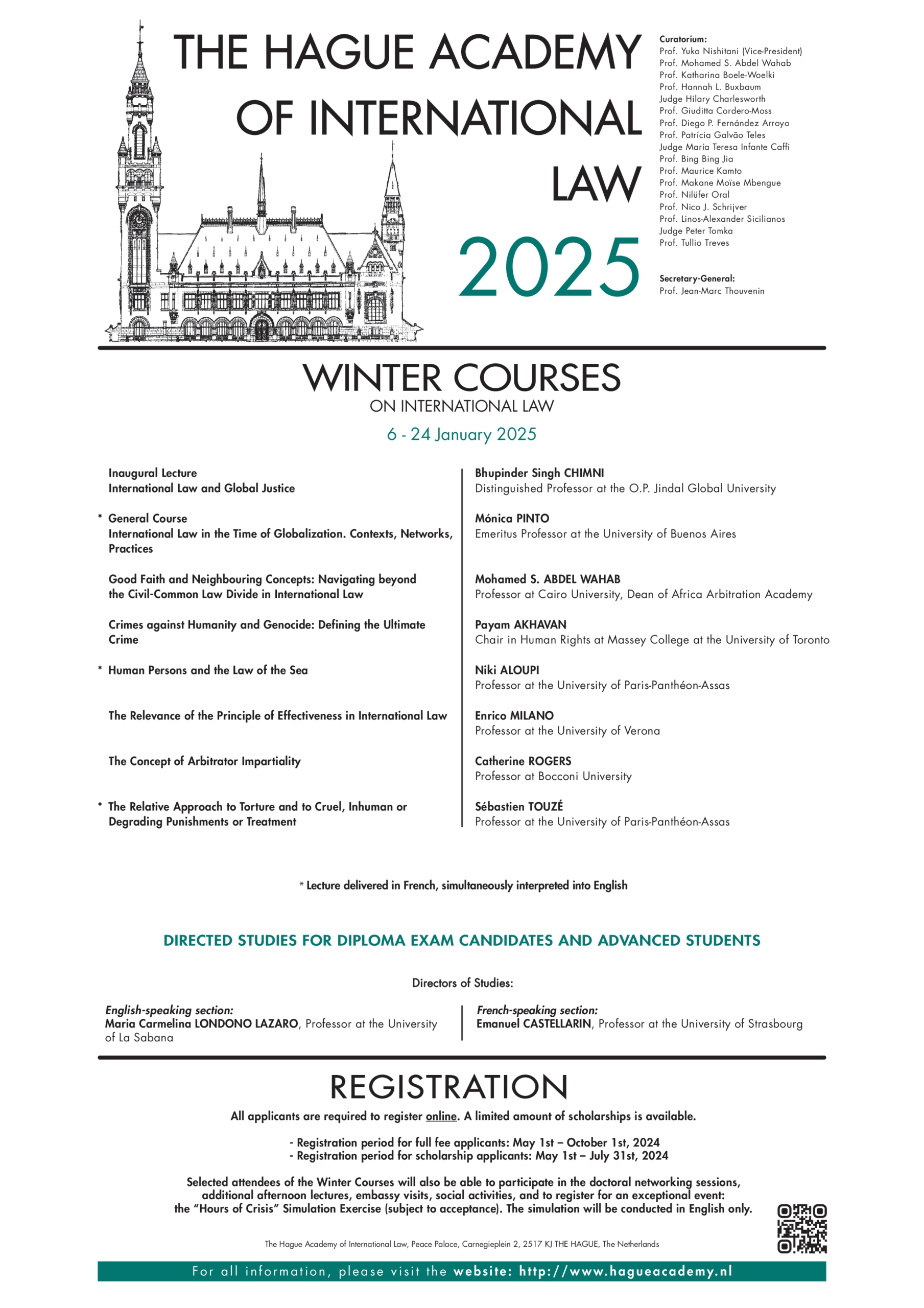
Registration for the 2025 programme of The Hague Academy of International Law’s renowned Winter Courses on International Law (6-24 January 2025) is now open. In contrast to the summer courses, this program combines aspects of both Public and Private International Law and therefore provides for a particularly valuable academic experience.
Following the Inauguaral Lecture by Bhupinder Singh Chimni (O.P. Jindal Global University), this year’s General Course in Private International Law will focus on “International Law in the Times of Globalization: Contexts, Networks, Practices” and will be delivered by Mónica Pinto (University of Buenos Aires). Furthermore, Special Courses will be offered in English by Mohamed S. Abdel Wahab (Cairo University), Payam Akhavan (University of Toronto), Enrico Milano (University of Verona) and Catherine Rogers (Bocconi University), while Niki Aloupi and Sébastien Touzé (Paris-Panthéon-Assas) will deliver their presentations in French. As always, all lectures will be simultaneously interpreted into English or French and vice versa. If you are interested in alternative dispute resolution, the lecture on “The Concept of Arbitrator Impartiality” seems particularly interesting.
Advanced Students, especially those who are ambitious to sit for the prestigious Diploma Exam, are highly encouraged to apply for the Academy’s Directed Studies as well. The French edition of these interactive afternoon seminars will be directed by Emanuel Castellarin (University of Strasbourg), while English-speaking candidates are taught by María Carmelina Londoño Lázaro (University of La Sabana).
Registration is open from 1 May 2024 to 1 October 2024 via the institution’s own Online Registration Form . Students who whish to apply for the Academy’s scholarship opportunities need to submit their application by 31 July 2024. For further information on the HAIL 2024 Winter courses and the Academy in general, please consult the HAIL Homepage or refer to the attached PDF Programme.
Job Vacancy at the University of Bonn (Germany): Research fellow in International Civil Procedural Law and/or International Commercial Arbitration

The Rhenish Friedrich Wilhelm University of Bonn is an international research university with a wide education and research profile. With a 200-year history, approximately 33,000 students, more than 6,000 staff, and an excellent reputation at home and abroad, the University of Bonn is one of the most important universities in Germany and is recognized as a university of excellence.
The Institute for German and International Civil Procedure is looking for a highly skilled and motivated PhD candidate and fellow (Wissenschaftliche/r Mitarbeiter/in) to work in the fields of International Civil Procedural Law and/or International Commercial Arbitration on a part-time basis (50%) to start as soon as possible.

(c) Volker Lannert / Universität Bonn
Responsibilities:
- Supporting research and teaching on Private International Law, International Civil Procedure and/or International Commercial Arbitraiton as well as German civil law (required by the Faculty, therefore an excellent command of German and profound knowledge of German civil law equivalent to the “First State Examination” is mandatory)
- Teaching obligation of two hours per week during term time (Semester)
Your Profile:
- You hold the First or Second German State Examination in law with distinction (or its international equivalent)
- If possible, you already had contact with International Civil Procedure Law and/or Commercial Arbitration Law
- You are interested in the international dimension of private law, in particular International Civil Procedural Law, and/or International Commercial Arbitration
- Excellent command of the English language (next to German)
- You are commited, flexible, team-oriented and interested in further professional development opportunities
We offer:
- Varied and challenging assignments with one of the largest employers in the region
- Opportunity to conduct your PhD or research project (according to the Faculty’s regulations) under the supervision of the Director of the Institute Prof Dr Matthias Weller, Mag.rer.publ., MAE
- Occupational pension scheme (VBL)
- Numerous offers of the University Sports Programme (Hochschulsport)
- Easy access to the public transport system and direct road link to the Autobahn due to the central location in Bonn as well as the possibility to use inexpensive parking facilities
- Flexible working hours; remote working options are available
- Renumeration according to German public service salary scale E-13 TV-L (50%); initial contract period is one year at least and up to three years, with an option to be extended.
The University of Bonn is committed to diversity and equal opportunity. It is certified as a family-friendly university. Its goal is to increase the proportion of women in areas where they are underrepresented and to particularly promote their careers. It therefore strongly encourages applications from relevantly qualified women. Applications are handled in accordance with the State Equal Opportunity Act. Applications from suitable persons with proven severe disabilities and persons treated as such are particularly welcome
If you are interested in this position, please send your application (cover letter in German; CV; and relevant documents and certificates, notably university transcripts and a copy of the German State Examination Law Degree) to Prof Dr Matthias Weller (weller@jura.uni-bonn.de).
For additional information, please refer to the attached pdf document (in German) or visit the Institute’s homepage.