


Views
Ducking the Ricochet: The Supreme Court of Canada on Foreign Judgments
Written by Stephen G.A. Pitel, Western University
The court’s decision in HMB Holdings Ltd v Antigua and Barbuda, 2021 SCC 44 (available here) is interesting for at least two reasons. First, it adds to the understanding of the meaning of “carrying on business” as a test for being present in a jurisdiction. Second, it casts doubt on the application of statutory registration schemes for foreign judgments to judgments that themselves recognize a foreign judgment (the so-called ricochet).
In this litigation HMB obtained a Privy Council judgment and then sued to enforce it in British Columbia. Antigua did not defend and so HMB obtained a default judgment. HMB then sought to register the British Columbia judgment in Ontario under Ontario’s statutory scheme for the registration of judgments (known as REJA). An important threshold issue was whether the statutory scheme applied to judgments like the British Columbia one (a recognition judgment). In part this is a matter of statutory interpretation but in part it requires thinking through the aim and objectives of the scheme.
Indonesia deposits its instrument of accession to the HCCH 1961 Apostille Convention
Guest post by Priskila P. Penasthika, Ph.D. Researcher at Erasmus School of Law – Rotterdam and Lecturer in Private International Law at Universitas Indonesia.
Indonesian Accession to the HCCH 1961 Apostille Convention
After almost a decade of discussions, negotiations, and preparations, Indonesia has finally acceded to the HCCH 1961 Apostille Convention. In early January this year, Indonesia enacted Presidential Regulation Number 2 of 2021, signed by President Joko Widodo, as the instrument of accession to the HCCH 1961 Apostille Convention. The HCCH 1961 Apostille Convention is the first HCCH Convention to which Indonesia became a Contracting Party.
In its accession to the HCCH 1961 Apostille Convention, Indonesia made a declaration to exclude documents issued by the Prosecutor Office, the prosecuting body in Indonesia, from the definition of public documents whose requirements of legalisation have been abolished in accordance with Article 1(a) of the HCCH 1961 Apostille Convention.
In accordance with Article 12 of the Convention, Indonesia deposited its instrument of accession to the HCCH 1961 Apostille Convention with the Ministry of Foreign Affairs of the Netherlands on 5 October 2021. The ceremony was a very special occasion because it coincided with the celebration of the 60th anniversary of the Convention. Therefore, the ceremony was part of the Fifth Meeting of the Special Commission on the practical operation of the HCCH 1961 Apostille Convention and witnessed by all Contracting Parties of the Convention.
The Minister of Law and Human Rights of the Republic of Indonesia, Yasonna H. Laoly, joined the ceremony and delivered a speech virtually via videoconference from Jakarta. Minister Laoly voiced the importance of the HCCH 1961 Apostille Convention for Indonesia and underlined Indonesia’s commitment to continue cooperating with the HCCH.
Indonesia’s accession to the HCCH 1961 Apostille Convention brings good news for the many parties concerned. The current process of public document legalisation in Indonesia still follows a traditional method that is highly complex, involves various institutions, and is time-consuming and costly. Because of the accession to the Convention, the complicated and lengthy procedure will be simplified to a single step and will involve only one institution – the designated Competent Authority in Indonesia. Referring to Article 6 of the HCCH 1961 Apostille Convention, in its accession to the Convention, Indonesia designated the Ministry of Law and Human Rights as the Competent Authority. When the HCCH 1961 Apostille Convention enters into force for Indonesia, this Ministry will be responsible for issuing the Apostille certificate to authenticate public documents in Indonesia for use in other Contracting Parties to the Convention.
A Reception Celebrating the 60th Anniversary of the HCCH 1961 Apostille Convention and Indonesian Accession
To celebrate the 60th anniversary of the HCCH 1961 Apostille Convention and Indonesia’s accession to it, an evening reception was held on 5 October 2021 at the residence of the Swiss ambassador to the Kingdom of the Netherlands in The Hague. The reception was organised at the invitation of His Excellency Heinz Walker-Nederkoorn, Swiss Ambassador to the Kingdom of the Netherlands, His Excellency Mayerfas, Indonesian Ambassador to the Kingdom of the Netherlands, and Dr Christophe Bernasconi, Secretary-General of the HCCH. Representatives of some Contracting Parties to the HCCH 1961 Apostille Convention attended the reception; among other attendees were the representatives from recent Contracting Parties such as the Philippines and Singapore, as well as some of the earliest signatories, including Greece, Luxembourg, and Germany.
The host, Ambassador Walker-Nederkoorn, opened the reception with a welcome speech. It was followed by a speech by Ambassador Mayerfas. He echoed the statement of Minister Laoly on the importance of the HCCH 1961 Apostille Convention for Indonesia, especially as a strategy to accomplish the goals of Vision of Indonesia 2045, an ideal that is set to commemorate the centenary of Indonesian independence in 2045. Ambassador Mayerfas also emphasised that Indonesia’s accession to the HCCH 1961 Apostille Convention marked the first important step for future works and cooperation with the HCCH.
Thereafter, Dr Christophe Bernasconi warmly welcomed Indonesia as a Contracting Party to the HCCH 1961 Apostille Convention in his speech at the reception. He also voiced the hope that Indonesia and HCCH continue good cooperation and relations, and invited Indonesia to accede to the other HCCH Conventions considered important by Indonesia.
The Entry into Force of the HCCH 1961 Apostille Convention for Indonesia
Referring to Articles 12 and 15 of the HCCH 1961 Apostille Convention, upon the deposit of the instrument of accession, there is a period of six months for other Contracting Parties to the Convention to raise an objection to the Indonesian accession. The HCCH 1961 Apostille Convention will enter into force for Indonesia on the sixtieth day after the expiration of this six-month period. With great hope that Indonesia’s accession will not meet any objection from the existing Contracting Parties to the Convention, any such objection would affect only the entry into force of the Convention between Indonesia and the objecting Contracting Party. The HCCH 1961 Apostille Convention will therefore enter into force for Indonesia on 4 June 2022.
A more in-depth analysis (in Indonesian) concerning the present procedure of public document legalisation in Indonesia and the urgency to accede to the HCCH 1961 Apostille Convention can be accessed here. An article reporting the Indonesian accession to the HCCH 1961 Apostille Convention earlier this year can be accessed here.
United Kingdom Supreme Court confirms that consequential loss satisfies the tort gateway for service out of the jurisdiction
This post is written by Joshua Folkard, Barrister at Twenty Essex.
In FS Cairo (Nile Plaza) LLC v Lady Brownlie [2021] UKSC 45 (“Brownlie II”), the Supreme Court held as a matter of ratio by a 4:1 majority that consequential loss satisfies the ‘tort gateway’ in Practice Direction (“PD”) 6B, para. 3.1(9)(a).
Background
PD 6B, para. 3.1(9)(a) provides that tort claims can be served out of the jurisdiction of England & Wales where “damage was sustained, or will be sustained, within the jurisdiction”. Brownlie concerned a car accident during a family holiday to Egypt, which tragically claimed the lives of Sir Ian Brownlie (Chichele Professor of Public International Law at the University of Oxford) and his daughter Rebecca: at [1], [10] & [91]. On her return to England, however, Lady Brownlie suffered consequential losses including bereavement and loss of dependency in this jurisdiction: at [83].
The question whether mere consequential loss satisfies the tort gateway had been considered before by the Supreme Court in the very same case: Brownlie v Four Seasons [2017] UKSC 80; [2018] 2 All ER 91 (“Brownlie I”). By a 3:2 majority expressed “entirely obiter” (Brownlie II, at [45]) the Court had answered affirmatively: [48]-[55] (Baroness Hale), [56] (Lord Wilson) & [68]-[69] (Lord Clarke). However, the obiter nature of that holding combined with a forceful dissent from Lord Sumption (see [23]-[31]) had served to prolong uncertainty on this point.
Majority’s reasoning
When asked the same question again, however, a differently-constituted majority of the same Court gave the same answer. Lord Lloyd-Jones (with whom Lords Reed, Briggs, and Burrows agreed: see [5] & [7])) concluded that there was “no justification in principle or in practice, for limiting ‘damage’ in paragraph 3.1(9)(a) to damage which is necessary to complete a cause of action in tort or, indeed, for according any special significance to a place simply because it was where the cause of action was completed”: at [49]. The ‘consequential’ losses suffered in England were accordingly sufficient to ground English jurisdiction for the tort claims.
Three main reasons were given. First, Lord Lloyd-Jones held that there had been no “assimilation” of the tests at common law and under the Brussels Convention/Regulation, which would have been “totally inappropriate” given the “fundamental differences between the two systems”: at [54]-[55]. Second, his Lordship pointed to what he described as an “impressive and coherent line” of (mostly first-instance) authority to the same effect: at [64]. Third, it was said that the “safety valve” of forum conveniens meant that there was “no need to adopt an unnaturally restrictive reading of the domestic gateways”: at [77].
Economic torts?
What is now the position as regards pure economic loss cases? Although Lord Lloyd-Jones concluded that the term “damage” in PD 6B, para. 3.1(9)(a) “simply refers to actionable harm, direct or indirect, caused by the wrongful act alleged” (at [81]), his Lordship expressly stated that:
- “I would certainly not disagree with the proposition, supported by the economic loss cases, that to hold that the mere fact of any economic loss, however remote, felt by a claimant where he or she lives or, if a corporation, where it has its business seat would be an unsatisfactory basis for the exercise of jurisdiction”: at [76].
- “The nature of pure economic loss creates a need for constraints on the legal consequences of remote effects and can give rise to complex and difficult issues as to where the damage was suffered, calling for a careful analysis of transactions. As a result, the more remote economic repercussions of the causative event will not found jurisdiction”: at [75].
The status of previous decisions on the meaning of PD 6B, para. 3.1(9)(a) in economic tort cases appears to have been called into doubt by Brownlie II because (as noted by Lord Leggatt, dissenting: at [189]) those decisions had relied upon an “inference” that PD 6B, para. 3.1(9)(a) should be interpreted consistently with the Brussels Convention/Regulation. That approach was, however, rejected by both the majority and minority of the Supreme Court: at [74] & [189]. It therefore appears likely that the application of Brownlie II to economic torts will be the subject of significant future litigation.
News

5th German Conference for Young Researchers in Private International Law, 14 and 15 Feb 2025, University of Heildeberg
On 14 and 15 February 2025, the 5th iteration of the German Conference for Young Researchers in Private International Law will take place at the University of Heidelberg. The conference – which is being organized by Felix Berner, Andreas Engel, Aron Johanson, Markus Lieberknecht, Sophia Schwemmer, Ann-Kathrin Voß, Charlotte Wendland, and Anton Zimmermann – is dedicated to the topic of ‘Digital transformation and Private International Law. Local connections in boundless spaces’:
After statute theory, Savignyan PIL and Europeanisation, digitalisation has the potential to initiate a fourth evolutionary stage in the history of conflict of laws, which is characterised by decentralisation and delocalisation. We may therefore be on the threshold of a PIL 4.0. At our conference, we would like to discuss how the conflict-of-laws problems arising from the boundless spaces of digitalisation can be solved in European and autonomous German, Austrian and Swiss private international law. At the same time, we would like to look at the possibilities for legal changes at national, European and international level.
A keynote will be given by Christiane Wendehorst (University of Vienna).
The programme can be found here; registration is possible here.
More information can also be found on the conference website.

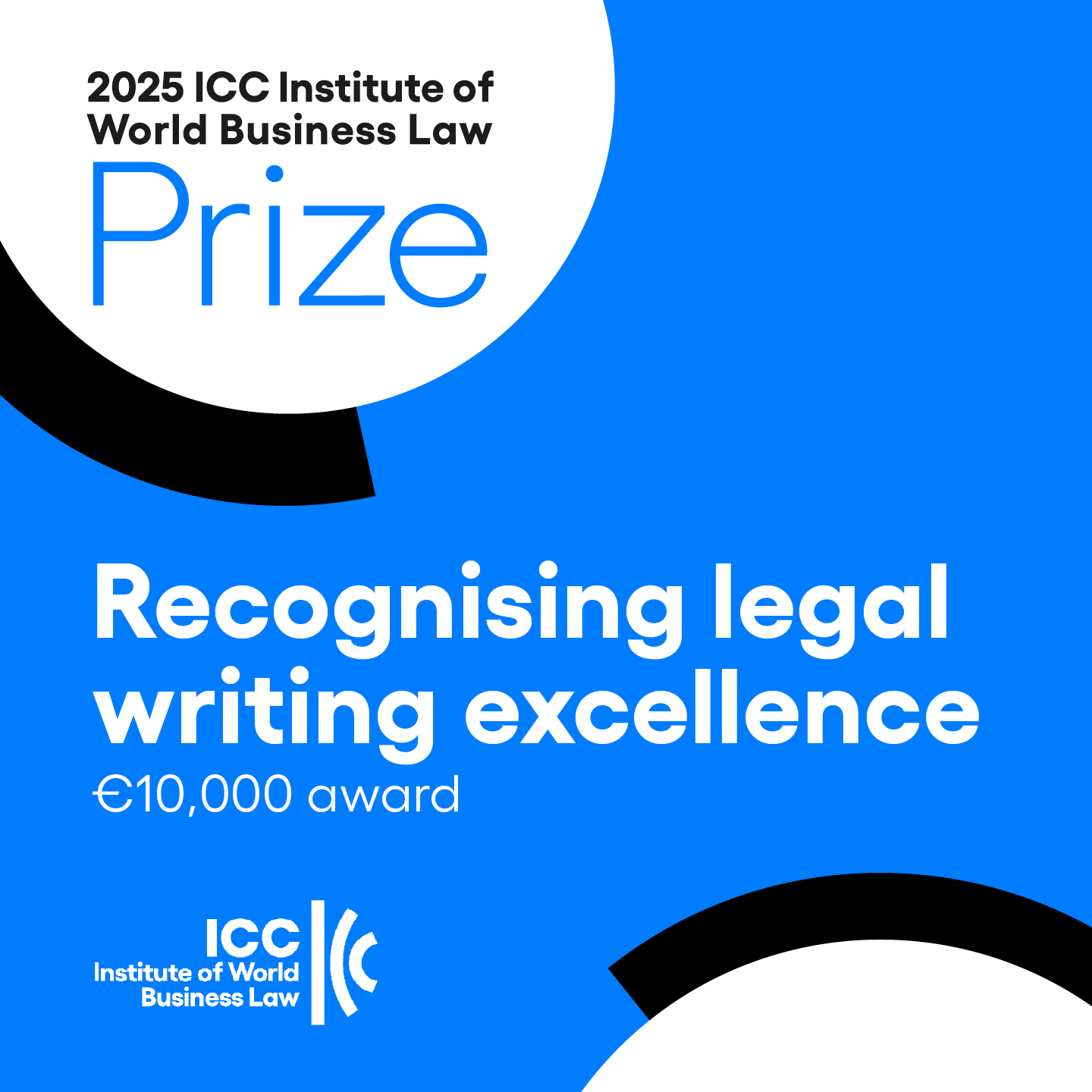
ICC Institute of World Business Law Prize 2025: Open for Submissions until 7 April 2025
Every two years, the ICC Institute of World Business Law awards a prize worth € 10,000 to the best doctoral dissertation or long essay on on international commercial law (including arbitration) written by an author under the age of 40 in English or French.
Submissions can be made until 7 April 2025.
More information can be found in the flyer and in the prize rules.

Call for papers: Australasian Association of Private International Law inaugural conference, Brisbane, Australia, 16-17 April 2025
The inaugural conference of the Australasian Association of Private International Law will be held from Wednesday 16 to Thursday 17 April at the Ship Inn conference centre, Southbank, Brisbane, Queensland, Australia, sponsored by Griffith Law School.
We are pleased to invite the submission of paper proposals for the conference, on any aspect of private international law, broadly understood. This includes issues of jurisdiction, choice of law, the recognition and enforcement of foreign judgments (including how they relate to cross-border issues within a federation), and all areas of private law that raise cross-border and transnational issues.
Paper proposals should be made on this form by Wednesday 29 January 2025. We also welcome panel proposals; please email aapril2025conference@gmail.com if you have a proposal for a panel. Proposed presenters on any panel will be required to submit paper proposals.
We welcome anyone interested in private international law, including from the judiciary, legal practice, government, and the academy, from any jurisdiction. Attendees, including presenters, will be required to pay a registration fee. A conference dinner will be held on the evening of Wednesday 16 April, at an additional cost.