


Views
Non-Qualifying Ceremonies: The Futility of Foreign Registration of Islamic Marriages under English Law
This blog note is kindly provided by Dr. Muhammad Zubair Abbasi (Lecturer, School of Law, Royal Holloway, University of London; zubair.abbasi@rhul.ac.uk). It follows the author’s previous post on this topic, which was published earlier on this blog. Read more
A few takeaways from the Conclusions & Decisions of the HCCH governing body (CGAP – 2026 meeting): parentage/surrogacy, jurisdiction project, cross-border recognition and enforcement of protection orders and a Note on the Trusts Convention
This week the Conclusions & Decisions (C&D) of the HCCH governing body, the Council on General Affairs and Policy (CGAP or Council), were published. Click the links below for the relevant language versions (English, French and Spanish).
Although a wide range of topics were discussed, I would like to focus on four items: parentage/surrogacy project, the cross-border recognition and enforcement of protection orders, the jurisdiction project and a Note on the Trusts Convention.
In my view, the C&D are significant for two reasons. First, the work related to a possible new instrument of a long-standing topic at the HCCH has been concluded (without a Convention) and secondly, a “new” topic has been inserted into the agenda of the HCCH. For more information, see below. Read more
Muscles from Munich? How German Courts Might Stop US Companies from Violating Copyright through AI Training
Yesterday, the Regional Court of Munich (Landgericht München I) held a highly interesting oral hearing in a dispute brought by GEMA, a German collecting society representing composers, and Suno, a generative music AI company based in Cambridge, MA. The hearing was noteworthy, first, because it gave the public an opportunity to listen to numerous international hits, from Alphaville’s Forever Young to Lou Bega’s Mambo No. 5 (and their alleged copies created by Suno) in a courtroom; and secondly, because the dispute raises some interesting questions of private international law.
After GEMA had already scored a famous victory against OpenAI in November 2025, when the same chamber of the Munich Court had held that the company had been violating the copyrights of several artists and composers by reproducing their song texts, the present proceedings differed not just in scope (focusing on the musical arrangement rather than texts) but also in its international dimension. For the first time, the claimant explicitly included the use of the protected works for training that had happened (according to both parties) exclusively in the US.
News
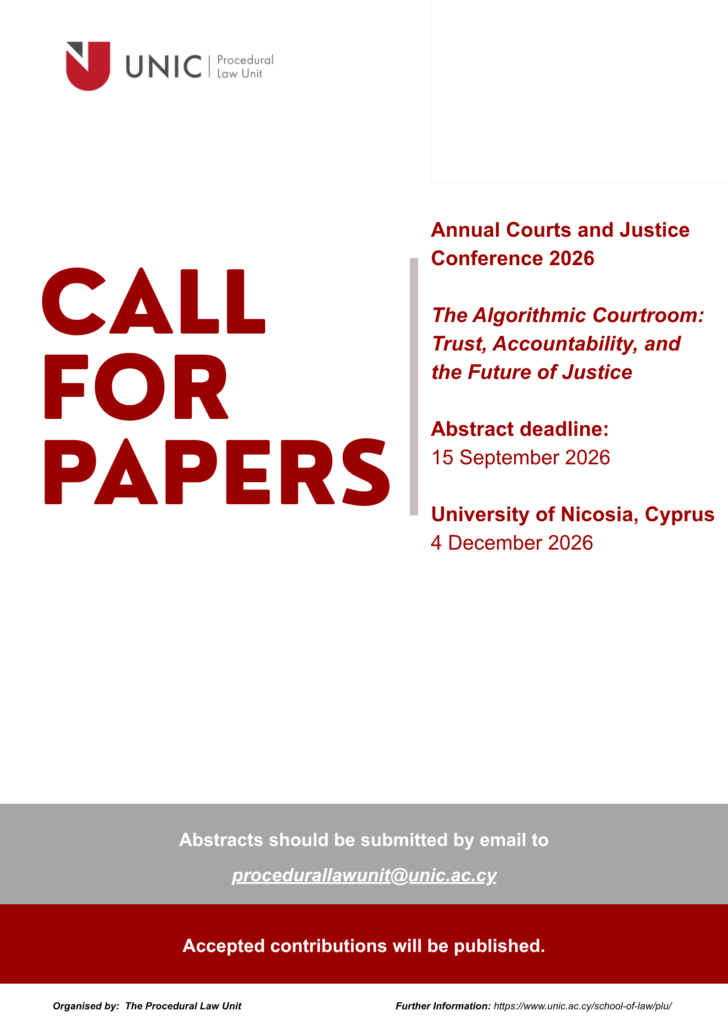
Call for Papers: Annual Courts and Justice Conference 2026 (4 Dec 2026, University of Nicosia)
This Call for Papers was shared with us by Procedural Law Unit of the University of Nicosia, Cyprus.
SLAPP-Directive implemented in Belgium
The SLAPP (Strategic Lawsuits Against Public Participation) Directive of the EU (2024/1069 of 11 April 2024) is transposed in Belgian law by the Act of 30 May 2026. The Act was published in the Belgian Official Journal on 12 June 2026 (see the French version and the Dutch version), and will enter into force on 22 June 2026.
The main features of the Act are:
Out Now: Status and Family Relationships in European PIL

The new extensive Volume Status and Family Relationships in Private International Law was just published by Edward Elgar Publishing.
Edited by Silvia Marino (University of Insubria, Como), Anna Wysocka-Bar (Jagiellonian University, Kraków) and Javier Carrascosa González (University of Murcia), the volume, builds on the presentations delivered at the 2024 EAPIL Winter School, held in Como in February 2024. It is the second book in the European Association of Private International Law series.