


Views
Conflict of Laws of Freedom of Speech on Elon Musk’s Twitter
Elon Musk’s purchase of Twitter has been a divisive event. Commenting on the response on Twitter and elsewhere, Musk tweeted:
The extreme antibody reaction from those who fear free speech says it all
>
By “free speech”, I simply mean that which matches the law.
I am against censorship that goes far beyond the law.
If people want less free speech, they will ask government to pass laws to that effect.
Therefore, going beyond the law is contrary to the will of the people.
Ralf Michaels quote-tweeted perceptively: ‘But which law?’
Twitter and the conflict of laws
By their very nature, digital platforms like Twitter present a variety of conflict of laws issues.
‘Twitter’ is not a monolithic entity. The functionality of the social media platform with which readers would be familiar is underpinned by a transnational corporate group. Twitter, Inc is incorporated in Delaware, and has various subsidiaries around the world; Twitter International Company, for example, is incorporated in Ireland and responsible as data controller for users that live outside of the United States. The business is headquartered in San Francisco but has offices, assets, and thousands of staff around the world.
The platform is populated by 400 million users from all over the world. After the US, the top 5 countries with the most Twitter users are comprised of Japan, India, the UK and Brazil. The tweets and retweets of those users may be seen all over the world. Users have wielded that functionality for all sorts of ends: to report on Russia’s war in real-time; to coordinate an Arab Spring; to rally for an American coup d’état; to share pictures of food, memes, and endless screams; and to share conflict of laws scholarship.
Disputes involving material on Twitter thus naturally include foreign elements. Where disputes crystallise into litigation, a court may be asked to consider what system of law should determine a particular issue. When the issue concerns whether speech is permissible, the answer may be far from simple.
Free speech in the conflict of laws
The treatment of freedom of speech in the conflict of laws depends on the system of private international law one is considering, among other things. (The author is one of those heathens that eschews the globalist understanding of our discipline.)
Alex Mills has written that the balance between free speech and other important interests ‘is at the heart of any democratic political order’.[1] Issues involving free speech may thus engage issues of public policy, or ordre public,[2] as well as constitutional considerations.
From the US perspective, the ‘limits of free speech’ on Twitter is likely to be addressed within the framework of the First Amendment, even where foreign elements are involved. As regards private international law, the Securing the Protection of our Enduring and Established Constitutional Heritage (SPEECH) Act 28 USC 4101- 4105 (‘SPEECH Act’) is demonstrative. It operates in aid of the constitutional right to freedom of expression and provides that a US ‘domestic court shall not recognize or enforce a foreign judgment for defamation unless the domestic court determines that’ the relevant foreign law would provide the same protections for freedom of speech as would be afforded by the US Constitution.[3]
Other common law jurisdictions have approached transnational defamation issues differently, and not with explicit reference to any capital-c constitutional rights. In Australia, the High Court has held that the lex loci delicti choice-of-law rule combined with a multiple publication rule means that defamation is determined by the law of the jurisdiction in which a tweet is ‘available in comprehensible form’: the place or places it is downloaded.[4] In contrast, where a claim concerns a breach of confidence on Twitter, an Australian court is likely to apply the equitable principles of the lex fori even if the information was shared into a foreign jurisdiction without authorisation.[5] In either case, constitutional considerations are sidelined.
The balance to be struck between free speech on the one hand, and so-called ‘personality rights’ on the other, is a controversial issue within a legal system, let alone between legal systems. So for example, the choice-of-law rule for non-contractual obligations provided by the Rome II Regulation does not apply to personality rights, as a consensus could not be reached on point.[6] Similarly, defamation and privacy are excluded from the scope of the HCCH Judgments Convention by Art 2(1)(k)–(l).
There is a diversity of approaches to choice of law for cross-border infringements of personality rights between legal systems.[7] But the ‘law applicable to free speech on Twitter’ is an issue that goes far broader than personality rights. It touches on as many areas of law as there are aspects of human affairs that are affected by the Twitter platform. For example, among other things, the platform may be used to:
- spread misrepresentation about an election, engaging electoral law;
- influence the price of assets, engaging banking and finance law; or
- promote products, engaging consumer law.
Issues falling into different areas of law may be subject to different choice-of-law rules, and different systems of applicable law. What one system characterises as an issue for the proper law of the contract could be treated as an issue for a forum statute in another.
All of this is to say: determining what ‘the law says’ about certain content on Twitter is a far more complex issue than Elon Musk has suggested.
The law applicable to online dignity
Key to the divisiveness of Musk’s acquisition is his position on content moderation. Critics worry that a laissez-faire approach to removing objectionable content on the platform will lead to a resurgence of hate speech.
Musk’s vision for a freer Twitter will be subject to a variety of national laws that seek to protect dignity at the cost of free speech in various ways. For example, in April, the European Parliament agreed on a ‘Digital Services Act’, while in the UK, at the time of writing, an ‘Online Safety Bill’ is in the House of Commons. In Australia, an Online Safety Act was passed in 2021, which provided an ‘existing Online Content Scheme [with] new powers to regulate illegal and restricted content no matter where it’s hosted’. That scheme complements various other national laws, like our Racial Discrimination Act 1975, which outlaws speech that is reasonably likely, in all the circumstances, to offend, insult, humiliate or intimidate another person or a group of people, and was done because of the race, colour or national or ethnic origin of the person or group.
When a person in the United States posts content about an Australian that is permissible under US law, but violates Australian statute, the difficulty of Musk’s position on the limits of censorship becomes clear. Diverse legal systems come to diverse positions on the appropriate balance between allowing online freedom and protecting human dignity, which are often struck with mandatory law. When your platform is frequented by millions of users all over the world, there is no single ‘will of the people’ by which to judge. Perhaps Musk will embrace technological solutions to give effect to national standards on what sort of content must be censored.
A host of other conflicts issues
Musk-era Twitter is likely to pose a smorgasbord of other issues for interrogation by conflict of laws enthusiasts.
For example: legal systems take diverse approaches to the issue of whether a foreign parent company behind a platform like Twitter can be imposed with liability, or even criminal responsibility, for content that is on the platform. While conservatives in America consider the fate of s 230 of the Communications Decency Act—a provision that means that Twitter is not publisher of content they host—other countries take a very different view of the issue. Litigation involving the companies behind Twitter is likely to engage courts’ long-arm jurisdiction.
Perhaps the thorniest conflicts problem that may emerge on Musk’s Twitter is the scope of national laws that concern disinformation. In an announcement on 25 April, Musk stated:
‘Free speech is the bedrock of a functioning democracy, and Twitter is the digital town square where matters vital to the future of humanity are debated’.
Recent years have shown that the future of humanity is not necessarily benefited by free speech on social media. How many lives were lost as a result of vaccine-scepticism exacerbated by the spread of junk science on social media? How many democracies have been undermined by Russian disinformation campaigns on Twitter? The extraterritorial application of forum statutes to deal with these kinds of issues may pose a recurring challenge for Musk’s vision.[8] I look forward to tweeting about it.
Michael Douglas is Senior Lecturer at UWA Law School and a consultant in litigation at Bennett + Co, Perth.
[1] Alex Mills, ‘The Law Applicable to Cross-border Defamation on Social Media: Whose Law Governs Free Speech in “Facebookistan”?’ (2015) 7 Journal of Media Law 1, 21.
[2] See, eg, International Covenant on Civil and Political Rights, art 19(3).
[3] SPEECH Act s 3; United States Code, title 28, Part VI, § 4102. See generally Lili Levi, ‘The Problem of Trans-National Libel’ (2012) 60 American Journal of Comparative Law 507.
[4] Dow Jones & Co Inc v Gutnick (2002) 210 CLR 575.
[5] But see Michael Douglas, ‘Characterisation of Breach of Confidence as a Privacy Tort in Private International Law’ (2018) 41 UNSW Law Journal 490.
[6] Art 4(1); see Andrew Dickinson, The Rome II Regulation (Oxford University Press, 2008).
[7] See generally Symeon C Symeonides, Cross-Border Infringement of Personality Rights via the Internet (Brill, 2021) ch VI; Tobias Lutzi, Private International Law Online: Internet and Civil Liability in the EU (Oxford University Press, 2020) ch 4.
[8] See generally Matthias Lehmann, ‘New Challenges of Extraterritoriality: Superposing Laws’ in Franco Ferrari and Diego P Fernández Arroyo (eds), Private International Law: Contemporary Challenges and Continuing Relevance (Edward Elgar, 2019) ch 10.
The CISG Applies to Hong Kong and Mainland China Now: Shall Macau Follow Suit?
(This post is provided by Zeyu Huang & Wenhui Chi. Mr. Huang practises law as a Shenzhen-based associate at Hui Zhong Law Firm. He holds LLB (Renmin U.), LLM & PhD (Macau U.). Ms. Chi is now working as a legal counsel at the Shenzhen Court of International Arbitration (SCIA) and the South China International Arbitration Center (Hong Kong) (SCIAHK). She holds BA (PKU), LLM & JD (PKU School of Transnational Law). The authors may be contacted at huangzeyu@huizhonglaw.com or chiwenhui@scia.com.cn.)
The People’s Republic of China (hereinafter “China” or “PRC”) deposited its instrument of ratification for the United Nations Convention on Contracts for the International Sale of Goods (hereinafter “CISG”) on 11 December 1986. Since its entry into force in 1988, it is beyond doubt that CISG applies to the territory of Mainland China albeit with some reservations and/or declarations (e.g. Article 96). However, businesspeople, courts, practitioners and scholars are split, uncertain and inconsistent over the issue whether the CISG should extend to Hong Kong and Macau after their returns respectively in 1997 and 1999. [1]
This issue stemed from the unclear intentions of China when it submitted the diplomatic notes to the United Nations, which purported to inform the Secretary-General of the status of Hong Kong and Macau in relation to deposited treaties. [2] However, China did not mention CISG in the Diplomatic Notes at all. As a result, whether China had expressed its intention of extending or excluding CISG to Hong Kong and Macau has been subject to inconsistent interpretations and enquires conducted by different non-Hong Kong fora. [3]
To solve this problem, China, after seeking the views of Hong Kong SAR Government, determined to actively remove the uncertainty by depositing a declaration of extension of the territorial application of CISG to Hong Kong on 5 May 2022. [4] On and after 1 December 2022, CISG will apply to both Hong Kong and Mainland China. It should be noted that the declaration that China is not bound by Article 1(1)(b) CISG does not apply to Hong Kong. Nevertheless, it remains to be seen whether the Macau SAR government will follow suit on this matter, requesting the Central Government to extend the application of CISG to Macau.
Extension of International Treatises Ratified by China to Hong Kong and Macau
The issue of whether international treaties ratified by China ‘automatically’ applies to the territory of the Hong Kong and Macau SARs was once hotly debated in the investor-State arbitration cases of Tza Yap Shum v. Peru [5] and Sanum v. Laos-I [6]. Contrary to international tribunals and the Court of Appeal of Singapore’s confirmative and liberal stances, Chinese government and commentators said no. [7] They all insist that China has made its intentions clear in the Diplomatic Notes that the treaty to which China is or will become a party applies to Hong Kong and Macau only after China has decided so and carried out separately the formalities for such application. [8] Moreover, the extension of territorial application to Hong Kong and Macau must be in line with the “One Country, Two Systems” policy and the Basic Laws of Hong Kong and Macau. [9] Accordingly, the PRC Central People’s Government in Beijing has the final say over whether the international treaty to which China is or will be a party applies to Hong Kong and Macau after consulting with the two SARs’ governments.
The same problem stays with the applicability of CISG in the Hong Kong and Macau SARs. On the one hand, no mention of CISG in the Diplomatic Notes submitted by China, at least on the side of Hong Kong, demonstrates China’s true intentions in public international law that the CISG shall not apply in the SAR. [10] In this view embraced by some French and US courts, China’s Diplomatic Notes not mentioning CISG qualify as Article 93(1) CISG reservation indicating that CISG does not apply to Hong Kong and Macau. [11] On the other hand, some other foreign courts considered the Diplomatic Notes did not constitute an Article 93(1) CISG reservation and therefore the default rule in Article 93(4) applies, saying that CISG ‘automatically’ applies to all territorial unites of China. [12] This interpretive approach is similar to the confirmative and liberal approach adopted by the tribunals in Tza Yap Shum v. Peru and Sanum v. Laos-I on the issue whether Chinese investment treaty absent in the Diplomatic Notes extends to territory of the Hong Kong and Macau SARs. However, such approach was often criticized as contrary to China’s expressed intentions. [13]
What Does It Mean for Hong Kong?
Legally speaking, the act of China’s depositing the declaration of extension of CISG to Hong Kong has three implications.
Firstly, and most obviously, on and after 1 December 2022 it would be correct for any foreign court or international tribunal to hold that CISG applies to Hong Kong. This will wipe out the “confusion and conflict as to whether or not China’s diplomatic notes for Hong Kong and Macao, deposited in 1997 and 1999 respectively, are sufficient to exclude the application of the CISG” to Hong Kong and Macau under Article 93 CISG. [14] Indeed, they are sufficient; but China has now decided to reverse its previous intention.
Secondly, China has impliedly confirmed that the Diplomatic Notes qualify as Article 93(1) CISG reservation, which means CISG would not automatically apply to territorial units of China such as Hong Kong and Macau unless China has determined so. In other words, China’s Central People’s Government has the final say on whether a Chinese international treaty applies to Hong Kong and Macau or not.
Thirdly, any construction of the Diplomatic Notes by foreign courts or arbitral tribunals which leads to the ‘automatic’ application of CISG or other international treaties (including Chinese investment agreements) to Hong Kong and Macau would be incorrect and in disregard of China’s true intentions expressed in the Diplomatic Notes. This will possibly prevent foreign courts or investment arbitration tribunals from easily reaching the decision that CISG or Chinese international investment agreement ‘automatically’ applies to Hong Kong and Macau. It also means Hong Kong might need seek the views of Central People’s Government on whether or not to extend Chinese international investment agreement to the Hong Kong SAR, especially in cases where the Hong Kong investors intend to rely on these international instruments to safeguard their rights and interests in investments made overseas.
In parallel with the ongoing Reform and Opening-up within and beyond China, China’s accession to CISG has fundamentally shaped the legislative and judicial landscape of codifying Chinese contract law. It is believed that the Ordinance [15] implementing the CISG in Hong Kong would for sure reshape the legislative and judicial landscape of Hong Kong law. [16]
Conclusion: Shall Macau Follow Suit?
The answer is of course yes. As another major player in the Belt and Road Initiative (BRI) and Greater Bay Area (GBA) in China, Macau is now confronted with the same “confusion and conflict” issue once faced by Hong Kong before 5 May 2022. As mentioned earlier, such “confusion and conflict” as to whether the Diplomatic Notes are sufficient to exclude the application of CISG and other international treaties not mentioned therein to Hong Kong and Macau has been removed. China impliedly reiterated itself through this act of extending CISG to Hong Kong that the Diplomatic Notes are sufficient to do so.
Hence, whether CISG or Chinese investment treaty extends to Macau is likewise subject to the final decision of China’s Central People’s Government. Despite divergent opinions and interpretations, Chinese government’s stance has been consistent – CISG or Chinese international investment agreement outside the Diplomatic Notes does not ‘automatically’ applies to Hong Kong and Macau, and such extension needs the Central People’s Government’s final approval. Therefore, according to Article 138(1) of the Macau Basic Law, Macau should follow up on future consultations with the Central People’s Government in Beijing to decide whether the CISG (and Chinese investment treaty) should apply to the Macau SAR, and if so, how they should apply. It is foreseeable that China would probably also deposit another separate instrument of extending the application of CISG to Macau. By then, perhaps we can see the dawn of unifying the sales law as key part of inter-regional private laws within the PRC.
——
Endnotes
[1] See the Department of Justice of Hong Kong, Consultation Paper titled “Proposed Application of The United Nations Convention on Contracts for the International Sale of Goods to the Hong Kong Special Administrative Region” (hereinafter “Consultation Paper”), Consultation Period expired by 30 December 2020, paras. 3.33-3.44. It is available at https://www.gov.hk/en/residents/government/publication/consultation/docs/2020/CISG.pdf.
[2] See United Nations, ‘Multilateral Treaties Deposited with the Secretary-General’ (hereinafter “Diplomatic Notes”), China: Notes 2 and 3, which informed the Secretary-General of the status of Hong Kong and Macau in relation to treaties deposited with the Secretary-General. The diplomatic notes laid out the deposited treaties that would respectively apply to Hong Kong and Macau.
[3] See Consultation Paper, supra note 1, paras. 3.38-3.39.
[4] For Press Release, see https://unis.unvienna.org/unis/en/pressrels/2022/unisl327.html.
[5] See Tza Yap Shum v. Peru, ICSID Case No. ARB/07/6, Award, 7 July 2011, where a Hong Kong resident having Chinese nationality relied upon the Peru-China BIT 1994 to bring the ICSID arbitration against Peru.
[6] See Sanum Investments Ltd. v. Lao People’s Democratic Republic, PCA Case No. 2013-13, Decision on Jurisdiction of 13 December 2013, where a Macau-based company invoked the China-Laos BIT 1993 to initiate the UNCITRAL ad hoc arbitration administered by PCA against Laos.
[7] See e.g., PRC Ministry of Foreign Affairs, ‘Foreign Ministry Spokesperson Hua Chunying’s Regular Press Conference on October 21, 2016’, available at https://www.mfa.gov.cn/ce/cegv//eng/fyrth/t1407743.htm; An Chen, ‘Queries to the Recent ICSID Decision on Jurisdiction Upon the Case of Tza Yap Shum v. Republic of Peru: Should China-Peru BIT 1994 Be Applied to Hong Kong SAR under the “One Country, Two Systems” Policy?’ (2009) 10 Journal of World Investment & Trade 829, at 832-844.
[8] See Diplomatic Notes, supra note 2.
[9] See Article 153 of the Hong Kong Basic Law and Article 138 of the Macau Basic Law.
[10] See Consultation Paper, supra note 1, paras. 3.42 (“While it is not disputed that in Hong Kong at least, the CISG should not apply ….”).
[11] See ibid, at para. 3.38. The Consultation Paper cited the following cases: Telecommunications Products Case, Cour de Cassation, Case No. 04-117726, 2 April 2008 (France); Innotex Precision Ltd v Horei Image Products, 679 F. Supp. 2d 1356 (2009) (US); America’s Collectibles Network Inc. v Timlly (HK) Ltd., 746 F. Supp. 2d 914 (2010) (US); Wuhan Yinfeng Data Network Co. Ltd. v Xu Ming (19 March 2003), Hubei High People’s Court (China).
[12] See ibid, at para. 3.39. The Consultation Paper cited the following cases: CNA Int’l Inc. v Guangdong Kelon Electronical Holdings et al. Case No. 05 C 5734 (2008) (US); Electrocraft Arkansas, Inc. v Super Electric Motors Ltd. (2009) 4:09 CV 00318 SWW (US).
[13] See Consultation Paper, supra note 1, para. 3.42. See also Mahdev Mohan & Siraj Shaik Aziz, ‘Construing A Treaty Against States Parties’ Expressed Intentions: Sanum Investments Ltd v Government of the Lao People’s Democratic Republic’ (2018) 30 Singapore Academy of Law Journal 384.
[14] See Consultation Paper, supra note 1, para. 3.42.
[15] https://www.elegislation.gov.hk/hk/cap641!en.
[16] For comparison between the CISG and Hong Kong law, see Consultation Paper, supra note 1, para. 2.8.
Sierd J. Schaafsma, Intellectual Property in the Conflict of Laws; The Hidden Conflict-of-law Rule in the Principle of National Treatment
This book presents a new explanation as to the conflict-of-law rule in the field of intellectual property. In addition, it also provides new insights into the history of the conflict-of-laws, aliens law and their relationship.
The book focusses on the difficult question whether the Berne Convention (on copyright) and the Paris Convention (on industrial property) contain a conflict-of-law rule. Opinions differ widely on this matter today. However, in the past, for the nineteenth-century authors of these treaties, it was perfectly self-evident that these treaties contain a conflict-of-law rule, namely in the ‘principle of national treatment’ as it is called. How is that possible? These are the fundamental questions at the heart of this book: does the principle of national treatment in the Berne Convention (article 5(1)) and the Paris Convention (Article 2(1)) contain a conflict-of-law rule? And if so, why do we no longer understand this conflict-of-law rule today?
The study reveals a ground-breaking new explanation why the principle of national treatment in these treaties contains a conflict-of-law rule: the lex loci protectionis.
Key to understanding is a paradigm shift. The principle of national treatment was developed as a doctrine-of-statute solution addressing a doctrine-of-statute problem. In that way of thinking, it is self-evident that the principle of national treatment contains a conflict-of-law rule. However, today we have started to think differently, i.e. within the paradigm of Von Savigny. This causes a problem: we look at an old, statutist solution through Savignian glasses, and as a result the conflict-of-law rule in the principle of national treatment is out of the picture. Meanwhile, we are not even aware that we are looking through Savignian glasses and that these glasses narrow our field of vision – and as a result, this conflict-of-law rule is beyond our reach. The explanation in this book results in a comprehensive and consistent interpretation of the respective provisions in these treaties, and it explains why we no longer understand this conflict-of-law rule today (see especially paragraph 5.1.2).
The search for this new explanation has, in addition, generated several new insights into the history of the conflict of laws in general (see especially paragraph 5.2.3), aliens law, and the relationship between these two fields of law.
Finally, the book is also detailed and authoritative explanation of the intersection of the conflicts of law and intellectual property law, providing a full and detailed analysis of the current state of affairs of the intersection of these fields of law. It also deals with less common themes such as material reciprocity (Chapter 6).
This book is an English translation of Sierd J. Schaafsma’s book, which appeared in Dutch in 2009, and is now updated with the most significant case law and legislation.
Elgar, 2022; see Elgar website.
News
Call for Applications: Deutsches Notarinstitut (DNotI)
The German Notarial Institute (Deutsches Notarinstitut; DNotI), located in Würzburg, is currently looking for lawyers interested in contributing to the Institute’s mission of providing expert advice to German notaries, including in cross-border settings.
The full job advertisement can be found here.
Revue Critique de droit international privé – issue 2024/4
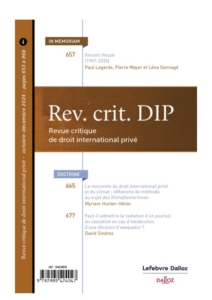 Written by Hadrien Pauchard (assistant researcher and doctoral student at Sciences Po Law School)
The fourth issue of the Revue Critique de droit international privé of 2024 will very shortly be released. It contains four articles, eight case notes and many book reviews. In line with the Revue Critique’s recent policy, the doctrinal part will shortly be made available in English on the editor’s website (for registered users and institutions). Read more
Praxis des Internationalen Privat- und Verfahrensrechts (IPRax) 2/2025: Abstracts
The latest issue of the „Praxis des Internationalen Privat- und Verfahrensrechts“ (IPRax) features the following articles: