


Views
Just released: EFFORTS Report on EU Policy Guidelines
A new Report on EU Policy Guidelines was just posted on the website of EFFORTS (Towards more EFfective enFORcemenT of claimS in civil and commercial matters within the EU), an EU-funded Project conducted by the University of Milan (coord.), the Max Planck Institute Luxembourg for Procedural Law, the University of Heidelberg, the Free University of Brussels, the University of Zagreb, and the University of Vilnius.
The Report was authored by Marco Buzzoni, Cristina M. Mariottini, Michele Casi, and Carlos Santaló Goris.
Building upon the outcomes of the national and international exchange seminars and the Project’s analytical reports, this Report formulates policy guidelines addressed to EU policymakers and puts forth suggestions to improve the current legal framework provided under the EFFORTS Regulations (namely: the Brussels I-bis Regulation and the Regulations on the European Enforcement Order, the European Small Claims Procedure, the European Payment Order, and the European Account Preservation Order) with regard to the enforcement of claims.
This Report was among the outputs and findings discussed at the Project’s Final Conference, hosted by the University of Milan on 30 September 2022, which provided an international forum where academics, policymakers, and practitioners discussed the Project’s key findings and exchanged their views on the national implementation of – and the path forward for – the EFFORTS Regulations. The content of the Final Conference will enrich the Final Study, which is forthcoming on the Project’s website.
Regular updates on the EFFORTS Project are available via the Project’s website, as well as LinkedIn and Facebook pages.
Project JUST-JCOO-AG-2019-881802
With financial support from the Civil Justice Programme of the European Union
Now or Then? The Temporal Aspects of Choice-of-Law Clauses
Several years ago, I published a paper that examined how U.S. courts interpret choice-of-law clauses. That paper contains a detailed discussion of the most common interpretive issues—whether the clause selects the tort laws of the chosen jurisdiction in addition to its contract laws, for example—that arise in litigation. There was, however, one important omission. The paper did not consider the question of whether the word “laws” in a choice-of-law clause should be interpreted to select the laws of the chosen jurisdiction (1) at the time the contract was signed, or (2) at the time of litigation.
In declining to address this issue, the paper was in good company. Neither the Restatement (Second) of Conflict of Laws (§ 2) nor the draft Restatement (Third) of Conflict of Laws (§ 1.02) discuss the relationship between choice-of-law and time. Nevertheless, the omission bothered me.
In the spring of 2021, I saw that Jeff Rensberger at the South Texas College of Law had posted a paper to SSRN entitled Choice of Law and Time. After downloading and reading the paper, I discovered that it contained no discussion of choice-of-law clauses. It was devoted solely to the question of how courts should address the issue of temporality in cases where the parties had declined to select a law in advance. After reading the paper, I wrote to Jeff to propose that we collaborate on a second paper that specifically addressed the temporal question in the context of choice-of-law clauses. When we spoke on the phone to discuss the project, however, we did not agree on the answer. Jeff argued for the laws at the time of signing. I argued for the laws at the time of litigation.
In early 2022, Jeff sent me a draft of his new paper, Choice of Law and Time Part II: Choice of Law Clauses and Changing Law, which makes the case for interpreting choice-of-law clauses to select the law at the time of signing. In response, I drafted an essay arguing that they should be interpreted to select the law at the time of litigation. A draft of my essay, The Canon of Evolving Law, is now available for download on SSRN.
If you happen to be one of the small number of people in the world interested in this fascinating (though obscure) interpretive issue, I would encourage you to download both papers and decide for yourself who has the better of the argument.
[This post is cross-posted at Transnational Litigation Blog.]
US District Court dismisses the case filed by Mexico against the US weapons industry regarding non-contractual obligations
Written by Mayela Celis
On 30 September 2022, a US District Court in Boston (Massachusetts, USA) dismissed the case filed by Mexico against the US weapons manufacturers regarding non-contractual obligations (among them, negligence and unjust enrichment). According to Reuters, the reason given by the judge to dismiss the case is that “federal law [Protection of Lawful Commerce in Arms Act] ‘unequivocally’ bars lawsuits seeking to hold gun manufacturers responsible when people use guns for their intended purpose” and that none of the exceptions contained therein applied.
One statement worthy of note as stated in multiple news media is: “While the court has considerable sympathy for the people of Mexico, and none whatsoever for those who traffic guns to Mexican criminal organizations, it is duty-bound to follow the law.”
The full case citation is Estados Unidos Mexicanos (plaintiff) vs. SMITH & WESSON BRANDS, INC.; BARRETT FIREARMS MANUFACTURING, INC.; BERETTA U.S.A. CORP.; BERETTA HOLDING S.P.A.; CENTURY INTERNATIONAL ARMS, INC.; COLT’S MANUFACTURING COMPANY LLC; GLOCK, INC.; GLOCK GES.M.B.H.; STURM, RUGER & CO., INC.; WITMER PUBLIC SAFETY GROUP, INC. D/B/A INTERSTATE ARMS (defendants), Case 1:21-cv-11269, filed in 2021.
In a nutshell, the allegations made by Mexico are the following (as stated in the complaint):
- Defendants have legal duties to distribute their guns safely and avoid arming criminals in Mexico;
- Defendants are fully on notice that their conduct causes unlawful trafficking to Mexico;
- Defendants actively assist and facilitate trafficking of their guns to drug cartels in Mexico:
- Defendants actively assist and facilitate the unlawful tracking because it maximizes their sales and profits;
- The Government has taken reasonable measures to try to protect itself from defendants’ unlawful conduct;
- Defendants cause massive injury to the government.
Claims for relief are (as stated in the complaint):
Negligence, public nuisance, defective condition – unreasonably dangerous, negligence per se, gross negligence, unjust enrichment and restitution, violation of CUTPA [Connecticut Unfair Trade Practices Act], Violation of Mass. G.L. c. 93A [Massachusetts Consumer Protection Act], punitive damages.
In addition to the argument given by the judge, I believe that it would be very hard to establish personal jurisdiction over the defendants. Think for example of the minimum contacts and the reasonableness test, in particular what are the contacts of the defendants with the state of Massachusetts (but see for example: Smith & Wesson is indeed based in Massachusetts until 2023), the existence of justified expectations that may be protected or hurt, and the forum State’s [the United States of America} interest in adjudicating the dispute.
Moreover, and aside from jurisdictional issues, given that the actual damage occurred overseas, an important issue would be to prove the causation link between the conduct of the defendants and the damage. This will prove particularly difficult considering all the intermediaries that exist in the weapons’ trade (legal and illegal, second-hand sales, pawn shops, etc.).
Nevertheless, this is a very interesting initiative and perhaps it is a battle worth fighting for (if only to raise public awareness). One thing is for sure: the Mexican Government has shown its increasing concern about the illicit traffic of firearms in its territory and its commitment to end it.
The Mexican Federal Government will appeal the judgment. The official statement is available here.
We will post any new updates on this blog. Stay tuned!
News
Out Now: Dominelli, Regolamento Bruxelles I bis e US jurisdiction in personam
Stefano Dominelli (Università di Genova) has just published a book titled Regolamento Bruxelles I bis e US jurisdiction in personam: riflessioni e proposte su condivisioni valoriali, influenze e osmosi di metodi with Editoriale Scientifica. The book is written in Italian but also features conclusions in English.
The author has kindly shared the following summary with us:
The book analyses the basic principles of the EU’ and US international civil procedure in contract and tort law. The investigation shows how both systems are partly inconsistent with their respective premises – of legal certainty, on the one hand, and fairness and justice, on the other. The juxtaposition of the dogmatic approaches and their contextualisation in the light of the law in action makes it possible to reconstruct a common and shared principle which shapes solutions in both systems – that of the necessary existence of a minimum connection between the jurisdiction and the case. This conclusion opens up, to a limited extent, to a conceptual rapprochement between legal systems and to reflections on possible legal transplants that respect the characteristics of the local legal culture.
The whole book is available open access under this link.
Call for Papers: XXII Conference of Young Scholars of International Legal Studies, University of Ferrara
On 4–5 December 2025, the Department of Law at the University of Ferrara will host the XXII edition of the Conference of Young Scholars of International Legal Studies, dedicated to “The Principle of Good Faith in International and European Union Law”.
The organizers have issued a call for papers open to scholars of public and private international law and EU law, who are currently enrolled in a PhD program or who have obtained their PhD no more than five years ago.
To apply, authors must submit an abstract (no more than 600 words), in either Italian or English, along with a curriculum vitae, by 22 June 2025, to the following email address: giovaniinternazionalisti2025@gmail.com.
Further information is available here.
The Pax Moot teams solved the “impossible” case of SSF versus Telerel and the Watermelon companies
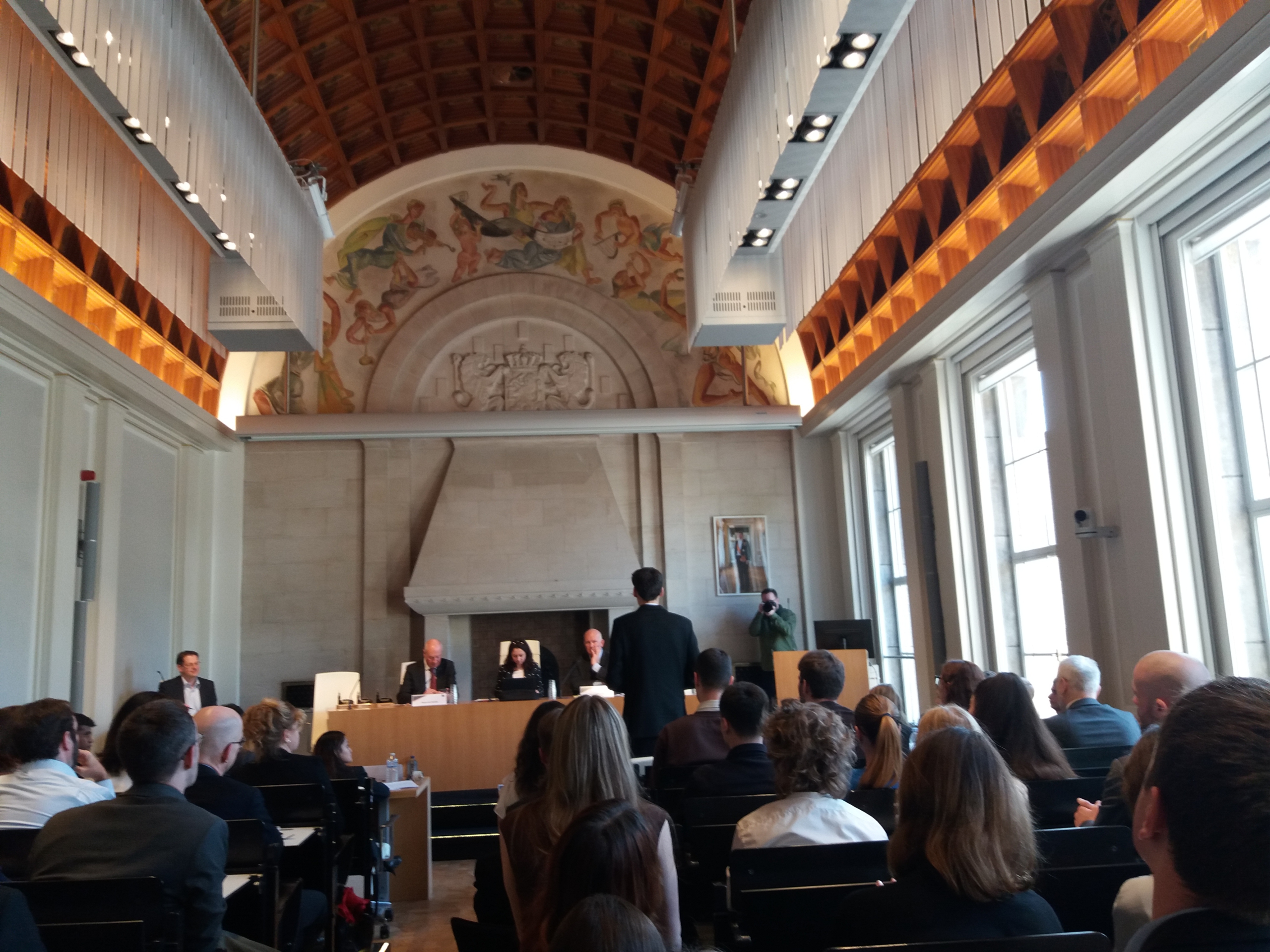 The Ulrich Huber round of the Pax Moot competition ended on Friday in the Meuse-Rhine Euroregion, at the University of Maastricht to be precise.
During three fierce days 34 Moot teams from all over Europe and as far as Georgia, Kazakhstan, India, Singapore and Uzbekistan pleaded against each other. They argued about whether self-employed content moderators for social media companies could be considered employees; about how to locate the damage that consists of the stress and mental health harm suffered by these digital nomads; about whether a UK subsidiary of an Irish company could be considered to be domiciled in the EU; about whether the proceedings instituted by a foundation under the Dutch WAMCA should be characterised as contract or tort; about whether a settlement in front of a UK court could be recognised under the 2019 Hague Judgments Convention and much more. They relied on old and new case law, reports and legal scholarship.
At the end, the University of Ljubljana won the competition, with Jindal Law School as the runner-up. The other two teams that made it to the semi-finals were the Universities of Sofia and Paris-Saclay.
The prize for the best memorials went to ESADE Law School, with the University of Ghent in second place, and Paris Dauphine and Sofia Universities in shared third places.
Jana Ušen won the best pleader’s award, followed by Brin Smole, both of Ljubljana University. In the third position was Joshua Tan and in fourth Ong Xin Yan, both of Singapore Management University.
Under the inexhaustible leadership of Marta Pertegás, expect the Pax team to be back with a new case in October/November, to be pleaded in Sofia in roughly one year’s time. Pax Moot is co-funded b y the European Commission.