


Views

Copyright, Targeting and Geo-Blocking: The CJEU Stirs the Pot
By Graham Smith, Of Counsel, Bird & Bird LLP, London, UK
The CJEU’s recent copyright decision in Anne Frank endorses state of the art geo-blocking as an effective way of shielding a website from the different copyright laws of another EU Member State. Although the result on the facts is welcome, the potential implications of the Court’s underlying reasoning are less so. At a principled level, the judgment creates post-Brexit divergence with the UK courts’ targeting approach to cross-border online copyright infringement.
A Follow-Up: The German Judges Association’s Response to the HCCH Draft Text of a Future Convention on Parallel Proceedings and Related Actions
This post follows up on our earlier observations on the public consultation responses to the HCCH Draft Text of a future Convention on Parallel Proceedings and Related Actions. At the time our overview was prepared, the response of the German Judges Association was not yet available to us among the consultation materials on the HCCH website and could therefore not be included. It has since been made available, and we would like to take this opportunity to briefly add its key points to the discussion, notwithstanding that there are still coming up new responses such as the ones by Jonathan Mance (UK) – „Former Deputy President of UK Supreme Court, Co-Chair of the LC Advisory Committee”, the International Association of Consumer Law (IACL) or the Philippine Women Judges Association. We will leave it to others to comment on these.
Private International Law Dimensions of Singapore’s New Legislation to Combat Online Harms
Guest post by Professor YEO Tiong Min, Yong Pung How Chair Professor of Law, Yong Pung How School of Law, Singapore Management University
Much has been in the news about governmental endeavours to protect children from the ills of social media, which has partially eclipsed the equally important issue of social media being used to cause online harms to both the young and not so young alike. The Online Safety (Relief and Accountability) Act 2025 (OSRAA) came into effect in Singapore on 29 June 2026, with the objective to strengthen the protection of victims against various types of emerging online harm, including intimate image abuse, image-based child abuse, doxxing, online harassment, and online stalking. The statute established the Online Safety Commission that can make orders to hold accountable those who post harmful content (Communicators), control the hosting of the harmful content (Administrators), or host the harmful content (Platforms).
News
Praxis des Internationalen Privat- und Verfahrensrechts (IPRax) 5/2026: Abstracts
The latest issue of the „Praxis des Internationalen Privat- und Verfahrensrechts“ (IPRax) features the following articles:
Clarity in Complexity: Nadia Rusinova’s Practical Handbook on EU Family Law, Part II – International Child Abduction Litigation
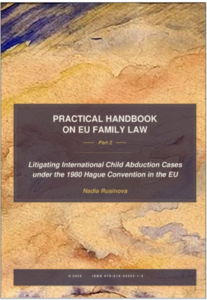 In an earlier post on this blog, we presented Part 1 of Nadia Rusinova’s Practical Handbook on EU Family Law, highlighting its success in bringing clarity and structure to the complex framework of cross-border family law in the European Union.
The project has now been extended with the publication of Part 2: Litigating International Child Abduction Cases under the 1980 Hague Convention in the EU (2026, ISBN 978-619-93392-1-3). While Part 1 provides the conceptual and terminological foundations, Part 2 applies them to one of the most demanding areas of cross-border family law: international child abduction proceedings.
The new handbook may be viewed and downloaded free of charge.
New book: Droit International Privé by Marc Fallon, Jean-Yves Carlier and Stéphanie Francq
The standard textbook of Belgian Private International Law in French has just been published in its fourth edition (by Larcier Intersentia). The great scholar François Rigaux published the first version of this précis in 1977-1979 (in two volumes). The second edition followed in 1987-1993, and the third in 2005. While the third edition comprised a single volume, it comes as no surprise that the number of legislative texts and court decisions have obliged the authors to return to the two-volume format. Printed in small typeset and on thin paper, the entire work surpasses 2000 pages. The book forms part of the series Precis de la faculté de droit et de criminologie de l’UCLouvain. The two volumes are truly a “travail de moine” (a very detailed and painstaking work that requires much time and patience).