
Clarity in Complexity: Nadia Rusinova’s Practical Handbook on EU Family Law, Part II – International Child Abduction Litigation


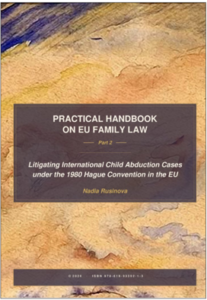 In an earlier post on this blog, we presented Part 1 of Nadia Rusinova’s Practical Handbook on EU Family Law, highlighting its success in bringing clarity and structure to the complex framework of cross-border family law in the European Union.
The project has now been extended with the publication of Part 2: Litigating International Child Abduction Cases under the 1980 Hague Convention in the EU (2026, ISBN 978-619-93392-1-3). While Part 1 provides the conceptual and terminological foundations, Part 2 applies them to one of the most demanding areas of cross-border family law: international child abduction proceedings.
The new handbook may be viewed and downloaded free of charge.
Following the course of a return case
Rather than following the sequence of the 1980 Hague Convention, Part 2 mirrors the progression of an actual return case. It moves from identifying the applicable framework and establishing whether the Convention applies to the parties’ positions, exceptions to return, evidence, child participation, domestic violence and protective measures. It concludes with return decisions, appeals, enforcement and post-decision proceedings.
This structure enables practitioners to move directly from a concrete problem to the relevant principles and authorities.
Comparative case law at the centre of the analysis
The handbook contains 481 case notes drawn from national decisions in 23 jurisdictions: Austria, Belgium, Bulgaria, Cyprus, the Czech Republic, Denmark, Estonia, Finland, France, Germany, Hungary, Ireland, Italy, Lithuania, the Netherlands, Poland, Portugal, Romania, Slovenia, Spain, Sweden, the United Kingdom and the United States. These are considered alongside judgments of the Court of Justice of the European Union and the European Court of Human Rights and encompass first-instance, appellate and supreme-court decisions.
This comparative approach reveals how recurring legal questions may produce different outcomes depending on the facts, available evidence and procedural context.
Issues capable of determining proceedings
Particular attention is devoted to issues that may prove decisive, including:
- custody rights and their exercise;
- consent, acquiescence and the child’s settlement;
- grave risk and intolerable situations;
- child objections and the right to be heard;
- burdens of proof and foreign-law evidence;
- domestic violence and protective measures;
- parallel parental-responsibility proceedings; and
- return orders, appeals, enforcement and the Brussels IIb overriding mechanism.
In her handbook, Nadia Rusinova examines throughout the interaction between the 1980 Hague Convention, Regulation (EU) 2019/1111 – Brussels IIb – and the 1996 Hague Child Protection Convention. Its treatment of child participation, domestic violence and protective measures is especially timely, reflecting the need to reconcile prompt return with an effective, evidence-based and child-centred assessment of risk.
A practical and accessible resource
The handbook is an essential resource for all professionals engaged in international child abduction and cross-border family law, including judges, lawyers, central authorities, court staff, researchers, trainers and translators. Wherever possible, the electronic edition provides direct links to the underlying decisions, enabling readers to examine their full factual context and judicial reasoning.
Part 2 complements Part 1 of the Practical Handbook on EU Family Law. The two volumes are designed to work together while remaining fully usable independently.
Further information is available on Nadia Rusinova’s EU Family Law Handbook webpage. Readers may also be interested in her related 2026 research project, Domestic Violence in Dutch Return Proceedings.