
TDM Call for Papers on “Project Finance in International Arbitration”


The following call was kindly shared with us by the editors of TDM.
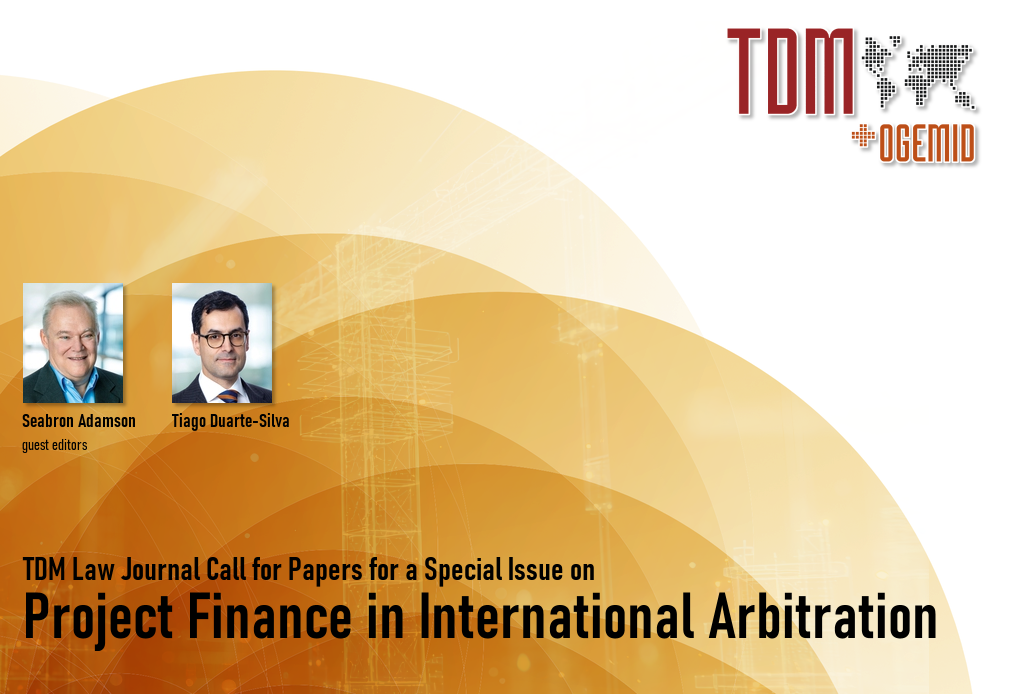
We are pleased to announce a forthcoming Transnational Dispute Management (TDM, ISSN 1875-4120, www.transnational-dispute-management.com) special issue on “Project Finance in International Arbitration” This Special Issue will be edited by Seabron Adamson and Tiago Duarte-Silva, both of Charles River Associates.
This call for papers can also be found on the TDM website:
https://www.transnational-dispute-management.com/news.asp?key=2118
Background
Project finance is used in many of the world’s largest energy, mining, infrastructure, telecommunications, and digital infrastructure projects. Many of the most complex commercial and investor-State arbitrations involve project financed businesses. However, the financial logic of special-purpose vehicle (SPV) structures, lender controls, cashflow waterfalls, and project financeability remains under-examined in arbitration writing. This special issue invites contributions on how project finance shapes jurisdiction, liability, causation, valuation, and remedies across both commercial and treaty disputes.
The sectors in which project finance is predominantly used — energy, mining, infrastructure, and telecommunications — are also the sectors that generate the greatest volume of international arbitration disputes. According to 2024 statistics, energy and construction matters collectively account for a substantial majority of ICC commercial arbitration cases, while energy and mining-related disputes represent nearly half of all ICSID cases. Project finance structures are therefore routinely at the heart of some of the most complex and high-value arbitrations in the world.
Despite this convergence, the specific financial mechanics of project finance remain under-explored in the international arbitration literature. The structural features of project-financed transactions (the SPV architecture, cashflow waterfalls, lender step-in rights, covenant frameworks, and heavily negotiated risk allocations) create a distinct legal and economic context that shapes how disputes arise, how liability is assessed, and how damages are quantified. Even modest disruptions to revenues or operations can trigger cascading contractual consequences that may wipe out equity value entirely, even when the underlying asset continues to function. Quantifying the full extent of such losses increasingly requires a sophisticated understanding of project finance mechanics by arbitration tribunals and practitioners.
Disputes in project-financed transactions frequently arise from governmental actions that may impair project economics or bankability (including permit delays, regulatory changes, and expropriation), counterparty failures (whether by offtakers, EPC or O&M contractors, or co-investors), or unforeseen operational disruptions. In the investor-State context, the interplay between treaty protections and the rights of lenders raises fundamental questions about who has standing to claim, what losses are recoverable, and how reparations should be structured. In commercial arbitration, multi-party, multi-contract disputes are common, involving intricate questions of risk allocation under construction contracts, power purchase agreements (PPAs), concession agreements, and financing documentation.
This special issue seeks to bring together leading practitioners, academics, and experts to examine the intersection of project finance and international arbitration in depth. Contributions from practitioners with experience in the field (whether as counsel, arbitrators, damages experts, or other specialists) are particularly welcome.
Topics
We invite submissions addressing one or more of the following topics, or any other relevant issues at the intersection of project finance and international arbitration:
Project Finance Structure and Arbitration
- The SPV structure and its implications for jurisdiction, standing, and enforcement in arbitration
- Lender rights in arbitration: step-in rights, direct agreements, and the role of lenders as parties or third parties to disputes
- Multi-party arbitration in project finance: aligning disputes across the contractual matrix (EPC, O&M, offtake, financing)
- Confidentiality and disclosure of financing documents in arbitral proceedings
- Arbitration clauses in project finance agreements: drafting considerations, potentially problematic clauses, and interaction between dispute resolution tiers
- The impact of political risk insurance
- Corruption and cronyism in project development
Investor-State Disputes Involving Project Finance
- Bankability and the fair and equitable treatment standard: when do regulatory changes cross the line?
- Stabilization clauses in concession agreements and their interaction with treaty protections
- Standing, nationality and attribution issues in investor-State claims involving SPVs, HoldCos, lending and sponsor syndicates and lender-controlled structures
- Force majeure, necessity, and hardship in project-financed infrastructure and energy disputes
- Government actions affecting project bankability: permit delays, regulatory creep, and currency restrictions
- The role of export credit agencies (ECAs), political risk insurers and multilateral development banks (MDBs) in shaping dispute outcomes
- Managing the risk of conflicting decisions across arbitral and judicial disputes involving separate claimants
- Political risk in project development and operation
Damages and Financial Analysis
- Quantifying losses in project-financed disputes: the role of the cashflow waterfall and financial model
- The “binary” nature of project finance equity losses: implications for damages methodology
- DCF and comparables-based valuation in early-stage, construction-phase, and operational project finance disputes
- Financeability as a damages issue: was the project realistically bankable, and how should that be assessed?
- Mitigation obligations and lender enforcement tools (waivers, cure periods, restructuring) in the damages analysis
- Loss of chance and causation in complex, multi-causal project finance disputes
- The impact of liability limits in project contracts
Sector-Specific Issues
- Renewable energy project finance disputes: PPAs, curtailment, and the energy transition
- Mining and natural resources: concession agreements, offtake disputes, and royalty financing in arbitration
- Infrastructure projects: PPP structures, availability-based payments, and government termination rights
- Oil and Gas project finance: production sharing agreements, joint operating agreements, and contractor disputes
- Digital infrastructure and data centres: emerging project finance disputes in a rapidly growing sector
- Disputes involving Islamic finance structures used in project financing
Procedural and Practical Considerations
- Interim measures and the protection of project assets and revenues pending arbitral proceedings
- Expert evidence in project finance disputes: financial modelling, engineering, and sector expertise
- Enforcement of project finance arbitral awards against States and SPVs
- Third-party funding in project finance arbitrations
- Insolvency, restructuring, and arbitration: managing distressed project finance disputes
- Dispute avoidance and management clauses in project finance documentation
Submissions
We invite all those with an interest in the subject to contribute articles or notes on one of the above topics or any other relevant issue. Proposals for papers (150–200 words) should be submitted to the editors by June 30th publication is expected final quarter 2026/first quarter 2027.
Please address all questions and proposals to the editors at sadamson@crai.com and tduarte@crai.com and CC info@transnational-dispute-management.com when submitting your materials.
Articles accepted for publication before this deadline will also go through TDM’s on-line advance publication process, allowing your work to reach its target audience as soon as the paper completes peer review and the editing process.
Guest Editors
|
Seabron Adamson Charles River Associates View profile * sadamson@crai.com |
Tiago Duarte-Silva Charles River Associates View profile * tduarte@crai.com |
Submission Guidelines
The minimum word count for articles is 5,000 words (excluding footnotes, endnotes, appendices, tables, summary etc.). Articles must include a short summary of the key points addressed and any conclusions drawn (150–200 words).
The layout of the articles should conform to TDM’s submission guidelines, available at: www.transnational-dispute-management.com/contribute.asp (more information available upon request).
For citations, please follow OSCOLA (4th Edition): www.law.ox.ac.uk/research-subject-groups/publications/oscola
This call for papers can also be found on the TDM website:
https://www.transnational-dispute-management.com/news.asp?key=2118