
Conflict of Laws
  • About
  • Editorial board
  • Subscription
  • Submission
  • Materials
  • Contact
  • Click to open the search input field Click to open the search input field Search
  • Menu Menu

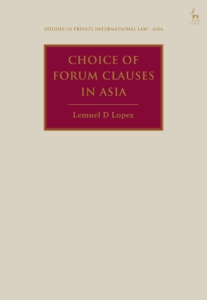
[Out Now] Lopez on Choice of Forum Clauses in Asia

August 9, 2025/in News/by Béligh Elbalti
image_pdfimage_print

The Hart Series “Studies in Private International Law – Asia” continues to deliver outstanding volumes, the latest being authored by Lemuel D. Lopez (lecturer of Law at the Royal Melbourne Institute of Technology University), and titled “Choice of Forum Clauses in Asia”.

This marks the 13th volume in the series, which was launched only a few years ago in 2019, with many more volumes expected to follow.

The topic is of great significance, and this book provides a much-needed Asian perspective, shedding light on how forum selection clauses function within the region’s unique legal environment.


The book’s description reads as follows:

This book compares and explains the approaches taken by Asian courts when choice of forum clauses in international commercial contracts are challenged in litigation.
It examines key common law jurisdictions (Singapore, Hong Kong and Malaysia), civil law jurisdictions (China, Japan, and Indonesia), and hybrid jurisdictions (the Philippines).
With Asia’s ascent in cross-border trade and investment, alongside a corresponding increase in cross-border litigation, understanding how Asian courts address choice of forum clauses in international commercial contracts has never been more critical. Employing a comparative law method, the book identifies and explains the relief and remedies used by Asian courts in enforcing choice of forum clauses, analysing how their classification as either contractual or procedural in nature shapes judicial approaches. It further distinguishes choice of forum clauses from arbitration agreements and explores their interaction with other contractual provisions. Party autonomy – as the parties’ freedom to determine the contents of the choice of forum clause and the freedom to control the flow of litigation – is also critically scrutinised.

Furthermore, the book investigates the factors courts consider in resolving key choice of forum clause issues (ie, enforceability; specific relief to be granted; existence, validity, interpretation of choice of forum clauses; role of mandatory rules, public policy, and international interests) and explores the prospects for future development of this area of law in Asia.

Crucially, the book highlights the unique approaches of Asian courts, while underscoring the differences and similarities among common law, civil law, and hybrid jurisdictions.


Table of Contents

1. Introduction
2. The Nature of Choice-of-Forum Clauses
3. Party Autonomy and Choice-of-Forum Clauses
4. The Enforcement of Choice-of-Forum Clauses: Singapore, Hong Kong, Malaysia, Philippines
5. The Factors Considered in Granting Relief: Singapore, Hong Kong, Malaysia, Philippines
6. Existence, Validity and Interpretation: Singapore, Hong Kong, Malaysia, Philippines
7. Mandatory Rules, Public Policy and International Interests: Singapore, Hong Kong, Malaysia, Philippines
8. Choice of Forum Clauses in Asian Civil Law Countries: China, Indonesia and Japan
9. Conclusions

Tags: choice of court agreement, Asia
Share this entry
  • Share on Facebook
  • Share on X
  • Share on WhatsApp
  • Share on Pinterest
  • Share on LinkedIn
  • Share on Tumblr
  • Share on Vk
  • Share on Reddit
  • Share by Mail
https://conflictoflaws.net/News/2020/08/CoL_Banner-1.png 0 0 Béligh Elbalti https://conflictoflaws.net/News/2020/08/CoL_Banner-1.png Béligh Elbalti2025-08-09 04:18:252025-08-09 04:18:25[Out Now] Lopez on Choice of Forum Clauses in Asia
Categories

  • Views
  • News

Most Recent Posts

  • The Demise of the Lex Domicilii Matrimonii in South African Private International Law August 18, 2026
  • Support in cross-border transactions by Adults: Contract law vs capacity law August 12, 2026
  • Recognition of Italian Extrajudicial Divorces in Tunisia — Between Methodological Uncertainty and the Need to Preserve Continuity of Personal Status Across Borders August 9, 2026
  • Private International Law and European Society August 4, 2026
  • The New Zealand Supreme Court’s judgment in Kea Investments Ltd v Wikeley on anti-enforcement relief August 3, 2026
  • Beyond Domicile: The BHP Litigation and the Functional Interconnection of Public and Private International Law August 3, 2026
  • Conflicts of jurisdiction in Senegal: lesson from the Senegalese Supreme Court on Lis Pendens and the Exequatur of foreign judgments July 27, 2026
  • Adoption in the proposal for a European Parenthood Regulation July 21, 2026
  • Copyright, Targeting and Geo-Blocking: The CJEU Stirs the Pot July 15, 2026
  • A Follow-Up: The German Judges Association’s Response to the HCCH Draft Text of a Future Convention on Parallel Proceedings and Related Actions July 15, 2026
  • Private International Law Dimensions of Singapore’s New Legislation to Combat Online Harms July 14, 2026
  • The 1961 HCCH Apostille Convention: Why All African Countries Should Ratify It? — Insights from Judicial Practice in Africa July 14, 2026
  • The enforcement of an advance on costs for substitute performance at the expense of a Russian debtor in German-French legal relations July 2, 2026
  • “Yes, in principle, but not quite there yet…” – Some Observations on the Public Consultation on the HCCH Draft Text of a Future Convention on Parallel Proceedings and Related Actions June 29, 2026
  • Judgment Mobility Rules in India’s Private International Law Regime: No place for a revision au fond? June 26, 2026
Link to: When Islamic Law Crosses Borders: Ila-Divorce and Public Policy in Japan Link to: When Islamic Law Crosses Borders: Ila-Divorce and Public Policy in Japan When Islamic Law Crosses Borders: Ila-Divorce and Public Policy in Japan Link to: Chair for Comparative and Private International Law, University of Vienna Link to: Chair for Comparative and Private International Law, University of Vienna Chair for Comparative and Private International Law, University of Vienna
Scroll to top Scroll to top Scroll to top