
Revue Critique de droit international privé – issue 2023/2


The second issue of the Revue critique de droit International privé of 2023 was released in August. It contains four articles and several case notes.
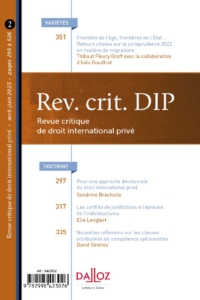 The first part of the issue features the doctrinal work of two young authors, who confront PIL techniques with contemporary developments in social sciences.
The first article Pour une approche décoloniale du droit international privé (A Decolonial Approach to Private International Law) is authored by Dr Sandrine Brachotte (Université Saint-Louis & Université de Lille). Following her doctoral work on The Conflict of Laws and Non-secular Worldviews: A Proposal for Inclusion (see presentation over at EAPIL), Dr Brachotte discusses colonial studies’ implications for PIL scholarship. She examines how plural normativities challenge the traditional conception of conflict of laws and then outlines the potential form of a decolonial PIL. An English translation of the article is available on the website of the editor. Its abstract reads as follows:
This article presents the decolonial approach to private international law, which has recently entered the list of pressing topics for the discipline, not only in colonised countries but also in Europe. In France, the subject may not yet be addressed as such, but it at least appeared in a Ph. D. thesis defended at the Sciences Po Paris Law School in May 2022, entitled “The Conflict of Laws and Non-secular Worldviews: A Proposal for Inclusion”. This thesis argues for an alternative theorisation of the notions of party autonomy, recognition, and international jurisdiction to make them more inclusive of non-occidental worldviews. After having offered a description of the decolonial approach and the current enterprise of decolonisation of private international law, this contribution summarises the essential points of the Ph. D. thesis in this respect and identifies the broader questions that it raises for private international law, especially as regards the notions of “law”, “foreign” and “conflict”.
Dr Élie Lenglart (Université Paris II Panthéon Assas) signed the second article on Les conflits de juridictions à l’épreuve de l’individualisme (Conflicts of Jurisdiction and Individualism). Dr Lenglart prolongs the reflection of his doctoral work on La théorie générale des conflits de lois à l’épreuve de l’individualisme (The General Theory of Conflicts of Laws Confronted with Individualism) in the field of conflicts of jurisdiction. He shows how the rules on jurisdiction and circulation of foreign judgments have been progressively liberalized, the satisfaction of individual interest becoming the gravity centre of PIL. The abstract reads as follows :
Individualism is one the characteristic features of modern legal theories. The emergence of the individualistic approach is profoundly linked to a special perception and evaluation of the reality based of the superiority of the individual. This conception has had decisive consequences in private international law. The impact of this tendency should not be underestimated. Its influence is noticeable in the first place on the determination of international competency of French jurisdictions, both via the provision of available courts to individuals and via the individuals’ propensity to extend their choices of jurisdictions based on their personal interests. It also influences the recognition and enforcement of foreign judgments by imposing the legal recognition of individual statuses under extremely liberal conditions, reorganizing in turn the whole system around the individual.
In the third article, Prof. David Sindres (Université d’Angers) shares some Nouvelles réflexions sur les clauses attributives de compétence optionnelles (New Reflections on Optional Jurisdiction Clauses). He successively discusses the principles and conditions of liceity of both the jurisdiction clauses of optional application and the clauses that establish an option between designated jurisdictions under Brussel 1 recast (from a French law perspective).
The fourth article is dedicated to a selective account of French and European developments in immigration law. Prof. Thibaut Fleury Graff (Université Versailles Saint-Quentin-en-Yvelines) and Inès Giauffret (Ph. D. candidate at Université Versailles Saint-Quentin-en-Yvelines) discuss recent case law on the “age border” (cases about the appreciation of minority and the rights of detained minors) and the “state border” (cases about measures of placement in waiting zones, detention, and expulsion in French law) in a tensed international context.
The full table of contents is available here.
Previous issues of the Revue Critique (from 2010 to 2022) are available on Cairn.
