
Conflict of Laws
  • About
  • Editorial board
  • Subscription
  • Submission
  • Materials
  • Contact
  • Click to open the search input field Click to open the search input field Search
  • Menu Menu

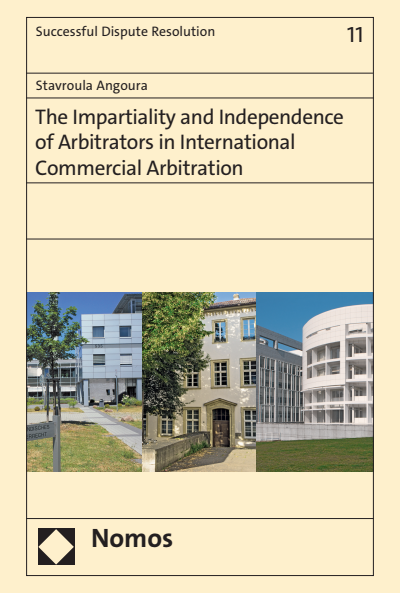
Out now: Stavroula Angoura, The Impartiality and Independence of Arbitrators in International Commercial Arbitration

February 10, 2022/in News/by Matthias Weller
image_pdfimage_print

Impartiality is key to any kind of production of justice and probably one of the very few principles of “justice” recognized universally, see e.g. Amartya Sen, The Idea of Justice, Chapter 5: “Impartiality and Objectivity”, pp. 114 et seq. with references also to non-Western traditions, see also e.g. Leviticus 19:15 (New International Version): “Do not pervert justice; do not show partiality to the poor or favoritism to the great, but judge your neighbor fairly.”; see also e.g. IBA Rules of Ethics, rule 1: “Arbitrators shall … remain free from bias”. Thus, there cannot be put enough emphasis and thought on how to implement this command, for acting arbitrators as well as parties and reviewing state courts, when they ask themselves in countless greyish constellations how to behave or judge in order to avoid even the slightest perception of bias but also to abstain from unproductive “due process paranoia”. The PhD thesis by Angoura, supervised by Burkhard Hess and published in the Luxembourg Max Planck Institute’s series “Successful Dispute Resolution”, offers solid information and thorough analysis on a comparative basis – highly recommended.

Share this entry
  • Share on Facebook
  • Share on X
  • Share on WhatsApp
  • Share on Pinterest
  • Share on LinkedIn
  • Share on Tumblr
  • Share on Vk
  • Share on Reddit
  • Share by Mail
https://conflictoflaws.net/News/2020/08/CoL_Banner-1.png 0 0 Matthias Weller https://conflictoflaws.net/News/2020/08/CoL_Banner-1.png Matthias Weller2022-02-10 08:08:432022-02-10 08:08:43Out now: Stavroula Angoura, The Impartiality and Independence of Arbitrators in International Commercial Arbitration
Categories

  • Views
  • News

Most Recent Posts

  • Recognition of Italian Extrajudicial Divorces in Tunisia — Between Methodological Uncertainty and the Need to Preserve Continuity of Personal Status Across Borders August 9, 2026
  • Private International Law and European Society August 4, 2026
  • The New Zealand Supreme Court’s judgment in Kea Investments Ltd v Wikeley on anti-enforcement relief August 3, 2026
  • Beyond Domicile: The BHP Litigation and the Functional Interconnection of Public and Private International Law August 3, 2026
  • Conflicts of jurisdiction in Senegal: lesson from the Senegalese Supreme Court on Lis Pendens and the Exequatur of foreign judgments July 27, 2026
  • Adoption in the proposal for a European Parenthood Regulation July 21, 2026
  • Copyright, Targeting and Geo-Blocking: The CJEU Stirs the Pot July 15, 2026
  • A Follow-Up: The German Judges Association’s Response to the HCCH Draft Text of a Future Convention on Parallel Proceedings and Related Actions July 15, 2026
  • Private International Law Dimensions of Singapore’s New Legislation to Combat Online Harms July 14, 2026
  • The 1961 HCCH Apostille Convention: Why All African Countries Should Ratify It? — Insights from Judicial Practice in Africa July 14, 2026
  • The enforcement of an advance on costs for substitute performance at the expense of a Russian debtor in German-French legal relations July 2, 2026
  • “Yes, in principle, but not quite there yet…” – Some Observations on the Public Consultation on the HCCH Draft Text of a Future Convention on Parallel Proceedings and Related Actions June 29, 2026
  • Judgment Mobility Rules in India’s Private International Law Regime: No place for a revision au fond? June 26, 2026
  • Nothing to See Here: The CJEU’s Decision in Case C-232/25 Idzinski June 18, 2026
  • Refusal to Enforce in Egypt of a Californian (U.S.) Judgment for Lack of Reciprocity: What Has Gotten into the Egyptian Supreme Court? June 15, 2026
Link to: EU Consultation on Protection of Vulnerable Adults Link to: EU Consultation on Protection of Vulnerable Adults EU Consultation on Protection of Vulnerable Adults Link to: Universidad Central de Venezuela: Call for Papers for the Private International Law and Comparative Law Master’s Program’s Yearbook Link to: Universidad Central de Venezuela: Call for Papers for the Private International Law and Comparative Law Master’s Program’s Yearbook Universidad Central de Venezuela: Call for Papers for the Private International...
Scroll to top Scroll to top Scroll to top