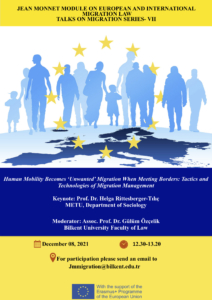
Online Conference: “Human Mobility Becomes ‘Unwanted’ Migration When Meeting Borders: Tactics and Technologies of Migration Management”


You are kindly invited for the online conference on “Human Mobility Becomes ‘Unwanted’ Migration When Meeting Borders: Tactics and Technologies of Migration Management” by Prof. Dr. Helga RITTESBERGER-TILIÇ (Middle East Technical University, Department of Sociology, Ankara, Turkey) on December 8, 2021, Wednesday between 12.30-13.30 (GMT+3). The conference is organised by Bilkent University as a part of the Talks on Migration Series within the Jean Monnet Module on European and International Migration Law. It will be held via zoom, free of charge. Please contact us (Jmmigration@bilkent.edu.tr) for participation.
Biography:
Prof. Dr. Helga RITTESBERGER-TILIÇ is a member of the Department of Sociology at Middle East Technical University (Ankara, Turkey) since 1985. She received her doctorate degree from Essen University, Germany.
She has extensively worked on different aspects of international as well as national migration. She covered a wide field of subthemes such as return migration from Germany, migration to Europe, human trafficking, unacompanied migrant children, foreign domestic women labor in the informal economy in Turkey, integration of Syrian migrants into the Turkish labor market, ‘legal’ foreigners in Turkey as well as rural-to-urban migration processes and urban poverty in the national Turkish context.
Abstract:
Human Mobility becomes ‘unwanted’ Migration When Meeting Borders: Tactics and Technologies of Migration Management
Some researchers might stress a quantitative analysis of numbers of ‘forced’ migrants, refugees, asylum seekers, deportations etc. or we may say the quantification of state categorizations of different types of wanted and unwanted migrants. Others might be more interested in the study of how social relations produce discriminatory practices such as the subjectification of deportees, the role of criminalization and securitization discourses, etc.
The categorization into ‘those migrants, who deserve’ and ‘those, who do not deserve’ to stay, live, and work in a country is part of multiple processes in which a variety of tactics, tools and strategies are employed by different actors on local, regional and global levels. There is a wide range of actors: politicians, civil society organizations, academia, media, migrant solidarity organizations, local people and the migrants themselves. But the underlying assumption that migrants are part of a subordinate inclusion into local and global labor regimes remains.
Among the strategies of migration management changing of border regimes and control mechanisms, closing of borders, policing and an increase in deportation measures can be listed. Migrants were forced to return, stay in hotspot detention camps, find ‘alternative’ routes, or built their self-made camps like in Calais. The migrants trying to pass border crossings and fighting police, pushbacks of crowded boats and death statistics are presented to us, the audience, as a mediatic spectacle. The manifestation of the COVID 19 pandemic can be stressed, referring to changing tactics of ‘re-bordering’ the national borders as purposeful activities in the name of public health emergency on a global scale.
Thus, the process of building borders and the externalization of border regimes should be part of a discussion on ’forced’ migration without forgetting that migrants are disposable labor but also subjective beings.