
Conflict of Laws
  • About
  • Editorial board
  • Subscription
  • Submission
  • Materials
  • Contact
  • Click to open the search input field Click to open the search input field Search
  • Menu Menu
April 7, 2019/2 Comments/in News/by Ivana Kunda
image_pdfimage_print

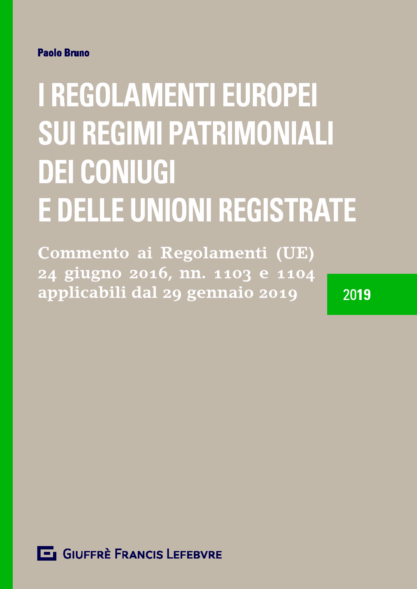
The book titled I Regolamenti europei sui regimi patrimoniali dei coniugi e delle unioni registrate: commento ai Regolamenti (UE) 24 giugno 2016, n.1103 e 1104 applicabili dal 29 gennaio 2019, authored by Paolo Bruno, was recently released by the Italian publisher Giuffrè.

The official description (translated from the Italian original) states:

With the adoption of Regulations (EU) Nos. 1103 and 1104 of 2016, applicable from 29 January 2019, the supranational legislator has completed – albeit in the form of enhanced cooperation – the framework of European family law, dictating common rules on jurisdiction, applicable law, recognition and enforcement of decisions in matters of matrimonial property regimes and property effects of registered partnerships. After intervening over the course of a decade in the matrimonial matters and parental responsibility, then in terms of maintenance obligations and succession, the Council of the European Union has therefore provided citizens and professionals with the necessary coordinates to reach a complete definition of the property relationships of spouses and partners (between them and third parties) deriving directly from the creation of the family bond or its dissolution. Retracing the structure of the two legislative acts, as supplemented by the Implementing Regulations (EU) No. 1935 and No. 1990 of 7 and 11 December 2018 which adopted the standard forms attached to them, and commenting on the discipline in the light of the most recent rulings of the European Courts, the author examines their compatibility with the relevant institutes of Italian substantive and procedural law – from the reflections on the discipline of legal communion and applicability to registered partnerships and de facto couples, to exploring their practical implications in terms of circulation of agreements on assisted negotiation – in a constantly evolving regulatory and social context.

This book follows Bruno’s former book Le controversie familiari dell’Unione Europea published with the same editor in 2018.

Share this entry
  • Share on Facebook
  • Share on X
  • Share on WhatsApp
  • Share on Pinterest
  • Share on LinkedIn
  • Share on Tumblr
  • Share on Vk
  • Share on Reddit
  • Share by Mail
https://conflictoflaws.net/News/2019/04/024202840.gif 589 417 Ivana Kunda https://conflictoflaws.net/News/2020/08/CoL_Banner-1.png Ivana Kunda2019-04-07 10:30:252019-04-07 17:32:11
2 replies
  1. Gilles says:
    April 7, 2019 at 2:13 pm

    Is the author’s name really Paolo Romano…?

  2. Ivana Kunda says:
    April 7, 2019 at 5:34 pm

    Thanks for the tip! And apologies for the lapsus, now corrected!

Comments are closed.

Categories

  • Views
  • News

Most Recent Posts

  • Recognition of Italian Extrajudicial Divorces in Tunisia — Between Methodological Uncertainty and the Need to Preserve Continuity of Personal Status Across Borders August 9, 2026
  • Private International Law and European Society August 4, 2026
  • The New Zealand Supreme Court’s judgment in Kea Investments Ltd v Wikeley on anti-enforcement relief August 3, 2026
  • Beyond Domicile: The BHP Litigation and the Functional Interconnection of Public and Private International Law August 3, 2026
  • Conflicts of jurisdiction in Senegal: lesson from the Senegalese Supreme Court on Lis Pendens and the Exequatur of foreign judgments July 27, 2026
  • Adoption in the proposal for a European Parenthood Regulation July 21, 2026
  • Copyright, Targeting and Geo-Blocking: The CJEU Stirs the Pot July 15, 2026
  • A Follow-Up: The German Judges Association’s Response to the HCCH Draft Text of a Future Convention on Parallel Proceedings and Related Actions July 15, 2026
  • Private International Law Dimensions of Singapore’s New Legislation to Combat Online Harms July 14, 2026
  • The 1961 HCCH Apostille Convention: Why All African Countries Should Ratify It? — Insights from Judicial Practice in Africa July 14, 2026
  • The enforcement of an advance on costs for substitute performance at the expense of a Russian debtor in German-French legal relations July 2, 2026
  • “Yes, in principle, but not quite there yet…” – Some Observations on the Public Consultation on the HCCH Draft Text of a Future Convention on Parallel Proceedings and Related Actions June 29, 2026
  • Judgment Mobility Rules in India’s Private International Law Regime: No place for a revision au fond? June 26, 2026
  • Nothing to See Here: The CJEU’s Decision in Case C-232/25 Idzinski June 18, 2026
  • Refusal to Enforce in Egypt of a Californian (U.S.) Judgment for Lack of Reciprocity: What Has Gotten into the Egyptian Supreme Court? June 15, 2026
Link to: Procedural Harmonization and Private Enforcement in the Area of Personal Data Protection Link to: Procedural Harmonization and Private Enforcement in the Area of Personal Data Protection Procedural Harmonization and Private Enforcement in the Area of Personal Data... Link to: 11th International Forum on the e-APP (electronic Apostille Program) will be held in Fortaleza, Brazil, from 16 to 18 October 2019 Link to: 11th International Forum on the e-APP (electronic Apostille Program) will be held in Fortaleza, Brazil, from 16 to 18 October 2019 11th International Forum on the e-APP (electronic Apostille Program) will be...
Scroll to top Scroll to top Scroll to top