
Quick and easy access to German case law in private international law – One year of ‘IPRspr 2.0’ (and almost 100 years of ‘IPRspr’)


Quick and easy access to German case law in private international law – One year of ‘IPRspr 2.0’ (and almost 100 years of ‘IPRspr’)
A comprehensive and carefully curated database providing free access to German court decisions on private international law – www.iprspr.de
Ralf Michaels/Jan Peter Schmidt
As is well known (at least among readers of this blog), the reality of private international law is found not in the highly abstract and often rudimentary black-letter rules, but only in their concrete application by courts. Case surveys are therefore crucial, but compiling the decisions comprehensively is hard. Private international law issues appear in all areas of private law and beyond: they can arise not only before civil and commercial courts, but also, for example, in criminal and in administrative proceedings. Sometimes courts do not even realize, or make explicit, the relevance of foreign law. The annual survey of US decisions on choice of law in the American Journal of Comparative Law, initiated by Symeon Symeonides and now continued by Coyle, Dodge, and Simowitz, relies on a keyword search. Other surveys do not even aim at being comprehensive.
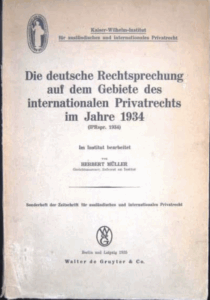
In Germany, a continuous and close-to-comprehensive compilation has been available since 1928 and thus for nearly 100 years. ‘Die deutsche Rechtsprechung auf dem Gebiete des Internationalen Privatrechts’, or short ‘IPRspr’, is published by the Max Planck Institute in Hamburg and offers a complete and systematic documentation of German case law on private international law, including procedural law and foreign law.
Comprehensiveness is a goal that is hard to achieve, but the IPRspr goes a long way. Apart from other available databases, more than 100 journals (from private law and beyond) are regularly surveyed. Via the legal opinions it prepares for German courts, the Institute also becomes aware of at least some of the (unfortunately, quite numerous) decisions that otherwise remain unpublished.
One particular value of the collection, appreciated within the discipline, is that the decisions are not merely collected and republished, but carefully edited. This entails, among other things, that the decisions are distilled down to their private international law aspects and categorized according to subject matter. References to domestic and foreign sources are checked (and mistakes are rectified). Depending on the case, the (unofficial) headnotes are reformulated or completely rewritten. Both practitioners and scholars have long relied on the collection; the entirety of its volumes enable access to the whole body of German case law on private international law.
The publication of the IPRspr in book form, one for each year of decisions, was long the only viable option, but came with two shortcomings. First, some court decisions became known only with considerable delay. Second, the increasing number of private international law decisions made it necessary to leave some decisions out to keep the size of each volume manageable.
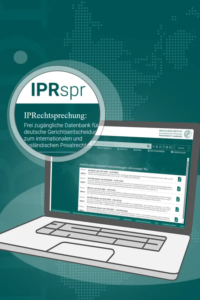
This changed in October 2024 when the ‘IPRspr’ was launched as a freely accessible database (www.iprspr.de). This is IPRspr 2.0 – a continuation of the old IPRspr and at the same time an entirely new, much more useful and convenient tool for legal research.
Since the shift to online access, the collection has increased by another 500 entries and surpassed the total number of 7,000 decisions, some of which were otherwise unpublished. Whereas the printed version, which has in the meantime been discontinued, typically lagged more than two years behind the reported period, the online database is close to achieving its goal of being entirely up to date. Currently, the decisions date back to 2004. Even earlier volumes, which date back to the cases of 1926, might be integrated in the future.
The access to new decisions is supported by an RSS-feed which can be limited to specific subject matters. Apart from the decisions as such, ‘IPRspr 2.0’ offers a wide range of search and retrieval functions. In addition to full-text searches, decisions can be filtered by, among other criteria, date(s), subject matter(s), jurisdiction(s), and statutory provision(s). Much more than in the old days of the print volumes, this allows for targeted research on specific and topical matters, be it for practical or for scholarly purposes. Hyperlinks make it possible to quickly access other cited decisions. Permalinks can be used for citations. More detailed instructions are found in the FAQ section of www.iprspr.de.
At the same time, the IPRspr has conserved – and expanded – its potential for identifying practically relevant issues and general trends. The latter point can be illustrated with a few examples:
- The total number of reported decisions per year has been relatively stable for the last 15 years, ranging between 300 and 400. Compared to 1970, the number has more than doubled.
- Decisions applying the Hague Convention on the Civil Aspects of International Child Abduction sharply increased beginning in 2016 and have declined again since 2022. The majority of cases concerned children abducted from Poland, the USA, and France. Since 2022, however, there have been more cases relating to Ukraine.
- Decisions concerning child adoption show a surprisingly unstable pattern. After a considerable increase in 2009, the number of cases later dropped, falling even to single digits between 2020 and 2023. 2024 once again saw a sharp increase to 32. Whether these shifts are mere coincidence or to be explained by specific factors might be worthy of further investigation.
- Decisions concerning the jurisdiction over consumer contracts (Article 17 Brussel Ibis Regulation) have sharply climbed since 2020, reaching almost 100 in 2023. As for the countries involved, Ireland and Malta are the clear front-runners, with the primary subject matter being data scraping in the first case and online-gambling in the second.
Shortly before reaching its 100th anniversary, the IPRspr has thus achieved the transition to the digital age, preserving many of its traditional features and adding important new ones. The IPRspr has become an even more useful tool for practitioners and scholars alike, and it hopefully inspires the creation of other free national databases, or even one for European PIL as a whole. Plans to add CJEU decisions to IPRspr are underway.
The IPRspr is compiled and edited by a team within the Institute’s Centre for the Application of Foreign Law, led by Jan Peter Schmidt. Its continued success depends, however, on its acceptance by the PIL community, both in Germany and abroad. We suggest that citations of decisions include the IPRspr number, at least in parallel to other possible case references (the format is Year-Number, e.g. “IPRspr 2025-110”). We kindly ask judges, academics and practitioners to submit or communicate new decisions, or case notes to these decisions, to iprspr@mpipriv.de. Any other kind of feedback, including suggestions for future improvements, is equally welcomed and can be sent to the same email address.
Decisions in the database – as edited by the IPRspr team – are published under a creative commons licence CC-BY 4.0. This means they can be republished, and even translated, freely. All that is required is naming IPRspr as a source.
This is a wonderful resource I wish I had available to me during my PhD research. I was also unaware of the RSS options until now. Thanks for pointing that out. And keep up this amazing work!
Informative and well shared, thank you!
Thank you for sharing this post; it’s truly helpful and informative. I appreciate the effort and valuable information you’ve provided.