
Rivista di diritto internazionale privato e processuale (RDIPP) No 2/2024: Abstracts


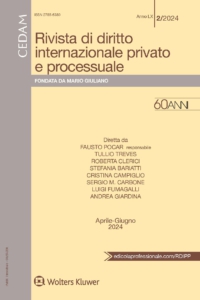 The second issue of 2024 of the Rivista di diritto internazionale privato e processuale (RDIPP, published by CEDAM) was just released. It features:
Sara Tonolo, Professor at the University of Padova, Il contributo degli studiosi italiani ai corsi de l’Aja di diritto internazionale privato (1973-2023) [The Contribution of Italian Scholars to The Hague Academy Courses on Private International Law (1973-2023); in Italian]
The Private International Law Courses taught by Italian scholars within the Hague Academy have undergone an interesting evolution that deserves consideration on the occasion of the Academy’s Centennial Anniversary, especially regarding the period between 1973 and 2023. Alongside features commons to the courses of the initial period, such as the approach to the study of private international law, outlined by Pasquale Stanislao Mancini, and the comparative method, there are however distinctive and noteworthy features in the courses offered between 1973 and 2023. Among the topics analysed in the Italian Courses during the considered period, the recognition of the substantive effectiveness of judgments through private international law rules is particularly noteworthy both for its influence on the national codification of private international law, and for its relevance in addressing coordination issues arising from the communitarization of private international law. This topic is particularly relevant concerning the interrelation of private international law with other areas of international law, such as international protection of human rights. Given the circular relationship between international protection of human rights and private international law, coordination needs to be established within a debate that is becoming increasingly complex among private international law scholars, thanks also to the role of Italian scholars within the Hague Academy.
Giacomo Biagioni, Associate Professor at the University of Cagliari, Dichiarazione ONU sui diritti dei contadini e diritto internazionale privato dell’Unione europea [The UN Declaration on the Rights of Peasants and EU Private International Law; in Italian]
On 17 December 2018 the United Nations General Assembly adopted by a majority the UN Declaration on the Rights of Peasants and Other People Working in Rural Areas, stressing the importance of agricultural production and recognizing individual and collective rights granted to people living and working in rural areas. The paper aims at assessing the possible impact of the principles enshrined in the Declaration on the system of private international law sources, moving from the general assumption that UN declaration of principles may contribute to the interpretation of domestic law. As peasants and other workers in rural areas can qualify, under the 2018 Declaration, as weaker parties, the paper attempts to clarify to what extent solutions enacted in EU private international law for other categories of weaker parties (such as employees or consumers) with regard to conflict-of-laws and to jurisdictional competence in contractual matters may be extendable to peasants. However, the general approach of EU instruments concerning judicial cooperation in civil matters does not seem to be especially open to receiving the instances of protection of the rights of categories of weaker parties, which are not expressly mentioned in those instruments. Accordingly, as the law now stands, only recourse to general clauses (fraude à la loi, public policy, overriding mandatory rules) may lead to give some consideration to the special position of peasants and other workers in rural areas and to adapt private international law rules to the protection of their fundamental rights.
This issue also comprises the following comments:
Anna Liebman, Research Fellow at the University of Milan, Il rinvio ai criteri della convenzione di Bruxelles del 1968 nel diritto internazionale privato italiano: orientamenti consolidati e questioni aperte [The Reference to the Jurisdiction Criteria of the 1968 Brussels Convention in Italian Private International Law: Established Orientations and Open Questions; in Italian]
The article examines a few issues arising in connection with the reference made by Art 3(2) of Law 31 May 1995 No 218 to the criteria laid down in the 1968 Brussels Convention. In the article, it is first observed how, in recent times and especially in the light of two recent judgments of the Italian Supreme Court, the traditional orientation has completely changed, and that scholars and jurisprudence agree in considering the reference made by this provision as a reference to the most recent EU regulations and not to the 1968 Convention. Second, the article emphasises need for a uniform interpretation of the criteria nationalised by Art 3(2), as this is considered the only solution that allows not to undermine the coherence of the system. Lastly, the article takes into consideration the possibility for Italian judges to submit a reference for a preliminary ruling to the Court of Justice of the European Union concerning the interpretation of the European discipline made applicable through Art 3 of Law No 218/1995, a possibility that seems to find consideration in the European case law.
Enrico Pedrotti, Juris Doctor, Problemi di giurisdizione in tema di azione contrattuale di garanzia proposta in via autonoma [Questions of Jurisdiction in Contractual Warranty Actions Brought in Autonomous Proceedings; in Italian]
Relying on the Italian Court of Cassation’s judgment No 613 of 8 January 2024, according to which Italian courts do not have jurisdiction pursuant to Art 8(2) of Regulation (EU) No 1215/2012 when an action on guarantee is brought in autonomous proceedings, this article discusses the link between such provision and national procedural rules on guarantees, highlighting how the exercise of judicial discretion in the authorization of a third-party claim in accordance with Art 269 of the Italian Code of Civil Procedure bears significant consequences on jurisdiction. Furthermore, the Author discusses the applicability of Art 7(1)(b) of Regulation No 1215/2012 on the basis of Art 3 of Law 31 May 1995 No 218 reforming the Italian system of private international law, in case the place of performance is located outside the EU, concluding in the negative.
Finally, the issue features the following book review by Francesca C. Villata, Professor at the University of Milan: Mihail DANOV, Private International Law and Competition Litigation in a Global Context, Hart Publishing, Oxford, 2023, pp. XI-375.