
Review of Kazuaki Nishioka, Treatment of Foreign Law in Asia, Oxford: Hart Publishing, 2023, 327 pp, hb £117


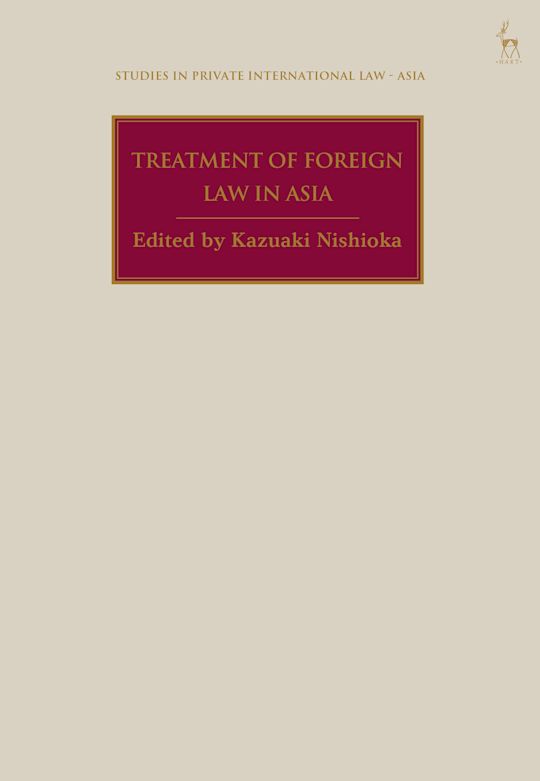
It is a great pleasure to review the book titled Treatment of Foreign Law in Asia, edited by Kazuaki Nishioka. This volume contains 17 chapters, including an introduction and conclusion, spanning 298 pages (excluding the series editor’s preface, table of contents, bibliography and index). The book examines 15 Asian jurisdictions, representing a variety of legal systems, including civil law (China, Taiwan, Japan, South Korea, Vietnam, Cambodia, Indonesia, and Thailand), common law (Hong Kong, Singapore, Malaysia, Myanmar, and India), and mixed jurisdictions (Philippines and Sri Lanka).
Currently, no international instrument comprehensively addresses the treatment of foreign law in cross-border matters. The central theme of this book is how 15 Asian states balance the demands of cost-effectiveness, time efficiency, and fairness in the ascertainment of foreign law, how their approaches can be improved, and how regional, quasi-regional, or international databases and institutions can facilitate the ascertainment of Asian and other foreign laws. The chapters explore four key themes: (A) the status of choice of law rules, (B) the handling of foreign law before judicial authorities, (C) the treatment of foreign law by administrative or non-judicial authorities and alternative dispute resolution service providers, and (D) access to local and foreign law. However, this review primarily focuses on the theme of proving foreign law before judicial authorities in Asia, as this is fundamental to private international law.
I have never been disappointed by reading Asian books on private international law. I have previously reviewed five other Asian books on this topic—three devoted to the recognition and enforcement of foreign judgments, one on direct/adjudicatory jurisdiction, and one on choice of law in international commercial contracts in Indonesia. This current review marks the fourth time I am reviewing an Asian book on private international law, and the sixth Asian book on the subject I have reviewed overall.
I once regarded the European Union as the superpower of private international law, wielding more influence than the U.S. or any other global power, largely due to its dominant role in shaping the Hague instruments and other global conflict of laws matters. However, it is now fair to say that Asia is emerging as a significant player in private international law, though it is not yet as united or formidable as the European Union. After reading this stimulating book, I feel inspired to write something related to the African continent (See also Richard F. Oppong, ‘Foreign Law in Commonwealth African Courts’ in Yuko Nishitani (ed), Treatment of Foreign Law: Dynamics towards Convergence? (Springer, 2017) 601–611.)
Professor Richard Fentiman rightly observes that the application of foreign law is the crux of conflict of laws. This is particularly true in Asia, where the diversity of legal systems regularly triggers conflict of laws scenarios. Fentiman also rightly notes that foreign law is only likely to be pleaded in England under three conditions: when English law offers no equivalent claim or defence; when foreign law is significantly more advantageous; and when pleading foreign law is mandatory, such as in cases involving foreign immovable property where the lex situs applies. While this statement is made in the context of English law, it is generally applicable to the proof of foreign law in Asia.
In civil law jurisdictions in Asia, foreign law is treated as “law,” similar to domestic law (with the exception of Thailand, where foreign law is treated as a question of fact). Courts in civil law countries, except Thailand, operate under the presumption that they are familiar with all laws, including foreign law (iura novit curia). Judges are obliged to apply relevant foreign law, regardless of whether it has been raised by the parties. In contrast, common law judges treat foreign law as a matter of fact, to be proven by the parties through expert testimony. If neither party pleads foreign law, judges are not obligated to raise it. If no evidence of foreign law is presented, the judge may assume that the foreign law is identical to the domestic law.
The common law approach in Asia can be costly and time-consuming due to the need for expert evidence, which not all parties can afford, particularly in cross-border family matters. This method may result in judgments that are a capricious mix of foreign and domestic law, failing to accurately reflect either. However, where parties can afford experts, proving foreign law in this manner can be more efficient, as the parties have a vested interest in the proceedings.
There is a gradual shift in common law towards allowing judges to take a more active role in ascertaining foreign law, provided it is pleaded. In a recent United Kingdom Supreme Court case in FS Cairo (Nile Plaza) LLC v Lady Brownlie, Lord Leggatt (with whom the other members of the Court all agreed) at paragraph 148 held that:
“[T]he old notion that foreign legal materials can only ever be brought before the court as part of the evidence of an expert witness is outdated. Whether the court will require evidence from an expert witness should depend on the nature of the issue and of the relevant foreign law. In an age when so much information is readily available through the internet, there may be no need to consult a foreign lawyer in order to find the text of a relevant foreign law.”
In a more recent case from the Cayman Islands (Gol Linhas Aereas SA v MatlinPatterson Global Opportunities Partners (Cayman) II LP), the United Kingdom Privy Council at paragraphs 46 – 47 approved the Cayman Court of Appeal’s approach of directly considering the text of foreign legislation and case law to ascertain the content of the applicable foreign law. Additionally, in a recent decision, the English Court of Appeal suggested that Brownlie (supra) did not limit the sources of evidence a court may rely on when determining the content of foreign law ( Soriano v Forensic News LLC [2021] EWCA Civ 1952 [64]).
The challenge in civil law countries in Asia is that the idealistic approach of automatically applying foreign law can be difficult in practice, especially when judges lack access to foreign legal resources or are unfamiliar with the relevant language or legal culture. Consequently, countries like Cambodia, Vietnam, and China have adopted a hybrid approach, treating foreign law as both law and fact, with judges and legal representatives cooperating to ascertain it. Courts in other civil law Asian countries may sometimes seek the assistance of counsel to interpret foreign law, especially when judges face difficulties in determining its application.
Where foreign law cannot be ascertained, both common law and civil law countries in Asia often apply the lex fori (the law of the forum). However, various civil law scholars in the book propose alternative approaches, including dismissing the case, applying general principles of law, drawing on a legal system similar to the foreign law in question, or utilising principles of the closest connection. Resorting to lex fori is ultimately more cost-effective, efficient, and pragmatic, making it a sensible fallback.
In conclusion, the common law approach may be more suitable for purely commercial disputes, where parties can afford foreign experts. Meanwhile, the civil law approach is better suited to non-commercial matters such as consumer or family cases, where the parties may not have the resources to hire experts. Judges in common law systems should not be barred from investigating foreign law if it is accessible and familiar to them. This is a concept that could be further developed in future academic work, judicial reforms, or international legislative instruments.
Nishioka’s edited book sparks renewed debate on the need for international, regional, and domestic instruments and judicial reforms concerning the treatment of foreign law in cross-border matters. It is a thought-provoking and highly recommended read.