
Conflict of Laws
  • About
  • Editorial board
  • Subscription
  • Submission
  • Materials
  • Contact
  • Click to open the search input field Click to open the search input field Search
  • Menu Menu

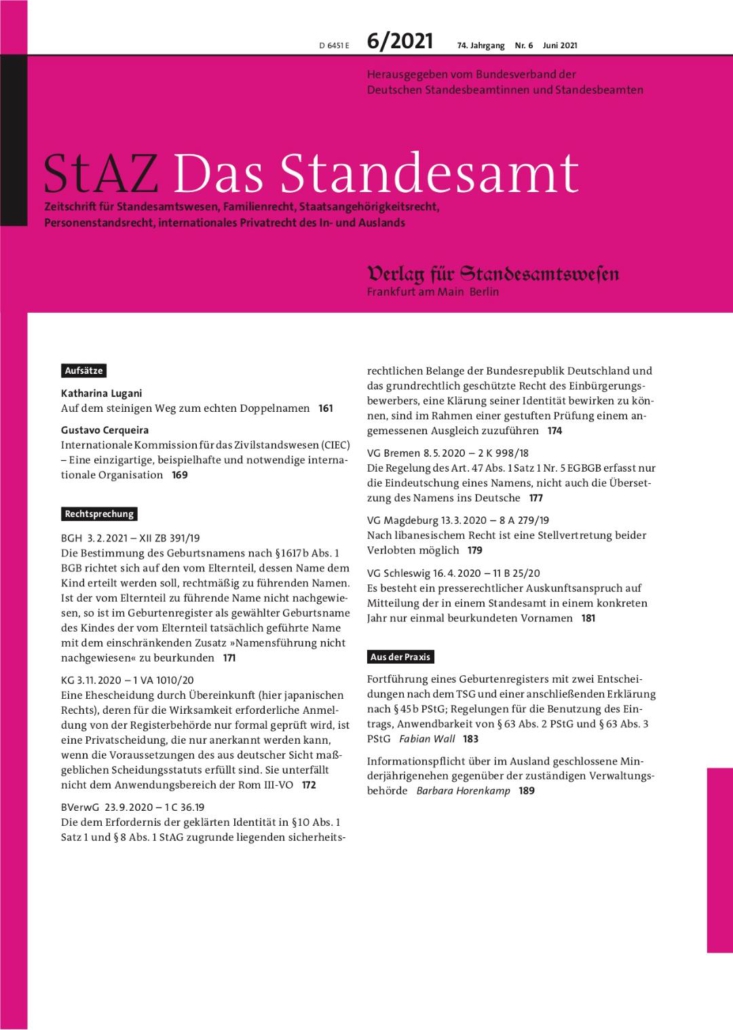
Just published: Cerqueira’s article on “International Commission on Civil Status. A unique, exemplary and necessary International Organization” translated into German

June 28, 2021/in News/by Mayela Celis
image_pdfimage_print

The summary below has been kindly provided by the author:

The International Commission on Civil Status has been working for seventy years for international cooperation in the field of civil status. In this period, 34 Conventions and 11 Recommendations were adopted. Notably, the Commission developed innovative methods, for example, multilingual Forms and Coding of entries in order to overcome translation problems related to civil status documents. Its results are remarkable to a point that some of its instruments serve as a model specially for the European Union.

Despite all the work already accomplished and the many projects still existing, the International Commission on Civil Status is now in risk of vanishing, mainly because of France and Germany’s recent withdrawal.

Still, its know-how is vital in the face of the new challenges posed by changes in the civil status of persons: same-sex marriage, medically assisted reproduction, surrogate motherhood, etc. In this context and for the common interest of present and future generations, rather than abandoning the Commission and the question of civil status in the international arena, it is more than ever time to get involved, by joining it and actively participating in its work.

In that perspective, the article constitutes a plea intended to convince the German authorities of course, but also those of other States, former members of the International Commission on Civil Status or not, to invest in it in order to save an institution which works in an essential field for private relations of an international character.

Such an investment would be all the more appropriate given that the International Commission on Civil Status has fundamentally changed its statutes and its mode of operation in recent years. For example, English is now the second official language of the Commission beside French.

These efforts must henceforth be accompanied. If this were not the case, the risk of losing all the patiently drawn up normative acquis which goes well beyond civil status in the strict sense but also affects family and nationality law exists.

The article is part of an awareness campaign carried out by eminent Authors for several months now.


Source: G. Cerqueira, « Internationale Kommission für das Zivilstandswesen. Eine einzigartige, beispielhafte und notwendige internationale Organisation», StAZ Das Standesamt, n. 6, Juni, 2021, p. 169-170.


Share this entry
  • Share on Facebook
  • Share on X
  • Share on WhatsApp
  • Share on Pinterest
  • Share on LinkedIn
  • Share on Tumblr
  • Share on Vk
  • Share on Reddit
  • Share by Mail
https://conflictoflaws.net/News/2020/08/CoL_Banner-1.png 0 0 Mayela Celis https://conflictoflaws.net/News/2020/08/CoL_Banner-1.png Mayela Celis2021-06-28 07:29:002021-06-28 07:29:00Just published: Cerqueira’s article on “International Commission on Civil Status. A unique, exemplary and necessary International Organization” translated into German
Categories

  • Views
  • News

Most Recent Posts

  • Support in cross-border transactions by Adults: Contract law vs capacity law August 12, 2026
  • Recognition of Italian Extrajudicial Divorces in Tunisia — Between Methodological Uncertainty and the Need to Preserve Continuity of Personal Status Across Borders August 9, 2026
  • Private International Law and European Society August 4, 2026
  • The New Zealand Supreme Court’s judgment in Kea Investments Ltd v Wikeley on anti-enforcement relief August 3, 2026
  • Beyond Domicile: The BHP Litigation and the Functional Interconnection of Public and Private International Law August 3, 2026
  • Conflicts of jurisdiction in Senegal: lesson from the Senegalese Supreme Court on Lis Pendens and the Exequatur of foreign judgments July 27, 2026
  • Adoption in the proposal for a European Parenthood Regulation July 21, 2026
  • Copyright, Targeting and Geo-Blocking: The CJEU Stirs the Pot July 15, 2026
  • A Follow-Up: The German Judges Association’s Response to the HCCH Draft Text of a Future Convention on Parallel Proceedings and Related Actions July 15, 2026
  • Private International Law Dimensions of Singapore’s New Legislation to Combat Online Harms July 14, 2026
  • The 1961 HCCH Apostille Convention: Why All African Countries Should Ratify It? — Insights from Judicial Practice in Africa July 14, 2026
  • The enforcement of an advance on costs for substitute performance at the expense of a Russian debtor in German-French legal relations July 2, 2026
  • “Yes, in principle, but not quite there yet…” – Some Observations on the Public Consultation on the HCCH Draft Text of a Future Convention on Parallel Proceedings and Related Actions June 29, 2026
  • Judgment Mobility Rules in India’s Private International Law Regime: No place for a revision au fond? June 26, 2026
  • Nothing to See Here: The CJEU’s Decision in Case C-232/25 Idzinski June 18, 2026
Link to: Conversations on transnational surrogacy and the ECtHR case Valdís Fjölnisdóttir and Others v. Iceland (2021) Link to: Conversations on transnational surrogacy and the ECtHR case Valdís Fjölnisdóttir and Others v. Iceland (2021) Conversations on transnational surrogacy and the ECtHR case Valdís Fjölnisdóttir... Link to: Series: Webinar climate change litigation – 1 July Link to: Series: Webinar climate change litigation – 1 July Series: Webinar climate change litigation – 1 July
Scroll to top Scroll to top Scroll to top