
Conflict of Laws
  • About
  • Editorial board
  • Subscription
  • Submission
  • Materials
  • Contact
  • Click to open the search input field Click to open the search input field Search
  • Menu Menu

Kotuby & Sobota on “General Principles of Law and International Due Process”

January 8, 2017/in /by Charles Kotuby
image_pdfimage_print

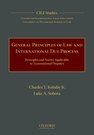
Kotuby & SobotaThis is a shameless plug for my new book. It is available for pre-order on the Oxford University Press website and on Amazon.com. I was fortunate enough to co-author this work with my friend and colleague Luke Sobota from Three Crowns.

This book is intended to be a modern update of Bin Cheng’s seminal book on general principles from 1953–identifying, summarizing and analyzing the core general principles of law and norms of international due process, with a particular focus on developments since Cheng’s writing. The aim is to collect and distill these principles and norms in a single volume as a practical resource for international law jurists, advocates, and scholars. The book includes a Foreward by Judge Stephen M. Schwebel.

We’ve been fortunate to receive some wonderful praise thus far. Judge Schwebel has called it “a signal contribution to the progressive development of international law, . . . [done] with scholarship, insight, and panache.” Pierre Marie Dupuy has deemed it a “most useful study on the place and role of general principles of law in contemporary international arbitration,” while Judge James Crawford expects it to become a “work that will benefit both scholars and practitioners.”

Share this entry
  • Share on Facebook
  • Share on X
  • Share on WhatsApp
  • Share on Pinterest
  • Share on LinkedIn
  • Share on Tumblr
  • Share on Vk
  • Share on Reddit
  • Share by Mail
https://conflictoflaws.net/News/2020/08/CoL_Banner-1.png 0 0 Charles Kotuby https://conflictoflaws.net/News/2020/08/CoL_Banner-1.png Charles Kotuby2017-01-08 19:55:302017-01-08 19:55:30Kotuby & Sobota on “General Principles of Law and International Due Process”
Categories

  • Views
  • News

Most Recent Posts

  • Recognition of a Kosovar Judgment in Greece (copy) October 27, 2026
  • The Philippines: Recognition of Foreign Divorces and Recent Amendments to the Rules of Court October 21, 2026
  • Mozambican Supreme Court Recognises an Indian Adoption: A Teleological Approach to the Recognition of Foreign Acts October 19, 2026
  • Egyptian Supreme Court Enforces Italian Judgment: The Right Outcome despite Some Reservations October 14, 2026
  • Talaq Divorce Cases in the United States October 7, 2026
  • Book Review: Choice of Forum Clauses in Asia (Lemuel L Lopez) October 5, 2026
  • Zamzam on Egyptian Private International Law (in Arabic): Towards Reviving the Golden Age of Egyptian Private International Law October 2, 2026
  • Maintenance Duties for a Gestational Surrogate Following Non-Recognition – An Unreported Spanish Judgment September 22, 2026
  • From Symbolism to Substance: Comity and Judicial Reform in South Africa’s Foreign Judgments Regime September 15, 2026
  • Persistent and Reasonable Efforts in the Field of Cross-Border Service of Documents. Continuation or Stay of Proceedings? September 12, 2026
  • Speaking for the Dead: Idziski and the Forum for Post-Mortem Likeness Claims September 7, 2026
  • Book Review: Andrew Dickinson and Alexander Thompson, The State Immunity Act 1978 (OUP, 2025) September 7, 2026
  • Political Immobilisation of Iranian Diaspora Property: Lex Situs, Human Rights and Public Policy August 22, 2026
  • The Demise of the Lex Domicilii Matrimonii in South African Private International Law August 18, 2026
  • Support in cross-border transactions by Adults: Contract law vs capacity law August 12, 2026
Link to: The EUPILLAR Database is live Link to: The EUPILLAR Database is live The EUPILLAR Database is live Link to: ERA conference “Freezing Bank Accounts Across Europe (and Beyond)”: compte-rendu Link to: ERA conference “Freezing Bank Accounts Across Europe (and Beyond)”: compte-rendu ERA conference “Freezing Bank Accounts Across Europe (and Beyond)”:...
Scroll to top Scroll to top Scroll to top