
Fallon – Lagarde – Poillot Peruzzetto (Eds.), Quelle architecture pour un code européen de droit international privé?


 On 17 and 18 March 2011 the University of Toulouse (IRDEIC) hosted a colloquium on the codification of European PIL (“Quelle architecture pour un code européen de droit international privé?“), follow-up to the conference organised in 2008 on “La matière civile et commerciale, socle d’un code européen de droit international privé?” (see the related volume). On the 2011 colloquium, see the report by Jurgen Basedow published in RabelsZ, 2011/3, p. 671 ff., and the one by Pedro de Miguel Asensio on his blog.
In his closing remarks, Paul Lagarde offered as a starting point for discussion a preliminary draft of 24 articles dealing with the general provisions of a future European PIL code (“Embryon de Règlement portant Code europeén de droit international privé”): the draft is published in RabelsZ, 2011/3, p. 673 ff.
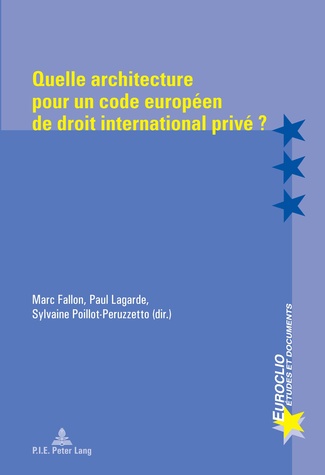
The papers presented at the 2011 colloquium have now been published by Peter Lang, under the editorship of Marc Fallon, Paul Lagarde and Sylvaine Poillot Peruzzetto: “Quelle architecture pour un code européen de droit international privé?“.
Here’s the table of contents (.pdf):
- Avant-propos;
- Marc Fallon : Rapport introductif;
Première Partie. La forme et l’instrument de la codification.
- Aude Mac Eleavy Fiorini : Qu’y a-t-il en un nom ? Un vrai code pour le droit international privé européen;
Deuxième Partie. Les fondements de la codification.
- Sylvaine Poillot-Peruzzetto : La priorité de l’Espace de Liberté, de Sécurité et de Justice et l’élaboration d’un code européen de droit international privé;
- Johan Meeusen : La priorité de l’Espace de Liberté, de Sécurité et de Justice et l’élaboration d’un code européen de droit international privé. Réponse à la contribution du professeur Sylvaine Poillot-Peruzzetto;
- Miguel Gardeñes Santiago : Les exigences du marché intérieur dans la construction d’un code européen de droit international privé, en particulier la place de la confiance et de la reconnaissance mutuelle;
- Catherine Kessedjian : Un code européen au regard des objectifs du droit international privé;
Troisième Partie. Le domaine de la codification.
- Laurence Idot : Introduction;
- Marc Fallon : Le domaine spatial d’un code européen de droit international privé. Émergence et modalités de règles de caractère universel;
- Pedro A. de Miguel Asensio/Jean-Sylvestre Bergé: The Place of International Agreements and European Law in a European Code of Private International Law;
- Horatia Muir Watt : La nécessité de la division tripartite. Conflit de lois, de juridiction, règles de reconnaissance et d’exécution ?;
- Isabelle Rueda : La place de la matière administrative et des immunités au sein d’un code européen de droit international privé;
- Blanca Vilà/Michel Attal : La place de la procédure et de la coopération entre juges et acteurs nationaux. Le périmètre de la codification;
Quatrième Partie. La structure et la teneur d’une codification.
- Michael Bogdan: Some Nordic Reflections on the Desirability of an EU Code of Private International Law;
- Sabine Corneloup/Cyril Nourissat : Quelle structure pour un code européen de droit international privé ?;
- Marie-Laure Niboyet : Les règles de procédure : l’acquis et les propositions. Les interactions entre les règles nationales de procédure et les « règles judiciaires européennes »;
- Michael Wilderspin : Règles de compétence et de reconnaissance et d’exécution. L’acquis et les propositions;
- Anne Marmisse-d’Abbadie d’Arrast/Marc-Philippe Weller : Définitions autonomes et rattachements. Propos introductifs;
- Anne Marmisse-d’Abbadie d’Arrast : Qualification et concepts autonomes dans l’élaboration d’un code européen de droit international privé;
- Marc-Philippe Weller : Les rattachements dans les conflits des lois;
Cinquième Partie. Les éléments d’une partie générale.
- Stefania Bariatti/Étienne Pataut : Codification et théorie générale du droit international privé;
En guise de synthèse
- Paul Lagarde : En guise de synthèse;
Annexe
- Eugénie Fabriès-Lecea : Quelle codification pour le droit international privé européen des procédures d’insolvabilité ?
– – – –
Title: Quelle architecture pour un code européen de droit international privé?, edited by M. Fallon, P. Lagarde and S. Poillot Peruzzetto, Peter Lang (Series: Euroclio – Volume 62), Bruxelles – Bern – Berlin – Frankfurt am Main – New York – Oxford – Wien, 2011, 388 pages.
ISBN 978-90-5201-823-2 br. Price: EUR 38.