
Postgraduate Studentships in Private International Law of the EU at Aberdeen

image_pdfimage_print

The University of Aberdeen has one of the most significant groups of private international law (PIL) researchers in the world, an excellent dedicated Law Library and a proven track record in research supervision. The EU has embraced harmonised PIL as the means of preserving the cultural and legal diversity that makes Europe so interesting while giving sufficient unity and coherence to the EU to make it strong.

The research topics that could be selected are from across all areas of private international law that have been or could be legislated for within the EU. Successful applicants will be given a significant financial award designed to cover their fees and in some cases to help with maintenance. We hope that there will be opportunities for successful applicants to supplement their income by working as tutors and/or research assistants in the Law School.

The awards are tenable from September 2011 (but the start date is flexible) and can last for up to 3 years for a PhD (depending on good progress) and one year for a research LLM.

Further particulars can be obtained from the Law School by contacting the postgraduate secretary, Mrs Claire Thomson, law438@abdn.ac.uk

How to apply?

Please send a copy of your cv, your research proposal and two academic references (in signed and sealed envelopes) to Professor Paul Beaumont, School of Law, University of Aberdeen, Aberdeen AB24 3UB, Scotland, UK by 1 February 2011.
Rome III: Agreement in Council on the Text of the New Rules on Divorce and Legal Separation

image_pdfimage_print

The JHA Council, in its meeting held on 3 December 2010 in Brussels, agreed on the text (doc. n. 17045/10) of the Rome III regulation implementing enhanced cooperation in the area of the law applicable to divorce and legal separation (see our previous post here).

As stated in the Council’s press release (doc. n. 17151/10),

The new rules will apply to all participating member states as of mid-2012. Other EU member states which are not yet ready but wish to join this pioneer group at a later stage will be able to do so. The agreement also constitutes the implementation of the first enhanced cooperation in the history of the EU.

For its adoption two more procedural steps are necessary:  The European Parliament is expected to adopt an opinion on the file in its December plenary session.  The Council will then adopt the new rules without discussion, most likely at the Environment Council on 20 December 2010.

Upon the adoption, the regulation will be accompanied by declarations by the Council (on forum necessitatis), and by the Commission, Malta and Finland on a new controversial art. 7a (“Differences in national law”): see Annexes I, II, III and IV to doc. n. 17046/10.

The position of the European Parliament, under examination in the JURI Committee, can be found in the Draft report prepared by rapporteur Tadeusz Zwiefka (see, in particular, the Explanatory Statement) and additional amendments.

EU Consultation on Harmonisation of Securities Law

image_pdfimage_print

The European Commission has launched a month ago a Consultation on the Harmonisation of Securities Law.

The objective of the consultation is to obtain

advice from Member States, market participants and other stakeholders, in particular investors, on a certain number of principles, on which the Commission could base its future legislative proposals in order to improve the EU-wide legal framework for cross-border transfers of securities

Contributions are welcome until January 1st, 2011.

The consultation raises an interesting issue of choice of law:

14 – Determination of the applicable law

14.1 Principle

1. The national law should provide that any question with respect to any of the matters specified in paragraph 3 arising in relation to account-held securities should be governed by the national law of the country where the relevant securities account is maintained by the account provider. Where an account provider has branches located in jurisdictions different from the head offices’ jurisdiction, the account is maintained by the branch which handles the relationship with the account holder in relation to the securities
account, otherwise by the head office.

2. An account provider is responsible for communicating in writing to the account holder whether the head office or a branch and, if applicable, which branch, handles the relationship with the account holder. The communication itself does not alter the determination of the applicable law under paragraph 1. The communication should be standardised.

3. The matters referred to in paragraph 1 are:
(a) the legal nature of account-held securities;

(b) the legal nature and the requirements of an acquisition or disposition of account-held securities as well as its effects between the parties and against third parties;

(c) whether a disposition of account-held securities extends to entitlements to dividends or other distributions, or redemption, sale or other proceeds;

(d) the effectiveness of an acquisition or disposition and whether it can be invalidated, reversed or otherwise be undone;

(e) whether a person’s interest in account-held securities extinguishes or has priority over another person’s interest;

(f) the duties, if any, of an account provider to a person other than the account holder who asserts in competition with the account holder or another person an interest in account-held securities;

(f) the requirements, if any, for the realisation of an interest in account-held securities.

4. Paragraph 1 determines the applicable law regardless of the legal nature of the rights conferred upon the account holder upon crediting of account-held securities to his securities account.

14.2 Background

Read more

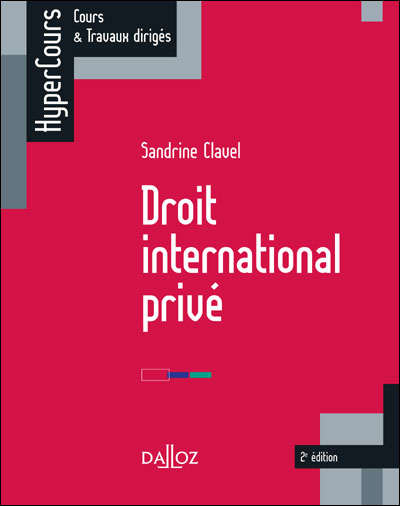
New Edition of Clavel’s Droit International Privé

image_pdfimage_print

Sandrine Clavel, who is a professor of law at the University of Versailles-Saint-Quentin and the co-director of the Master Arbitrage et Commerce International, has published the second edition of her manual.

The book offers an account of the entirety of French private international law. But it is also a teaching book, as it includes a variety of exercises, many summaries of cases and tests that students may use to verify their correct understanding of the field. 

More details can be found here.

China’s First Statute on Choice of Law – German Translation

image_pdfimage_print

Following Gilles’ post of 3 November, Christian Heinze (Hamburg) kindly brought to my attention the German translation of the Chinese Statute on Choice of Law. The translation by Knut Benjamin Pißler (Max Planck Institute for Comparative and Private International Law, Hamburg) can be found here.

EP Workshop on Civil Justice: “How to facilitate the life of European families and citizens?”

image_pdfimage_print

On 30 November 2010 the European Parliament’s Committee on Legal Affairs will host in Brussels an interparliamentary workshop on Civil Justice, organized in collaboration with the national parliaments of the Member States: How to facilitate the life of European families and citizens?. The conference is structured in 4 parts, and can be watched live in video streaming on the EP’s website:

Morning Sessions (h 9.30 – 13.00):

  • Opening
  • I. Family Law: Latest Developments and the Way Forward;
  • II. Cross-Border Successions.

Afternoon Sessions (h 15 – 18.30):

  • III. Parental Responsibility and the Protection Of Children;
  • IV. Civil Status;
  • Conclusions.

Each session will include speakers from the EP, national parliaments and the Commission, as well as the academic world and practitioners: a detailed draft programme is available here.

Here’s a presentation of the event:

Removing the legal and administrative barriers that citizens face when they start a family life in a Member State other than their own will be at the centre of the Workshop on Civil Justice which will take place in the European Parliament on 30 November.

The Workshop, which will be attended by EU and national parlamentarians, will be composed of four thematic sessions. The first two sessions will present the “state of play” in the drafting of new legal instruments in the field of European family law and the law of succession.

The third session will focus on child protection in cross-border situations. The topics of parental responsibility, including the controversial issue of the recognition of surrogacy agreements, as well as of international adoption will be addressed therein. Legal practitioners and academics will report on the current situation as it stands in several Member States.

The last session will provide an overview of the current difficulties faced by citizens in proving their civil status in cross-border situations. In this regard, a number of actions ranging from the suppression of the legalisation formalities of civil status acts to the interconnection of civil status registers will be presented. The challenging idea of creating a European “civil status” document will also be discussed.

Finally, the Workshop will  also include speeches from Melchior Wathelet, Belgian State Secretary for Family Policy, on the achievements of the Belgian Presidency in the field of family law and Viviane Reding, European Commission (EC) Vice-President, on the actions planned by the EC in this field.

An Italian View on the Living Dead Convention

image_pdfimage_print

I am grateful to Pietro Franzina, a researcher in International law at the University of Ferrara, Italy, for sharing his thoughts on the recent case of the Cassazione on the Brussels Convention. Pietro dealt with this topic in ‘Interpretazione e destino del richiamo compiuto dalla legge di riforma del diritto internazionale privato ai criteri di giurisdizione della Convenzione di Bruxelles’, Rivista di diritto internazionale, 2010, 817 et seq. 

I agree with Gilles Cuniberti: the conclusion reached by the Corte di Cassazione in its order of 21 October 2009 regarding Article 3(2) of the Italian Statute on Private International Law (see his post here) is an unfortunate one.

Before I attempt to explain why, in my view, the Court erred in saying that the reference made by that provision to the 1968 Brussels Convention should still be interpreted as a reference to the Convention, and not to the Brussels I regulation, let me put forward a few preliminary remarks.

(a) Article 3(2) of the Italian Statute on Private International Law of 31 May 1995 (hereinafter, the Statute) determines whether Italian courts have jurisdiction in civil and commercial matters in respect of proceedings falling outside the scope of application of the 1968 Brussels Convention on Jurisdiction and the Recognition of Judgments in Civil and Commercial Matters, i.e. proceedings instituted against defendants domiciled outside the territory of a contracting State (or a contracting State of the Lugano Conventions). In respect of such proceedings the Italian legislator of 1995 was virtually free to lay out any rule on jurisdiction, and still is.

(b) The drafters of the Statute decided to make use of this freedom in an almost unprecedented way. They incorporated the heads of jurisdiction set out in section 2, 3 and 4 of chapter II of the Brussels Convention within the Statute. To do so, they made an express reference to such heads of jurisdiction, as provided for by the 1968 Convention and by its subsequent modifications in force for Italy (“e successive modificazioni in vigore per l’Italia”). This way, the Italian legislator introduced national rules providing heads of jurisdiction corresponding to those employed in Articles 5-15 of the Convention.

Read more

The Living Dead Convention

image_pdfimage_print

Reports of the death of the 1968 Brussels Convention have been greatly exaggerated.

In some parts of Europe, it is still possible to enjoy the application of old Article 5.1 of the Convention and to determine the place of performance of the obligation in question for a basic sale of goods.

One such example is Italy, where the Convention has risen from the dead. This happened a year ago, in Rome.

Italian Private International Law Act, 1995

In 1995, Italy reformed its private international law and adopted a new statute reforming the Italian System of Private International Law. Article 2 of the 1995 Statute provides that international conventions prevail over domestic rules. Thus, jurisdiction of Italian courts over disputes falling within the scope of the Brussels I Regulation is governed by the said Regulation.

Article 3 of the Statute provides a remarkable rule for disputes in civil and commercial matters falling outside the territorial scope of European law, i.e. when the defendant is not domiciled within the jurisdiction of a Contracting state. Instead of laying down its own rules of jurisdiction, the Italian lawmaker decided to apply further the ‘Brussels Convention’. Article 3 provides that the heads of jurisdiction provided by the Convention remain applicable. In other words, Italy extended the territorial scope of the Convention to civil and commercial disputes where the defendant is domiciled outside of a contracting state.

Art. 3 Ambito della giurisdizione.

2. La giurisdizione sussiste inoltre in base ai criteri stabiliti dalle Sezioni 2, 3 e 4 del Titolo II della Convenzione concernente la competenza giurisdizionale e l’esecuzione delle decisioni in materia civile e commerciale e protocollo, firmati a Bruxelles il 27 settembre 1968, resi esecutivi con la L. 21 giugno 1971, n. 804, e successive modificazioni in vigore per l’Italia, anche allorché il convenuto non sia domiciliato nel territorio di uno Stato contraente, quando si tratti di una delle materie comprese nel campo di applicazione della Convenzione.

That was all fine in 1995, when the Brussels Convention was alive and kicking. But when the Convention was replaced by the Brussels I Regulation, an issue arose. Was the reference to the ‘1968 Brussels Convention and it successive modifications in force in Italia’ to be interpreted as a reference to the new Regulation? Did it matter that Danemark kept on for a while applying the Brussels Convention? and that it has now stopped?

Read more

Latest Issue of “Praxis des Internationalen Privat- und Verfahrensrechts” (6/2010)

image_pdfimage_print

Recently, the November/December  issue of the German law journal “Praxis des Internationalen Privat- und Verfahrensrechts” (IPRax) was published.

Here is the contents:

  • Anne Röthel/Evelyn Woitge: “Das Kollisionsrecht der Vorsorgevollmacht” – the English abstract reads as follows:

  Various European national laws have recently implemented powers of representation granted by an adult to be exercised when he or she is not in a position to protect his or her interests. The authors show the existence and scope of these powers of representation within Europe and identify the need for conflict norms for this legal institution. Based on an analysis of the respective rules in the Hague Convention on the international protection of adults, the authors highlight the need to find a national solution that acknowledges the special interests of incapable adults. They suggest a regulation for powers of representation in autonomous international private law that adapts the concept of the Hague Convention.

  • Stefanie Sendmeyer: “Die Rückabwicklung nichtiger Verträge im Spannungsfeld zwischen Rom II-VO und Internationalem Vertragsrecht” – the English abstract reads as follows:

In private international law, it is highly disputed whether the law applicable to claims aiming to reverse enrichment in case of a void contract is determined by Art. 10 (1) lit. e) Rome II Regulation or by Art. 10 (1) lit. e) Rome Convention or Art. 12 (1) lit. e) Rome I Regulation respectively. After a short analysis of the current state of discussion, it is shown that the argument emanates from the erroneous assumption that the question of restitution in such cases is a matter of unjust enrichment according to Art. 10 Rome II Regulation as well as a topic of private international law concerning contractual obligations. In fact, the question has to be solved by clearly differentiating between contractual and non-contractual obligations and, therefore, between the scope of the Rome II Regulation and the scope of the instruments of private international law dealing with contractual obligations. In consistence with European international procedural law, restitution in case of a void contract is considered a contractual obligation and, therefore, the applicable law is determined by Art. 10 (1) lit. e) Rome Convention or Art. 12 (1) lit. e) Rome II Regulation respectively.

  • Anatol Dutta: “Grenzüberschreitende Forderungsdurchsetzung in Europa: Konvergenzen der Beitreibungssysteme in Zivil- und Verwaltungssachen?” (on ECJ, 14.1.2010 – C-233/08 – Milan Kyrian ./. Celní úrad Tabor)   the English abstract reads as follows:

The dogma that claims of the State based on its penal, revenue or other public law are not enforceable abroad – a doctrine also known as the revenue rule – is more and more displaced by European instruments obliging the Member States to collect public law claims of their fellow Member States. One example for this development is the Tax Recovery Directive 76/308/EC (later: 2008/55/EC, now: 2010/24/EU) on the mutual assistance for the recovery of claims relating to taxes, duties and other measures – an instrument, which has been gradually extended to all taxes levied by the Member States. The present article, which discusses a recent decision of the European Court of Justice interpreting the Tax Recovery Directive, attempts to highlight some similarities between the European enforcement rules for public law claims and those for private law claims. These similarities do not only allow fertilisation across the public-private law border when applying and interpreting the different enforcement rules, but once more demonstrate that the revenue rule should be reconsidered.

  • Sebastian Mock: “Internationale Streitgenossenzuständigkeit” the English abstract reads as follows:

The international jurisdiction for claims against several defendants at the domicile of one of the defendants as today established by Art. 6 No. 1 Brussels I Regulation is unknown in several member states and consequently causes general doubts due to the existing possibilities of manipulation in this context. Although the European Court of Justice reflected these doubts by establishing the additional need of the risk of irreconcilable judgments resulting from separate proceedings in the application of Art. 6 No. 1 Brussels Convention and Art. 6 No. 1 Lugano Convention – which was later recognized by the European legislator in the drafting of Art. 6 No. 1 Brussels I Regulation – the determination of this additional requirement is still left unclear. In its recent decision the German Federal Court of Justice delivered a rather broad understanding of this requirement. The court held that the jurisdiction under Art. 6 No. 1 Lugano Convention/Art. 6 No. 1 Brussels I Regulation does not require that all defendants have to be sued at the same time. Moreover the court held that the violation of a duty of a member of the board of directors is sufficient to establish a jurisdiction under Art. 6 No. 1 Lugano Convention/Art. 6 No. 1 Brussels I Regulation for a claim against the member of the board of directors when the plaintiff already filed a claim against the company of the director. However, the author doubts that this ruling can be considered as a general principle in the application of Art. 6 No. 1 Lugano Convention/Art. 6 No. 1 Brussels I Regulation and shows that the ruling has to be seen in context with a special provision of the applicable Swiss corporate law.

  • Martin Schaper: “Internationale Zuständigkeit nach Art. 22 Nr. 2 EuGVVO und Schiedsfähigkeit von Beschlussmängelstreitigkeiten – Implikationen für den europäischen Wettbewerb der Gesellschaftsrechte” the English abstract reads as follows:

Art. 22 (2) Brussels I Regulation establishes an exclusive jurisdiction of a Member State’s court for proceedings which have as their object, among others, the nullity or the dissolution of companies and the validity of the decisions of their organs. This jurisdiction depends on where the company’s seat is located. For determining this seat the court has to apply its rules of International Private Law (lex fori). Although Germany generally adheres to the real seat theory, the OLG Frankfurt a.M. (Higher Regional Court) decided that a private limited company’s statutory seat is the relevant factor for determining the exclusive jurisdiction.

Since the freedom of establishment, as interpreted by the Court of Justice of the European Union, promoted corporate mobility there is an increasing demand for settling disputes not in the state of incorporation, but in the country where the major business operations take place. Therefore, the article examines the possibility of arbitration proceedings on the nullity and avoidance of decisions taken by shareholders’ meetings in an international context.

Finally, based on the experience with the state competition for corporate charters in the USA, the impact of a jurisdiction’s courts and the admissibility of arbitration proceedings is analysed within the context of regulatory competition in company law in Europe.

  • Veronika Gärtner: “Internationale Zuständigkeit deutscher Gerichte bei isoliertem Versorgungsausgleichsverfahren” the English abstract reads as follows:

Until recently, German law did not know an explicit rule on international jurisdiction with regard to proceedings dealing with the adjustment of pension rights between divorced spouses. The Federal Court of Justice held in several judgments that international jurisdiction with regard to the adjustment of pension rights followed – also in cases where those proceedings are initiated independently from divorce proceedings – the rules of international jurisdiction with regard to the divorce proceedings due to the strong link between both issues.

With reference to this case law, the Regional Court of Karlsruhe held in its decision of 17 August 2009 (16 UF 99/09) that German courts lacked international jurisdiction with regard to (independent) proceedings on the adjustment of domestic pension rights between two Portuguese divorced spouses habitually resident in Portugal, based on the argumentation that Art. 3 Brussels II bis Regulation had to be applied analogously with regard to the question of international jurisdiction. Due to the fact that the requirements of this provision were not met, German courts were – according to the Higher Regional Court Karlsruhe – not competent to rule on the adjustment of the (German) pension rights.

This result is undoubtedly incorrect under the present legal situation: With effect of 1 September 2009 – in the course of a general revision of the procedural rules in family law and non-contentious cases – a new rule has been introduced stating explicitly that German courts have international jurisdiction with regard to proceedings on the adjustment of pension rights inter alia in cases concerning domestic (pension) rights (§ 102 Nr. 2 FamFG).

However, the author argues that also before the entry into force of this new rule, the Regional Court of Karlsruhe should have answered the question of international jurisdiction in the affirmative: First, it is argued that the court’s reference to Art. 3 Brussels II bis Regulation was misplaced since – as Recital No. 8 of the Brussels II bis Regulation illustrates – “ancillary measures” – and therefore also proceedings on the adjustment of pension rights of divorced spouses – are not included into the scope of application of Brussels II bis.

Further, the author argues that the negation of international jurisdiction in cases concerning domestic (pension) rights leads to a denial of justice. Therefore it is argued that international jurisdiction could – and should – have been assumed on the basis of general principles of jurisdiction.

Read more

The French Revision of Prescription: A Model for Louisiana?

image_pdfimage_print

François-Xavier Licari, Professor at the University of Metz, and Benjamin West Janke, of Baker, Donelson, Bearman, Caldwell & Berkowitz, PC, have posted “The French Revision of Prescription: a Model for Louisiana?” on SSRN. The paper has also been publised at the Tulane Law Review, vol. 85, p. 1 (2010).

Here is the abstract

Though the draftsmanship of the French and Louisiana Civil Codes is generally celebrated, prescription in both Codes is notoriously defective. Located at the end of both Codes as almost an afterthought, the titles of prescription do not share the same general, relative style contained elsewhere. Part of the cause of the prescription title’s shortcoming is attributable to the content.

The provisions that ring loudest are spelled out in numbers rather than letters. Numbers are blind, arbitrary, cold, and inanimate – ace of society accelerates, prescription becomes anachronistic. It is worth questioning whether the very nature of prescription eludes the capacity for codification.

Prescription’s inherent difficulties have created turmoil for both the French and Louisiana civilian systems. Both have struggled with the arbitrariness of any one particular prescriptive period, attempting to balance objectivism against subjectivism, relativity against certainty, and generality against particularity. Though both France and Louisiana began with what might be considered excessively long general periods of prescription, the French and Louisiana legislatures either whittled down the general period or chiseled out particular actions from it. Over time, these piecemeal amendments eviscerated the core components of the doctrine, causing a desperate need for substantial revision.

In 2008, the French legislature took the necessary step and drastically reformed prescription. The general period is now shorter and unified (five years); there are new grounds for suspension (including codified contra non valentem); and a long-stop period is introduced. Louisiana has yet to make any substantial reform to prescription, and revision is long overdue.

This essay will outline the faults in Louisiana and France’s original prescriptive regimes and identify the main innovative trends in the French revision. It then will offer a critical appraisal of the French revision, endorse it as a basis for a Louisiana revision, and discuss how Louisiana jurisprudence is uniquely positioned to integrate the revision in French law. We offer the following as a true dialogue from both the French and Louisiana perspectives about the continuing influence of the French Civil Code in Louisiana, the nature of prescription and its placement in a Civil Code, and the unique opportunity for the Louisiana experience to influence the interpretation of the French revision.