
Conference: The new European Choice-of-Law Revolution – Lessons for the United States?


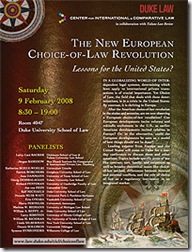 On Saturday 9th February 2008, Duke University School of Law will host an international conference entitled, “The New European Choice-of-Law Revolution: Lessons for the United States.” Here’s the blurb:
In a globalizing world of interdependent legal systems, determining which laws apply to international private transactions is crucial. Choice of Law, the field that deals with these questions, was once so vibrant in the U.S. that we spoke of a veritable choice-of-law-revolution in the sixties and seventies. At that time, Europeans watched, with a mixture of fascination and disdain, these developments at the forefront of scholarship in this field.
Now, the pendulum has swung. The field is in a crisis in the United States, unattractive to scholars, and disliked by courts. By contrast, it is thriving in Europe. The most important choice-of-law questions are being addressed wholesale in the European Union. Rules are being unified in Europe-wide codifications, especially two regulations promulgated in 2007 and 2008 dealing with contractual and non-contractual obligations, respectively.The European Court of Justice is rendering important decisions and academics are engaging in active discussions and debates.
After the American choice-of-law revolution in the sixties and seventies, are we now observing a new European choice-of-law revolution? Can European developments incite reforms and rekindle excitement in the U.S., as earlier American developments incited reforms in Europe? Alternatively, are European developments a model of how things should not be done?
This conference brings together leading scholars from both the United States and Europe to engage in debate and comparative examination of approaches taken in Europe and the United States, with an eye towards renewing interest here in the United States. Methodological issues to be discussed include, federalization of choice of law, choice of law as an instrument of market regulation and methodological approaches. Substantive issues include choice of law in family, tort, contract, and corporate law. There will be ample time for the panelists to field questions and discuss these issues with those attending.
Sponsored by Duke University Center for International & Comparative Law in collaboration with the Tulane Law Review. Students are encouraged to attend.
The programme:
Saturday, February 9, 2008
Registration and Continental Breakfast 8:30 – 9:00
Welcome and Opening Remarks 9:00 – 9:15
Dean David Levi (Duke Law School)
Ralf Michaels (Center for International and Comparative Law)
Haller Jackson (Tulane Law Review)
Part I – Specific Areas of Law
Contract and Tort Law 9:15 – 10:45
Panelists:
Patrick Borchers, Professor of Law, Vice-President for Academic Affairs,
Creighton University School of Law
Jan von Hein, Professor of Law, Universität Trier
Dennis Solomon, Professor of Law, Universität Tübingen
Symeon Symeonides, Professor of Law, Dean, Willamette College of Law
Family Law 11:00 – 12:15
Panelists:
Katharina Boele-Woelki, Professor of Law, Universiteit Utrecht
Marta Pertegás, Associate Professor International Private Law, Universiteit Antwerpen
Linda Silberman, Martin Lipton Professor of Law, New York University School of Law
Lunch Break: 12:15-13:30
Corporate Law 13:30 – 14:45
Panelists:
Larry Catá Backer, Professor of Law, Penn State Dickinson School of Law, Visiting Professor of Law, Tulane University Law School
Jens Dammann, Assistant Professor of Law, University of Texas School of Law
Onnig Dombalagian, Associate Professor of Law, Tulane University Law School
Part II -Methodology
Methods and Approaches 14:45 – 16:15
Moderator: TBA
Panelists:
Richard Fentiman, Solicitor, Reader in Private International Law, University of Cambridge Faculty of Law
Ralf Michaels, Professor of Law, Duke University School of Law
William A. Reppy Jr., Charles L. B. Lowndes Emeritus Professor of Law, Duke University School of Law
William M. Richman, Professor of Law, The University of Toledo College of Law
Internal and External Conflicts, Federalism and Market Regulation 16:30 – 18:00
Panelists:
Mathias W. Reimann, Hessel E. Yntema Professor of Law, University of Michigan Law School
Jürgen Basedow, Professor of Law, Max Planck Institute for Comparative and International Private Law
Horatia Muir Watt, Professor of Law, Université Paris I, Panthéon-Sorbonne
Erin O’Hara, Professor of Law, Vanderbilt University Law School
Larry Ribstein, Mildred Van Voorhis Jones Chair in Law, University of Illinois College of Law
Closing Discussion: 18:00 – 18:30
More information can be found on the conference website.