Views
Dubai Supreme Court Enforces Civil Compensation for Economic Loss Ordered in a Criminal Judgment Rendered by a Chinese Court

I. Introduction
The enforcement of foreign judgments can be regarded as one of the most crucial stages of international litigation. The inability to have a foreign judgment enforced not only undermines the effectiveness of judicial proceedings but may also render the entire process of cross-border litigation practically meaningless. Successful enforcement, however, depends on compliance with a number of fundamental requirements, which may vary depending on the applicable legal regime, notably on whether enforcement is sought under domestic law or pursuant to an applicable international convention.
INTERNATIONAL CHILD ABDUCTION UNDER THE 1980 HAGUE CONVENTION A recent survey of Greek law [Russia / Bulgaria / USA]
I. Introduction
International child abduction constitutes one of the most complex areas of private international family law, as it lies at the intersection of the protection of family life, international judicial cooperation, and the need for the immediate protection of the best interests of the child. In order to address this phenomenon, the Hague Convention of 25 October 1980 on the Civil Aspects of International Child Abduction was adopted. The Convention was ratified in Greece by Law 2102/1992. Its purpose is not to resolve the substantive merits of custody disputes, but rather to restore the pre-existing status quo through the prompt return of the child to the State of his or her habitual residence.
CJEU in Marwanak C-873/24 on the interpretation of the Succession Regulation in light of its objectives
In its judgment C‑873/24 Marwanak, 22 October 2026, ECLI:EU:C:2026:887, the Court of Justice of the European Union (CJEU) ruled on the interpretation of the Succession Regulation (Regulation 650/2012 on matters of succession and the creation of a European Certificate of Succession). Specifically, the CJEU addressed the question of whether the applicants for issuing a European Certificate of Succession had the right to request (and the issuing authority had an obligation to ensure) that the Certificate included an identification of the immovable property that forms part of the estate and is located in a country other than the State of the issuing authority. The CJEU answered this question in the affirmative, interpreting the Succession Regulation in light of the purpose of the European Certificate of Succession and the regulation’s broader objectives. Read more
News
Virtual workshop on Tuesday, 1 December 2026: Jacco Bomhoff on “IS THIS CONFLICT REALLY NECESSARY? Private International Law and Mid-Century Legalism”

On Tuesday, December 1, 2026, the Hamburg Max Planck Institute will host its monthly virtual workshop Current Research in Private International Law at 11:00 a.m. – 12:30 p.m. (CEST).
Jacco Bomhoff (London School of Economics and Political Science) will speak, in English, about the topic
“IS THIS CONFLICT REALLY NECESSARY? Private International Law and Mid-Century Legalism”
About the Speaker:
Jacco Bomhoff is Professor of Law at the London School of Economics and Political Science (LSE). His main interest is in the comparative and historical, cultural, study of legal thought, in relation to both private international law (conflict of laws) and constitutional law. His current monograph project is on mid-century legalism in Western Europe and North America.
About the Topic:
The early post-war decades were a period of intensive institution-building and world-making, in North America and Western Europe (the focus of this project), as well as in many newer nation states. Private international law and associated forms of international legal ordering, such as projects for transnational law or ‘world legal order’ were central to these efforts. This project aims to situate private international legal thought within its intellectual contexts during the period of the ‘long 1950s’ (roughly: the end of World War II, up to the mid 1960s). The project has two main goals. First, to better grasp the character of private international law – its disciplinary aesthetics and world-view, notably – by approaching it as a key instantiation of a distinctively ‘mid-century’ brand of legalism. Second, to develop a more refined sense of mid-century legalism itself, as an intellectual formation and cultural phenomenon, by looking in detail at scholarly work and institutional advocacy in relation to private international legal ordering specifically. Key themes in this account are (a) a remarkable degree of faith in law, and in technical devices more generally; (b) an attachment to ideas of order, notably as a necessary and precarious antidote to ‘chaos’; and (c) a commitment to various forms of calibration, comparison, and commensuration. Authors central to this project include Hessel Yntema, Henri Batiffol, Willis Reese, Roger Traynor, Wilhelm Wengler, and Petros Vallindas.
About the Virtual Workshop Series:
The virtual workshop series “Current Research in Private International Law” is organised by Ralf Michaels and Antonia Sittig. The series features leading national and international scholars who present and discuss their work on current developments and research topics in private international law. The workshops are geared to scholars who are researching in the field of private international law, but attendance is open to all individuals having an academic interest (doctoral candidates and students are expressly invited).
The presentation will be followed by open discussion. All are welcome. More information and sign-up here.
If you want to be invited to these events in the future, please write to veranstaltungen@mpipriv.de.
Seminar Announcement – Private International Law Issues Arising in the Context of Blockchain
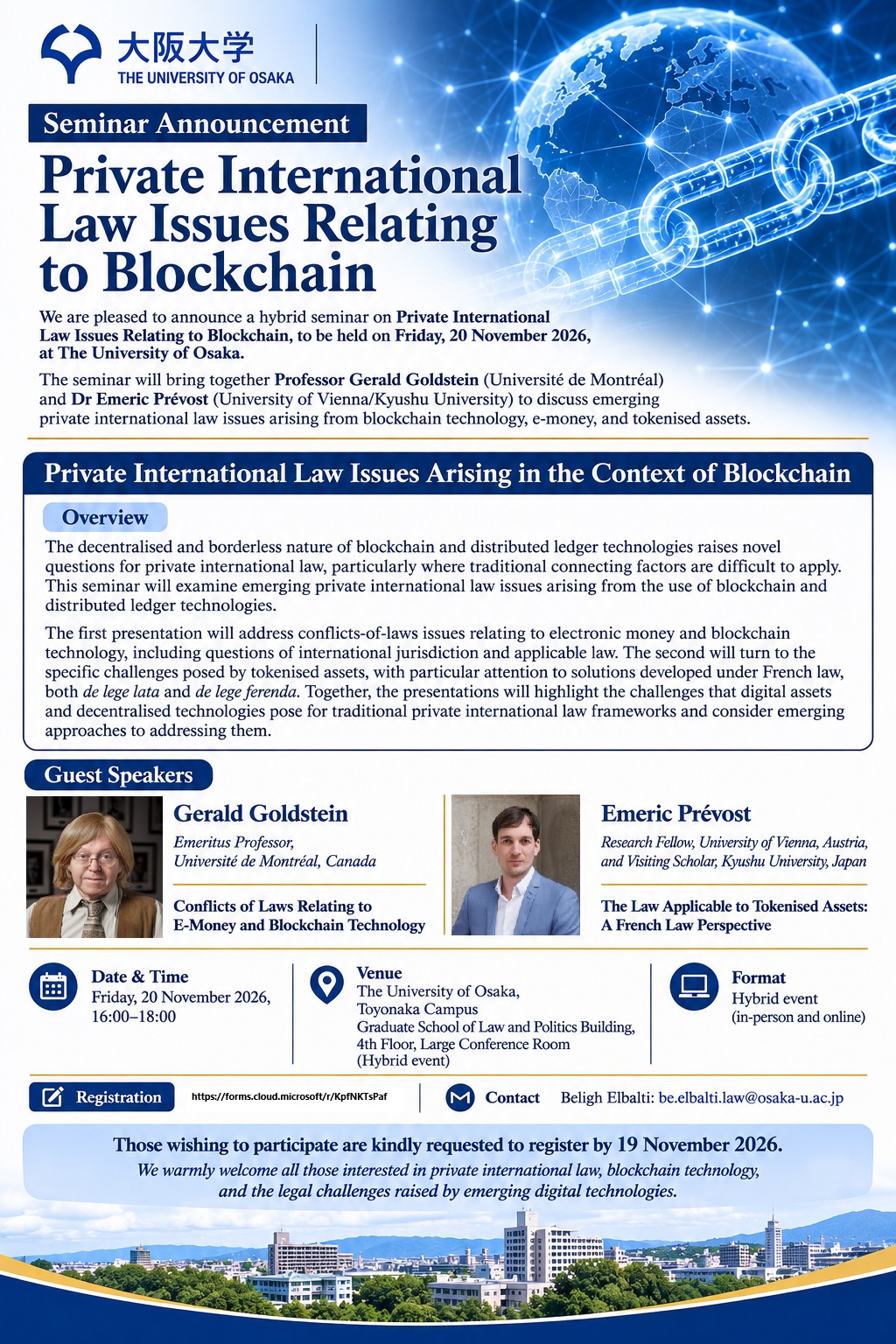
We are pleased to announce a hybrid seminar on Private International Law Issues Relating to Blockchain, to be held on Friday, 20 November 2026, at The University of Osaka.
The seminar will bring together Professor Gerald Goldstein (Université de Montréal) and Dr Emeric Prévost (University of Vienna/Kyushu University) to discuss emerging private international law issues arising from blockchain technology, e-money, and tokenised assets.
Details are as follows:
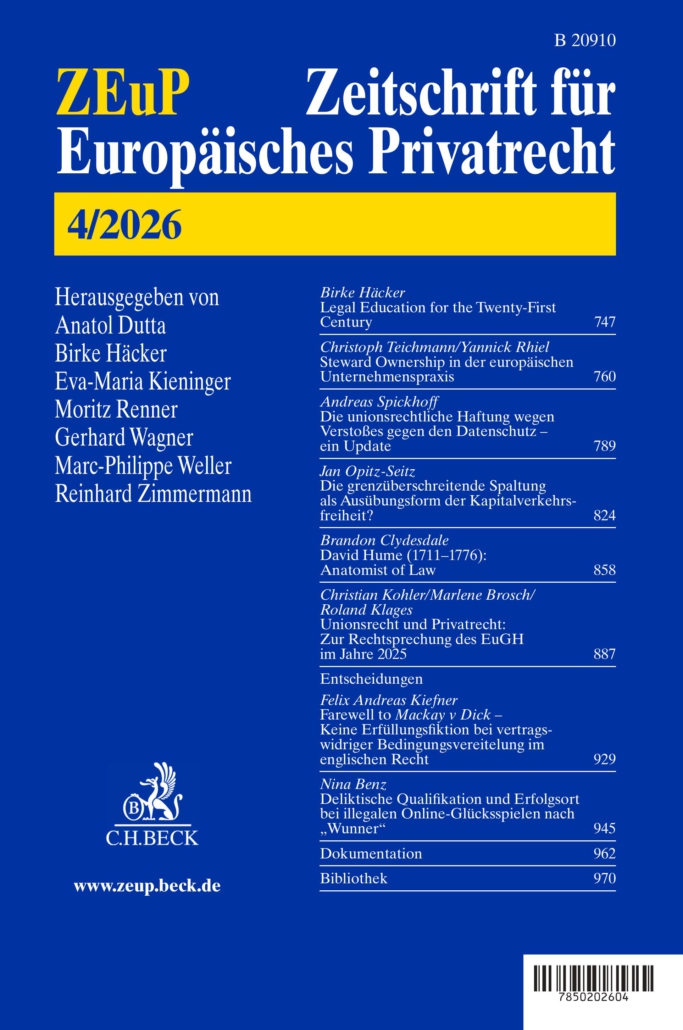
ZEuP – Zeitschrift für Europäisches Privatrecht 4/2026
Issue 4 of 2026 of ZEuP – Zeitschrift für Europäisches Privatrecht is now available and includes contributions on EU private law, comparative law and legal history, legal unification, private international law, and individual European private law regimes. The full table of contents can be accessed here: https://rsw.beck.de/zeitschriften/zeup.