
Book Launch: Rethinking Choice of Law in Cross-Border Sales


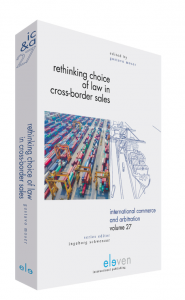 Gustavo Moser has authored a new book on choice of law in cross-border sales. He has kindly provided the following summary:
The choice of a governing contract law is a paramount contractual decision. This is because the governing contract law will dictate a contract’s life from beginning to end, thereby attaching legal and economic consequences to each step taken in the course of a contractual relationship. Yet, this choice is seldom subject to an ex anteevaluation by the parties being rather often defer to an ex postverification. Would this be a contracting parties’ behaviour verified in cross-border contracts? If so, what would be the underlying cause(s) of this pattern of conduct?
Despite its acknowledged theoretical importance, it is often suggested that negotiators might dedicate less attention than they should to the particulars of the choice of law clause. Instead, negotiators tend to opt for law that may be convenient for business, or be the result of previous experiences, including, for example, following in a partner’s footsteps, or a successful deal in the past, without further deliberation. Parties may thus simply attribute a “tag” to this experience and evaluate it according to the outcomes achieved in these previous experiences. However, these evaluations may not always be accurate and can be clouded by emotion. Are there rational and non-rational elements involved in this choice? How can we ascertain these elements?
In light of this apparent discrepancy between theory and practice, we decided to investigate further how traders actually choose the law for their deals. We also wanted to find out the reasons for these decisions and the foundations on which these decisions are based. We therefore mapped out and delved into studies and surveys conducted in the past to appreciate the empirical efforts that had been undertaken so far.
Despite their unquestionable importance, scarce information is available in these studies on how this decision is taken, and the main factors informing choice of governing contract law. The alternatives available to improving and optimising this choice are likewise unexplored.
Additionally, the connection and role of law, economics and psychology in decision-making processes is often underexplored and possibly underestimated. Unfortunately, in a dynamic, globalized and complex world of contracts, interdisciplinary approaches are rarely studied. Therefore, there does not seem to be any answer to these practical questions:
- Are contracting parties maximizers of their welfare?
- Are they, generally speaking, self-interested players who seek to reach efficient results?
- Does it depend on the context and external stimuli?
- Do emotions play any role in the choice?
- Can these emotions cloud or enlighten the judgment of these choices? If so, to what extent?
- How can we avoid, control or minimize the effects of these emotional factors?
- How can parties seek to influence and improve choice of governing contract law?
This is how the Global Empirical Survey on Choice of Law (for the purposes of this summary, the Global Empirical Survey) was conceived in 2014. The survey was essentially designed to investigate parties’ concerns regarding choice of law, reveal how and what factors determine the way contracting parties choose the law to govern their agreements, and to assess whether neutral legal frameworks were welcome in addressing these concerns.
The first chapter of the book sets out evidence on the choice of law and include a focus on how negotiators typically approach the subject and what are the main drives and triggers of this decision. We further investigate whether contracting parties are aware of the vast legal market options available and whether they actually enjoy their benefits. The first part also unveil the results of the Global Empirical Survey, which shown a rather clearer picture of the imperfections produced by cognitive limitations while choosing a governing contract law. In the second and third chapters, we map out some of the market distortions and imperfections to which negotiators are (consciously or not) routinely exposed. We also reveal the common psychological triggers that influence decision-making processes and how to identify and better control them to a party’s best advantage. We further shed light on the idiosyncratic contract design and the mechanisms to manage this properly in an international context, all in an attempt to identify and use the appropriate tools to make better decisions and obtain more efficient outcomes.
Readers will subsequently be invited to consider the major market distortions and failures to which contracting parties are routinely exposed. We demonstrate that, with the increase of market activities and complexity of deals worldwide, parties need to be equipped with the most efficient tools to maximize gains from cross-border contracts, thereby avoiding risks and costly mistakes. With this purpose in mind, we analyse choice of law studies undertaken and offer alternatives to be used in practice, which seek to overcome recurrent complaints, uncertainties and fears when it comes to choosing governing contract law, including potential interplays and intersections with jurisdictional choices. We also attempt to verify the effectiveness of these solutions in light of the evidence presented.
The final chapter of the book concentrates on alternatives to escape “arm-wrestling”, “home turf”, deadlock situations and other tactical scenarios in cross-border contracts. We present and compare alternatives which can be used in international contract settings and then test the effectiveness of the solutions they can provide, taking into account both the legal and economic aspects and contracting parties’ real-life concerns and preferences collected in the earlier chapters. Readers are invited to find out the answers to the following questions: what really matters to contracting parties when drafting choice-of-law clauses? Are there key provisions, “backbones”, legal standards or frameworks that are indeed indispensable? Do contracting parties consider legal and economic choices at all? With this in mind, we aim to offer to legal practitioners tools that enable them to excel and effectively optimise, at a rather even level between parties, the exchange of goods worldwide.