Conflict of Laws
  • About
  • Editorial board
  • Subscription
  • Submission
  • Materials
  • Contact
  • Click to open the search input field Click to open the search input field Search
  • Menu Menu

Tag Archive for: personality rights

Nothing to See Here: The CJEU’s Decision in Case C-232/25 Idzinski

June 18, 2026/in Views/by Tobias Lutzi

Earlier today, the Court of Justice rendered its decision in Case C-232/25 Idzinski, essentially confirming its previous case law, combined with a restrictive reading of its infamous decision in Joint Cases C-509/09 and C-161/10 eDate.

The facts of the case (which was given the entirely fictitious name Idzinski) are eerily similar to those of the Court’s 2021 decision in Case C-800/19 Mittelbayrischer Verlag. Just like in that earlier case, they involved a claim by Polish claimants against a German media outlet regarding the correction of, and damages for, the publication of content that allegedly violated their personality rights, including their national dignity. Only two elements of the facts were different: first, the content complained of was broadcasted on television, in addition to being published online; second, the claimants were (1) a private person who was part of a Polish military unit during World War II, which the German broadcaster had allegedly portrayed as ‘anti-Semitic and nationalistic and as having collaborated with the Nazis in the Holocaust’, and (2) an association bringing together members of that unit.

After two decisions against the defendants (to varying degrees), the Polish Supreme Court had submitted two questions relating to the international jurisdiction of the Polish courts.

Read more

https://conflictoflaws.net/News/2025/10/eu-court-of-justice-213379_1920.jpg 1275 1920 Tobias Lutzi https://conflictoflaws.net/News/2020/08/CoL_Banner-1.png Tobias Lutzi2026-06-18 22:47:262026-06-21 21:32:51Nothing to See Here: The CJEU’s Decision in Case C-232/25 Idzinski

German Federal Court of Justice on the Pegasus-Software Scandal: States do not have a general right of personality

March 9, 2026/in Views/by Jan von Hein

This case note is kindly provided by Dr. Samuel Vuattoux-Bock, LL.M. (Kiel), Freiburg University (Germany)

On February 24, 2026, the German Federal Court of Justice ruled on the Kingdom of Morocco’s claim against the German news portal “Zeit Online” (Case no. VI ZR 415/23). In 2021, the journal alleged that Morocco had spied on several lawyers, journalists, and high-ranking politicians, including French President Emmanuel Macron, using the surveillance software “Pegasus”. Morocco denied the allegations and sued the publication for damages, claiming an infringement of its general right of personality. The Federal Court of Justice of Germany, the highest court for civil and criminal matters, rejected Morocco’s claim, arguing that states do not have such a right. This decision is interesting because it lies at the intersection of private international law, national tort law, and public international law. The following article aims to present the main points of this decision in terms of both its international and substantive aspects.

Read more

https://conflictoflaws.net/News/2020/08/CoL_Banner-1.png 0 0 Jan von Hein https://conflictoflaws.net/News/2020/08/CoL_Banner-1.png Jan von Hein2026-03-09 16:22:292026-03-09 20:03:48German Federal Court of Justice on the Pegasus-Software Scandal: States do not have a general right of personality

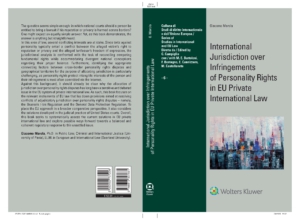
Marola on International Jurisdiction over Infringements of Personality Rights in EU Private International Law: Book Review

January 15, 2026/in News/by Cristina Mariottini

Giacomo Marola’s International Jurisdiction over Infringements of Personality Rights in EU Private International Law (2025 Wolters Kluwer) addresses a deceptively simple but persistently debated question: where should a claimant be entitled to sue when reputation, privacy, or personal data are infringed across borders? As the book makes clear from the outset, this question lies at the intersection of private international law, fundamental rights, and the realities of online communication. Personality rights disputes are structurally conflictual, typically opposing the protection of moral integrity to freedom of expression, while the Internet continues to strain jurisdictional rules built around territorial connecting factors. Against this backdrop, the book offers a timely and systematic assessment of the EU framework.

Chapter I constitutes the analytical core of the work. It provides a detailed examination of Article 7(2) of the Brussels I-bis Regulation and the Court of Justice’s case law on the ‘place of the harmful event’ in personality rights disputes. From Shevill to eDate Advertising, Bolagsupplysningen, Mittelbayerischer and Gtflix, Marola carefully examines the construction of locus actus and locus damni, focusing in particular on the publisher’s place of establishment, the persistence of the ‘mosaic’ approach, and jurisdiction based on the victim’s centre of interests. The chapter goes beyond doctrinal reconstruction by assessing these solutions against the objectives of proximity, predictability, and procedural balance, and by advancing a well-argued proposal de lege ferenda.

Chapter II places the EU approach in comparative perspective through an analysis of US jurisdictional doctrine in defamation and online tort cases. By retracing the path from Keeton and Calder to the rise and decline of the Zippo test and the renewed prominence of the ‘effects’ doctrine, the chapter sheds light on both convergences and structural differences. In doing so, it provides a useful corrective to overly enthusiastic transatlantic borrowings sometimes found in the European literature.

The final chapter turns to the General Data Protection Regulation and its interaction with the Brussels I-bis Regulation. Chapter III examines both public and private enforcement mechanisms, with particular attention to Article 79 GDPR and its implications for jurisdictional choice in data protection litigation. By integrating GDPR disputes into the broader analysis of personality rights, the book captures an increasingly central area of cross-border litigation.

Overall, the monograph combines doctrinal precision, critical insight, and pragmatic proposals, making it a valuable contribution for scholars and practitioners engaged with jurisdictional questions at the crossroads of EU private international law and fundamental rights.

https://conflictoflaws.net/News/2020/08/CoL_Banner-1.png 0 0 Cristina Mariottini https://conflictoflaws.net/News/2020/08/CoL_Banner-1.png Cristina Mariottini2026-01-15 07:19:192026-01-15 07:19:22Marola on International Jurisdiction over Infringements of Personality Rights in EU Private International Law: Book Review

Categories

  • Views
  • News

Most Recent Posts

  • Private International Law and European Society August 4, 2026
  • The New Zealand Supreme Court’s judgment in Kea Investments Ltd v Wikeley on anti-enforcement relief August 3, 2026
  • Beyond Domicile: The BHP Litigation and the Functional Interconnection of Public and Private International Law August 3, 2026
  • Conflicts of jurisdiction in Senegal: lesson from the Senegalese Supreme Court on Lis Pendens and the Exequatur of foreign judgments July 27, 2026
  • Adoption in the proposal for a European Parenthood Regulation July 21, 2026
  • Copyright, Targeting and Geo-Blocking: The CJEU Stirs the Pot July 15, 2026
  • A Follow-Up: The German Judges Association’s Response to the HCCH Draft Text of a Future Convention on Parallel Proceedings and Related Actions July 15, 2026
  • Private International Law Dimensions of Singapore’s New Legislation to Combat Online Harms July 14, 2026
  • The 1961 HCCH Apostille Convention: Why All African Countries Should Ratify It? — Insights from Judicial Practice in Africa July 14, 2026
  • The enforcement of an advance on costs for substitute performance at the expense of a Russian debtor in German-French legal relations July 2, 2026
  • “Yes, in principle, but not quite there yet…” – Some Observations on the Public Consultation on the HCCH Draft Text of a Future Convention on Parallel Proceedings and Related Actions June 29, 2026
  • Judgment Mobility Rules in India’s Private International Law Regime: No place for a revision au fond? June 26, 2026
  • Nothing to See Here: The CJEU’s Decision in Case C-232/25 Idzinski June 18, 2026
  • Refusal to Enforce in Egypt of a Californian (U.S.) Judgment for Lack of Reciprocity: What Has Gotten into the Egyptian Supreme Court? June 15, 2026
  • PRC Double Interest neither Double nor Penal: Australian Courts Clear Its Name When Enforcing Chinese Judgments June 10, 2026
Scroll to top Scroll to top Scroll to top