
The Hague Academy of International Law Centre for Studies and Research 2025: “Artificial Intelligence and International Law”
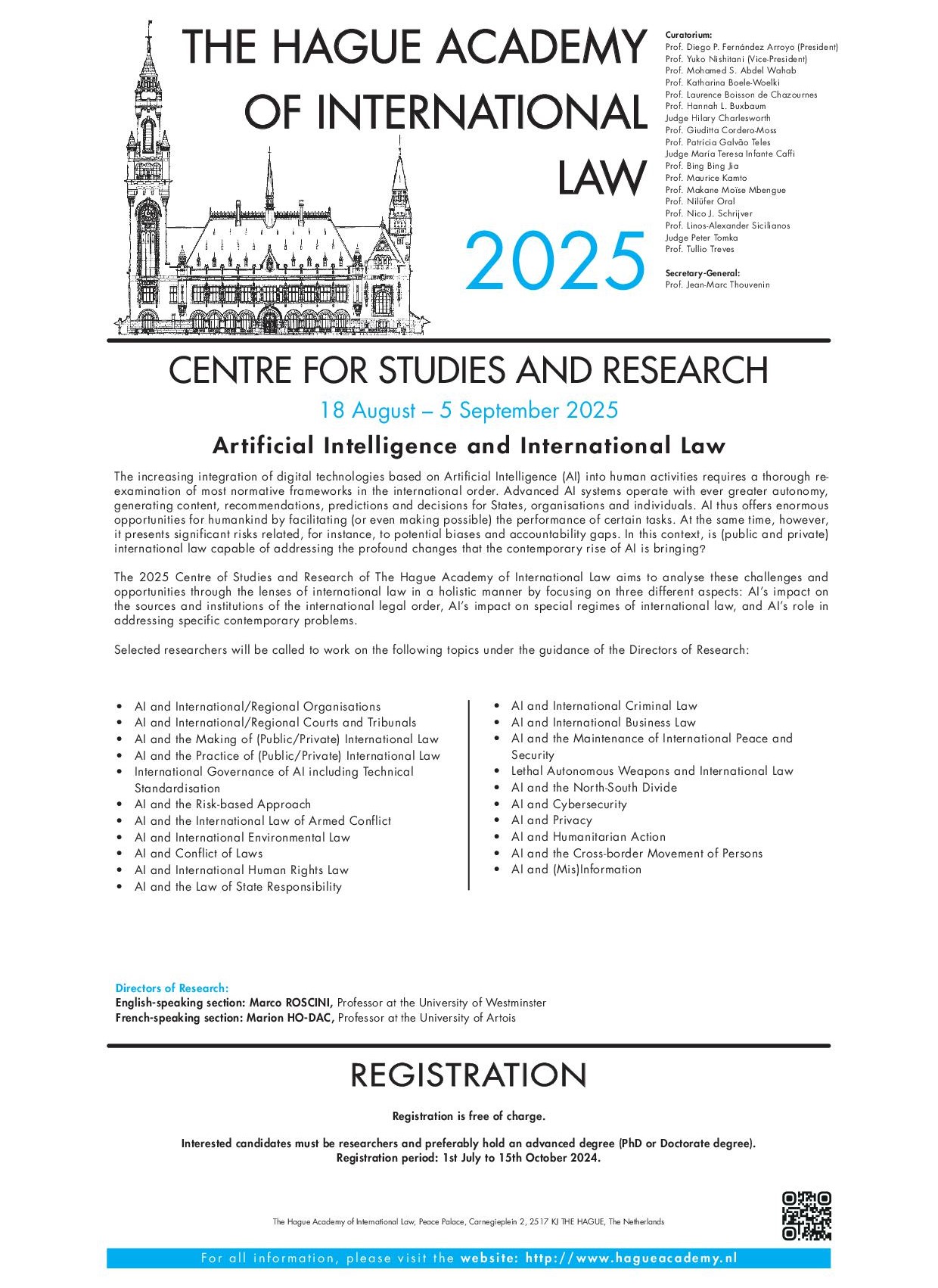
As recently highlighted by contributions on this blog, new technologies have a significant impact on the development of the law. Hence, the Curatorium of the Hague Academy of International Law has chosen for the the 2025 edition of the Centre for Studies and Research (18 August – 5 September 2025) to focus on the emerging topic of “Artificial Intelligence and International Law“. This year, the selected researchers will be work under the guidance of the Directors of Research, Marion Ho-Dac (Université d’Artois) for the French-speaking section as well as Marco Roscini (University of Westminster) for the English-speaking section.
Interested candidates must be researchers and preferably hold an advanced degree (PhD or Doctorate degree). Registration for the 2025 Centre is open from 1 July to 15 October 2024 via the institution’s own Online Registration Form.
The Academy describes the scope of its 2025 Programme as follows (emphasis added to highlight passages of specific interest to col.net readers):
The increasing integration of digital technologies based on Artificial Intelligence (AI) into human activities requires a thorough re-examination of most normative frameworks in the international order. Advanced AI systems operate with ever greater autonomy, generating content, recommendations, predictions and decisions for States, organisations and individuals. AI thus offers enormous opportunities for humankind by facilitating (or even making possible) the performance of certain tasks. At the same time, however, it presents significant risks related, for instance, to potential biases and accountability gaps. In this context, is (public and private) international law capable of addressing the profound changes that the contemporary rise of AI is bringing?
The Centre of Studies and Research 2025 of The Hague Academy of International Law aims to analyse these challenges and opportunities through the lenses of international law in a holistic manner by focusing on three different aspects: AI’s impact on the sources and institutions of the international legal order, AI’s impact on special regimes of international law, and AI’s role in addressing specific contemporary problems.
Selected researchers will be called to work on the following topics under the guidance of the Directors of Research:
- AI and International/Regional Organisations
- AI and International/Regional Courts and Tribunals
- AI and the Making of (Public/Private) International Law
- AI and the Practice of (Public/Private) International Law
- International Governance of AI including Technical Standardisation
- AI and the Risk-based Approach
- AI and the International Law of Armed Conflict
- AI and International Environmental Law
- AI and Conflict of Laws
- AI and International Human Rights Law
- AI and the Law of State Responsibility
- AI and International Criminal Law
- AI and International Business Law
- AI and the Maintenance of International Peace and Security
- Lethal Autonomous Weapons and International Law
- AI and the North-South Divide
- AI and Cybersecurity
- AI and Privacy
- AI and Humanitarian Action
- AI and the Cross-border Movement of Persons
- AI and (Mis)Information
For further information on the HAIL 2025 Centre and the Academy in general, please consult the HAIL Homepage or refer to the attached PDF Programme.