Conflict of Laws
  • About
  • Editorial board
  • Subscription
  • Submission
  • Materials
  • Contact
  • Click to open the search input field Click to open the search input field Search
  • Menu Menu

Tag Archive for: Artificial Intelligence (AI)

CfP: 3rd International Seminar “The Challenges of Private International Law in Contemporary Society” – Belo Horizonte, Brazil, 4-6 November 2026

August 3, 2026/0 Comments/in News/by Ralf Michaels

Call for Papers: 3rd International Seminar “The Challenges of Private International Law in Contemporary Society” – Belo Horizonte, Brazil, 4-6 November 2026


This Call for Papers has been kindly shared with us by Inez Lopes / University of Brasilia (UnB) and Fabricio B. Pasquot Polido / University of Minas Gerais (UFMG)

Following the previous editions hosted by the University of Brasilia in 2019 and 2024, the Third Seminar “The Challenges of Private International Law in Contemporary Society”, will be held from 4 to 6 November 2026 at the Faculty of Law of the Federal University of Minas Gerais, Brasil. The theme of the 2026 edition is:

“Jurisdiction and Transnational Access to Justice between New Technologies and ‘The Human Side of Artificial Intelligence’” Read more
https://conflictoflaws.net/News/2020/08/CoL_Banner-1.png 0 0 Ralf Michaels https://conflictoflaws.net/News/2020/08/CoL_Banner-1.png Ralf Michaels2026-08-03 17:19:322026-08-03 19:11:40CfP: 3rd International Seminar “The Challenges of Private International Law in Contemporary Society” – Belo Horizonte, Brazil, 4-6 November 2026

Muscles from Munich? How German Courts Might Stop US Companies from Violating Copyright through AI Training

March 10, 2026/1 Comment/in Views/by Tobias Lutzi

Yesterday, the Regional Court of Munich (Landgericht München I) held a highly interesting oral hearing in a dispute brought by GEMA, a German collecting society representing composers, and Suno, a generative music AI company based in Cambridge, MA. The hearing was noteworthy, first, because it gave the public an opportunity to listen to numerous international hits, from Alphaville’s Forever Young to Lou Bega’s Mambo No. 5 (and their alleged copies created by Suno) in a courtroom; and secondly, because the dispute raises some interesting questions of private international law.

After GEMA had already scored a famous victory against OpenAI in November 2025, when the same chamber of the Munich Court had held that the company had been violating the copyrights of several artists and composers by reproducing their song texts, the present proceedings differed not just in scope (focusing on the musical arrangement rather than texts) but also in its international dimension. For the first time, the claimant explicitly included the use of the protected works for training that had happened (according to both parties) exclusively in the US.

Read more

https://conflictoflaws.net/News/2026/03/GEMA-SUNO-pdf.jpg 960 1707 Tobias Lutzi https://conflictoflaws.net/News/2020/08/CoL_Banner-1.png Tobias Lutzi2026-03-10 11:38:372026-03-10 11:38:37Muscles from Munich? How German Courts Might Stop US Companies from Violating Copyright through AI Training

Border Control & Migration: Safeguarding Fundamental Rights in the Age of Artificial Intelligence

December 10, 2025/in News/by Zeynep Derya Tarman

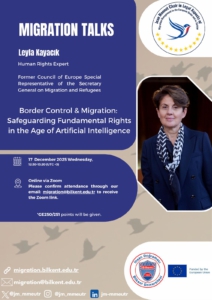
You are invited to the next Migration Talk organized by the Jean Monnet Chair in Legal Aspects of Migration Management in the European Union and in Türkiye by Leyla Kayac?k (Human Rights Expert/ Council of Europe Former Special Representative of the Secretary General on Migration and Refugees) on “Border Control & Migration: Safeguarding Fundamental Rights in the Age of Artificial Intelligence”.

Venue: Online via Zoom
Date: 17 December 2025, Wednesday
Time: 12:30 – 13:20 (UTC +3)
The Zoom link shall be provided upon request: migration@bilkent.edu.tr

https://conflictoflaws.net/News/2020/08/CoL_Banner-1.png 0 0 Zeynep Derya Tarman https://conflictoflaws.net/News/2020/08/CoL_Banner-1.png Zeynep Derya Tarman2025-12-10 16:18:442025-12-10 16:18:47Border Control & Migration: Safeguarding Fundamental Rights in the Age of Artificial Intelligence

AI in Arbitration: Will the EU AI Act Stand in the Way of Enforcement?

August 24, 2025/in Views/by Thalia Kruger

This guest post was written by Ezzatollah Pabakhsh, Master’s Student at the University of Antwerp

The European Union has taken an unprecedented step by regulating artificial intelligence (AI) through the EU AI Act, which is the world’s first comprehensive legal framework for AI governance. According to Recital 61, Article 6(2) and Annex III, 8(a), AI tools used in legal or administrative decision-making processes—including alternative dispute resolution (ADR), when used similarly to courts and producing legal effects—are considered high risk. These tools must comply with the strict requirements outlined in Articles 8 through 27. Read more

https://conflictoflaws.net/News/2020/08/CoL_Banner-1.png 0 0 Thalia Kruger https://conflictoflaws.net/News/2020/08/CoL_Banner-1.png Thalia Kruger2025-08-24 18:00:032025-08-25 07:33:21AI in Arbitration: Will the EU AI Act Stand in the Way of Enforcement?

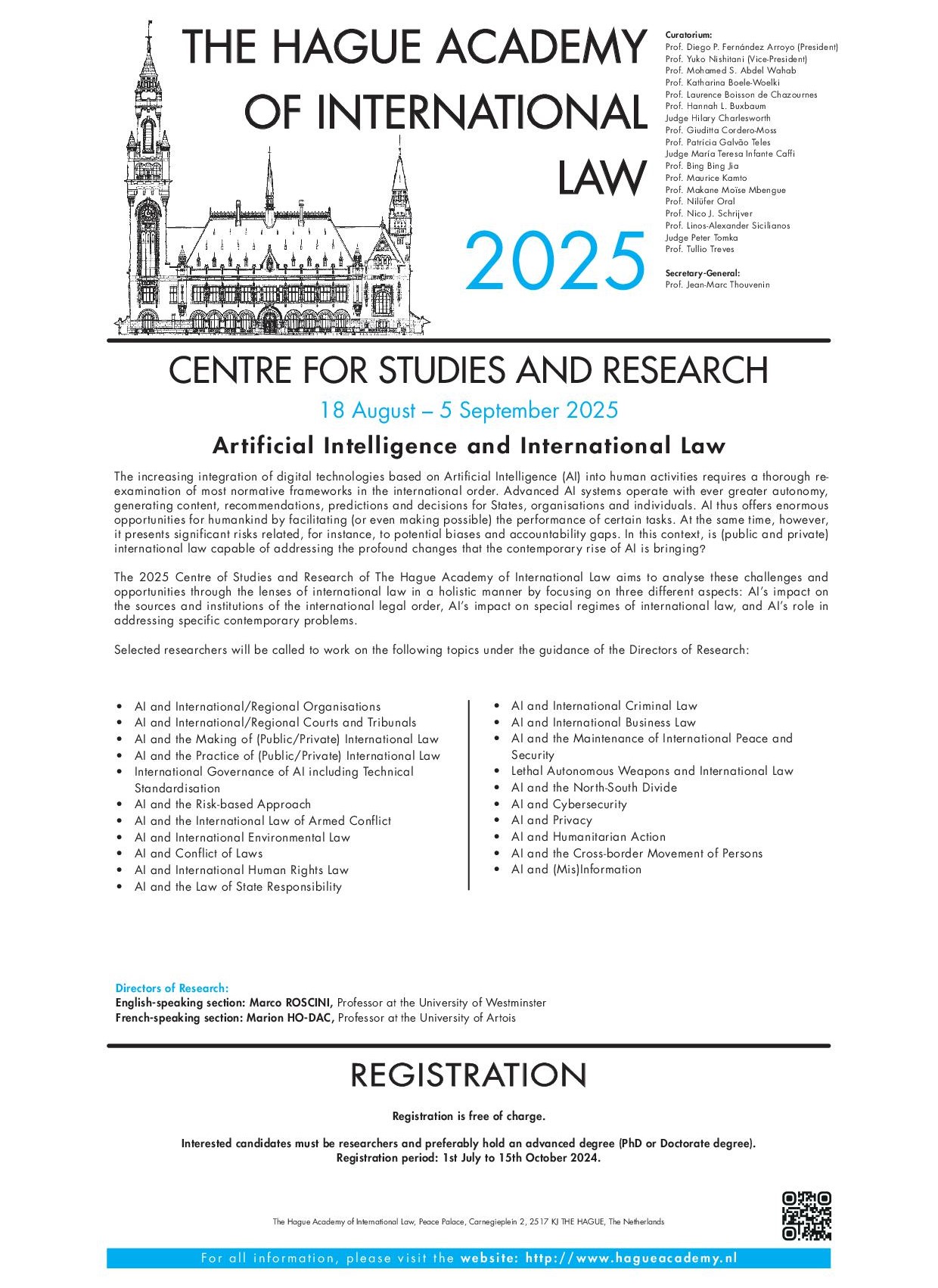
The Hague Academy of International Law Centre for Studies and Research 2025: “Artificial Intelligence and International Law”

July 14, 2024/2 Comments/in News/by Matthias Weller

As recently highlighted by contributions on this blog, new technologies have a significant impact on the development of the law. Hence, the Curatorium of the Hague Academy of International Law has chosen for the the 2025 edition of the Centre for Studies and Research (18 August – 5 September 2025) to focus on the emerging topic of “Artificial Intelligence and International Law“. This year, the selected researchers will be work under the guidance of the Directors of Research, Marion Ho-Dac (Université d’Artois) for the French-speaking section as well as Marco Roscini (University of Westminster) for the English-speaking section.

Interested candidates must be researchers and preferably hold an advanced degree (PhD or Doctorate degree). Registration for the 2025 Centre is open from 1 July to 15 October 2024 via the institution’s own Online Registration Form.

The Academy describes the scope of its 2025 Programme as follows (emphasis added to highlight passages of specific interest to col.net readers):

The increasing integration of digital technologies based on Artificial Intelligence (AI) into human activities requires a thorough re-examination of most normative frameworks in the international order. Advanced AI systems operate with ever greater autonomy, generating content, recommendations, predictions and decisions for States, organisations and individuals. AI thus offers enormous opportunities for humankind by facilitating (or even making possible) the performance of certain tasks. At the same time, however, it presents significant risks related, for instance, to potential biases and accountability gaps. In this context, is (public and private) international law capable of addressing the profound changes that the contemporary rise of AI is bringing? 

The Centre of Studies and Research 2025 of The Hague Academy of International Law aims to analyse these challenges and opportunities through the lenses of international law in a holistic manner by focusing on three different aspects: AI’s impact on the sources and institutions of the international legal order, AI’s impact on special regimes of international law, and AI’s role in addressing specific contemporary problems.

Selected researchers will be called to work on the following topics under the guidance of the Directors of Research:

  • AI and International/Regional Organisations
  • AI and International/Regional Courts and Tribunals
  • AI and the Making of (Public/Private) International Law
  • AI and the Practice of (Public/Private) International Law
  • International Governance of AI including Technical Standardisation
  • AI and the Risk-based Approach
  • AI and the International Law of Armed Conflict
  • AI and International Environmental Law
  • AI and Conflict of Laws 
  • AI and International Human Rights Law
  • AI and the Law of State Responsibility
  • AI and International Criminal Law
  • AI and International Business Law 
  • AI and the Maintenance of International Peace and Security
  • Lethal Autonomous Weapons and International Law
  • AI and the North-South Divide
  • AI and Cybersecurity
  • AI and Privacy  
  • AI and Humanitarian Action
  • AI and the Cross-border Movement of Persons
  • AI and (Mis)Information

For further information on the HAIL 2025 Centre and the Academy in general, please consult the HAIL Homepage or refer to the attached PDF Programme.

https://conflictoflaws.net/News/2020/08/CoL_Banner-1.png 0 0 Matthias Weller https://conflictoflaws.net/News/2020/08/CoL_Banner-1.png Matthias Weller2024-07-14 14:40:542024-07-14 14:40:54The Hague Academy of International Law Centre for Studies and Research 2025: “Artificial Intelligence and International Law”

Categories

  • Views
  • News

Most Recent Posts

  • The Demise of the Lex Domicilii Matrimonii in South African Private International Law August 18, 2026
  • Support in cross-border transactions by Adults: Contract law vs capacity law August 12, 2026
  • Recognition of Italian Extrajudicial Divorces in Tunisia — Between Methodological Uncertainty and the Need to Preserve Continuity of Personal Status Across Borders August 9, 2026
  • Private International Law and European Society August 4, 2026
  • The New Zealand Supreme Court’s judgment in Kea Investments Ltd v Wikeley on anti-enforcement relief August 3, 2026
  • Beyond Domicile: The BHP Litigation and the Functional Interconnection of Public and Private International Law August 3, 2026
  • Conflicts of jurisdiction in Senegal: lesson from the Senegalese Supreme Court on Lis Pendens and the Exequatur of foreign judgments July 27, 2026
  • Adoption in the proposal for a European Parenthood Regulation July 21, 2026
  • Copyright, Targeting and Geo-Blocking: The CJEU Stirs the Pot July 15, 2026
  • A Follow-Up: The German Judges Association’s Response to the HCCH Draft Text of a Future Convention on Parallel Proceedings and Related Actions July 15, 2026
  • Private International Law Dimensions of Singapore’s New Legislation to Combat Online Harms July 14, 2026
  • The 1961 HCCH Apostille Convention: Why All African Countries Should Ratify It? — Insights from Judicial Practice in Africa July 14, 2026
  • The enforcement of an advance on costs for substitute performance at the expense of a Russian debtor in German-French legal relations July 2, 2026
  • “Yes, in principle, but not quite there yet…” – Some Observations on the Public Consultation on the HCCH Draft Text of a Future Convention on Parallel Proceedings and Related Actions June 29, 2026
  • Judgment Mobility Rules in India’s Private International Law Regime: No place for a revision au fond? June 26, 2026
Scroll to top Scroll to top Scroll to top