Conflict of Laws
  • About
  • Editorial board
  • Subscription
  • Submission
  • Materials
  • Contact
  • Click to open the search input field Click to open the search input field Search
  • Menu Menu

Tag Archive for: arbitral award

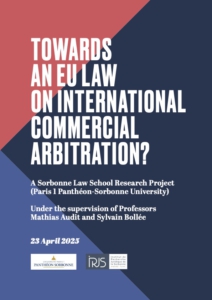
“Towards an EU Law on International Commercial Arbitration?” A Sorbonne Law School Research Project

July 15, 2025/1 Comment/in Views/by Etienne Farnoux

Written by Dr. Nima Nasrollahi-Shahri (Sorbonne Law School) and Vincent Bassani-Winckler (PhD Candidate, Sorbonne Law School), both authors participated in the Working Group.

A few days ago, the Sorbonne Law School released the final report of a collective research project chaired by Professors Mathias Audit and Sylvain Bollée, entitled “Towards an EU Law on International Commercial Arbitration?”.

Conducted within the IRJS (Institut de Recherche Juridique de la Sorbonne), and more specifically its research group on private international law, SERPI (Sorbonne – Étude des Relations Privées Internationales), this project sets out to examine whether and how to improve the relationship between commercial arbitration and EU law.

Read more

https://conflictoflaws.net/News/2020/08/CoL_Banner-1.png 0 0 Etienne Farnoux https://conflictoflaws.net/News/2020/08/CoL_Banner-1.png Etienne Farnoux2025-07-15 16:09:452025-07-15 16:09:45“Towards an EU Law on International Commercial Arbitration?” A Sorbonne Law School Research Project

U.S. Courts Recognize NAFTA Award Against Mexico

January 13, 2025/in News/by Charles Kotuby

This submission written by Celeste Hall, JD Candidate at the University of Pittsburgh School of Law and Global Legal Scholar.

The legal news has been awash lately in the recognition and enforcement of investment arbitration awards by U.S. courts. Most of the press is on the long-running and still-unfolding saga regarding Spain (see here and here). And a new decision recognizing an award against Zimbabwe was just issue at the end of December, as well. Here, however, we would like to add to the news with the recent decision recognizing an investment arbitration award against Mexico in United Mexican States v. Lion Mexico Consolidated.

Like most investment arbitrations, the decision tells a sordid tale. Lion Mexico Consolidated (LMC) is a Canadian company which provided financing to a Mexican businessman, Mr. Hector Cardenas Curiel, to develop real estate projects in Nayarit and Jalisco, Mexico. Cardenas’ company failed to pay on the loans, and LMC tried for years to obtain payment, all to no avail. Cardenas then began what was described as a “complex judicial fraud” to avoid payment, including a forgery and a subsequent lawsuit in a Jalisco court to cancel the loans. LMC was never informed of the suit and therefore, never appeared. The Jalisco Court issued a default judgment discharging the loans and ordering LMC to cancel the mortgages; Cardenas then arranged for an attorney to act fraudulently on LMC’s behalf to file and then purposefully abandon the appeal. LMC only learned of the entire scheme when they attempted to file their own constitutional challenge and were rejected. The Mexican Courts refused to allow LMC to submit evidence of the forgeries, so LMC brought a NAFTA Chapter 11 arbitration against Mexico for its failure to accord Lion’s investments protection under Article 1105(1) of NAFTA. Read more

https://conflictoflaws.net/News/2020/08/CoL_Banner-1.png 0 0 Charles Kotuby https://conflictoflaws.net/News/2020/08/CoL_Banner-1.png Charles Kotuby2025-01-13 17:16:462025-01-14 08:25:57U.S. Courts Recognize NAFTA Award Against Mexico

Chinese court refuses enforcement of an IFTA Arbitration award

August 6, 2020/in News/by Apostolos Anthimos

Shawn He reported recently on a Chinese judgment refusing the declaration of enforceability of an arbitral award issued by the Independent Film & Television Alliance Arbitration Court.

The Tianjin Intermediate People’s Court dismissed the application on two grounds: No standing to be sued of the Chinese company, and notification vices.

One point which should be highlighted is the duration of the proceedings: The application was filed on March 2018, and the judgment (in first instance) was rendered on May 2020…


https://conflictoflaws.net/News/2020/08/CoL_Banner-1.png 0 0 Apostolos Anthimos https://conflictoflaws.net/News/2020/08/CoL_Banner-1.png Apostolos Anthimos2020-08-06 15:01:192020-08-06 15:01:19Chinese court refuses enforcement of an IFTA Arbitration award

Limitation Period for Enforcing Foreign Arbitration Award

June 1, 2010/1 Comment/in /by Stephen Pitel

In Yugraneft Corp. v. Rexx Management Corp., 2010 SCC 19 (available here) the Supreme Court of Canada has upheld the decision of two lower courts that the plaintiff’s claim to enforce a Russian arbitration award was brought after the expiry of the applicable provincial limitation period.

Following a contractual dispute, Yugraneft commenced arbitration proceedings before the International Commercial Arbitration Court at the Chamber of Commerce and Industry of the Russian Federation.  The arbitral tribunal issued its final award on September 6, 2002, ordering Rexx to pay US$952,614.43 in damages to Yugraneft.  Yugraneft applied to the Alberta Court of Queen’s Bench for recognition and enforcement of the award on January 27, 2006, more than three years after the award was rendered.

The court was required to interpret article 3 of the New York Convention, which provides that recognition and enforcement shall be “in accordance with the rules of procedure of the territory where the award is relied upon”.  This raised an issue in Canadian litigation since the Supreme Court of Canada has held (in Tolofson v. Jensen, [1994] 3 S.C.R. 1022) that limitation periods are substantive and not procedural.  The court rightly concludes that this does not mean that the forum’s limitation period cannot be applied to the enforcement action (paras. 18-29). 

The remainder of the decision deals with what the limitation period is under Alberta law.  The plaintiff attempted to convince the court to apply a ten-year period, applicable to a “claim based on a judgment or order for the payment of money” (para. 43).  The court, based on the clear wording of the statute, had to conclude that an arbitration award did not fall within this language (para. 44).  As a result, the claim was governed by the general two-year period and so was, on the facts, time barred (para. 63).

The court does suggest that the two-year time period will not start to run until the plaintiff discovers, or should have discovered, that the defendant has assets in the place where enforcement is sought (para. 49).  This fact is not strictly part of the cause of action.  Still, this statement, if accepted as correct, should provide some comfort in the face of the relatively short two-year period.  However, this statement draws in part on the specific language of s. 3(1)(a)(iii) of the Alberta limitation statute, which deals with knowing whether a proceeding is “warranted” (see para. 61).  If so, the analysis could be different under a statute that did not have this specific language as part of the test of discoverability (see for example the language in s. 5(1)(a)(iv) of the Ontario limitation statute).

This area would benefit from a clear legislative solution, namely a provision containing an express limitation period for claims on foreign arbitration awards.  Such a period should, in recognition of the issues involved, be longer than the province’s general limitation period.

https://conflictoflaws.net/News/2020/08/CoL_Banner-1.png 0 0 Stephen Pitel https://conflictoflaws.net/News/2020/08/CoL_Banner-1.png Stephen Pitel2010-06-01 12:00:452010-06-01 12:02:13Limitation Period for Enforcing Foreign Arbitration Award

Categories

  • Views
  • News

Most Recent Posts

  • Support in cross-border transactions by Adults: Contract law vs capacity law August 12, 2026
  • Recognition of Italian Extrajudicial Divorces in Tunisia — Between Methodological Uncertainty and the Need to Preserve Continuity of Personal Status Across Borders August 9, 2026
  • Private International Law and European Society August 4, 2026
  • The New Zealand Supreme Court’s judgment in Kea Investments Ltd v Wikeley on anti-enforcement relief August 3, 2026
  • Beyond Domicile: The BHP Litigation and the Functional Interconnection of Public and Private International Law August 3, 2026
  • Conflicts of jurisdiction in Senegal: lesson from the Senegalese Supreme Court on Lis Pendens and the Exequatur of foreign judgments July 27, 2026
  • Adoption in the proposal for a European Parenthood Regulation July 21, 2026
  • Copyright, Targeting and Geo-Blocking: The CJEU Stirs the Pot July 15, 2026
  • A Follow-Up: The German Judges Association’s Response to the HCCH Draft Text of a Future Convention on Parallel Proceedings and Related Actions July 15, 2026
  • Private International Law Dimensions of Singapore’s New Legislation to Combat Online Harms July 14, 2026
  • The 1961 HCCH Apostille Convention: Why All African Countries Should Ratify It? — Insights from Judicial Practice in Africa July 14, 2026
  • The enforcement of an advance on costs for substitute performance at the expense of a Russian debtor in German-French legal relations July 2, 2026
  • “Yes, in principle, but not quite there yet…” – Some Observations on the Public Consultation on the HCCH Draft Text of a Future Convention on Parallel Proceedings and Related Actions June 29, 2026
  • Judgment Mobility Rules in India’s Private International Law Regime: No place for a revision au fond? June 26, 2026
  • Nothing to See Here: The CJEU’s Decision in Case C-232/25 Idzinski June 18, 2026
Scroll to top Scroll to top Scroll to top