
Conflict of Laws
  • About
  • Editorial board
  • Subscription
  • Submission
  • Materials
  • Contact
  • Click to open the search input field Click to open the search input field Search
  • Menu Menu

Tag Archive for: Anti-arbitration injunction

Anti-Arbitration Injunction in Foreign-Seated Arbitrations: The Delhi High Court’s Controversial Intervention in Engineering Projects (India) Limited v. MSA Global LLC (Oman)

February 28, 2026/2 Comments/in Views/by Saloni Khanderia

This post is posted on behalf of Arnav Sharma, Jindal Global Law School, Sonipat, India


Introduction

On 25th July 2025, a single judge bench of the Delhi High Court delivered a judgment in Engineering Projects (India) Limited v. MSA Global LLC (Oman) in CS (OS) 243 of 2025[1] that has stirred considerable discourse in international arbitration circles. The fundamental question at issue in the instant case was whether an Indian Court can grant an anti-arbitration injunction to stay proceedings in a foreign-seated arbitration on grounds of the proceedings turning oppressive and vexatious due to procedural impropriety, notwithstanding internationally well-settled principles of minimal judicial intervention, party autonomy, and lex arbitri that govern international commercial arbitration? The Delhi High Court answered in the affirmative, holding that Indian civil courts possess inherent power under Section 9 read with Section 151 of the Code of Civil Procedure, 1908 (“CPC”) to intervene under exceptional circumstances where the arbitral process itself becomes a vehicle of abuse.
Read more

https://conflictoflaws.net/News/2020/08/CoL_Banner-1.png 0 0 Saloni Khanderia https://conflictoflaws.net/News/2020/08/CoL_Banner-1.png Saloni Khanderia2026-02-28 06:55:582026-02-28 09:27:25Anti-Arbitration Injunction in Foreign-Seated Arbitrations: The Delhi High Court’s Controversial Intervention in Engineering Projects (India) Limited v. MSA Global LLC (Oman)

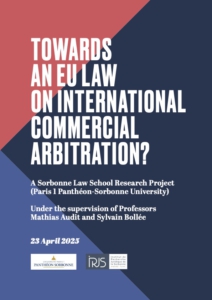
“Towards an EU Law on International Commercial Arbitration?” A Sorbonne Law School Research Project

July 15, 2025/1 Comment/in Views/by Etienne Farnoux

Written by Dr. Nima Nasrollahi-Shahri (Sorbonne Law School) and Vincent Bassani-Winckler (PhD Candidate, Sorbonne Law School), both authors participated in the Working Group.

A few days ago, the Sorbonne Law School released the final report of a collective research project chaired by Professors Mathias Audit and Sylvain Bollée, entitled “Towards an EU Law on International Commercial Arbitration?”.

Conducted within the IRJS (Institut de Recherche Juridique de la Sorbonne), and more specifically its research group on private international law, SERPI (Sorbonne – Étude des Relations Privées Internationales), this project sets out to examine whether and how to improve the relationship between commercial arbitration and EU law.

Read more

https://conflictoflaws.net/News/2020/08/CoL_Banner-1.png 0 0 Etienne Farnoux https://conflictoflaws.net/News/2020/08/CoL_Banner-1.png Etienne Farnoux2025-07-15 16:09:452025-07-15 16:09:45“Towards an EU Law on International Commercial Arbitration?” A Sorbonne Law School Research Project

Delhi High Court Grants Rare Anti-Enforcement Injunction: Implications for International Disputes

October 2, 2024/1 Comment/in Views, News/by Saloni Khanderia

By Ananya Bhargava, Jindal Global Law School, OP Jindal Global University, India.

Recently, the Delhi High Court in the case of Honasa Consumer Limited v RSM General Trading LLC granted an anti-enforcement injunction against the execution proceedings instituted in the Dubai Court on the ground that it threatened the arbitral process in India. The Court deemed the proceedings before the Dubai Court as an attempt to frustrate a possible arbitration envisaged by the contract between the parties.  The injunction was granted under S.9 of the Indian Arbitration and Conciliation Act 1996 as an “interim measure.”  This is a significant turning point in the intersection of arbitration and cross-border litigation in India since the remedy of anti-enforcement injunction is rarely granted by judicial authorities across jurisdictions.

Read more

https://conflictoflaws.net/News/2020/08/CoL_Banner-1.png 0 0 Saloni Khanderia https://conflictoflaws.net/News/2020/08/CoL_Banner-1.png Saloni Khanderia2024-10-02 04:55:082025-07-21 13:44:35Delhi High Court Grants Rare Anti-Enforcement Injunction: Implications for International Disputes

Third Issue of the Lloyd’s Maritime and Commercial Law Quarterly for 2024

August 21, 2024/in News/by Chukwuma Okoli

The third issue of the Lloyd’s Maritime and Commercial Law Quarterly was recently released. It contains the following article, case note and book reviews:

Adrian Briggs, “The Hague 2019 Convention”

The Hague Convention on the Recognition and Enforcement of Judgments in Civil and Commercial Matters 2019 will come into force for the United Kingdom on 1 July 2025. It will represent the principal means for the mutual recognition of judgments between the United Kingdom and the European Union (and any other states adopting it), and it is for this reason timely to examine the instrument which will replace, but certainly not replicate, Chapter III of the Brussels I Regulation. In discussing the structure and detail of the Convention, it is noticeable how far it falls short of the pre-existing regime.

Pau S Davies and Katherine Ratcliffe, “Anti-Arbitration Injunctions and Stays to Arbitration”

Andrew Tettenborn, “Book Review – The 2019 Hague Judgments Convention”

Adrian Briggs, “Book Review – Governing aw Risks in International Business Transactions”


https://conflictoflaws.net/News/2020/08/CoL_Banner-1.png 0 0 Chukwuma Okoli https://conflictoflaws.net/News/2020/08/CoL_Banner-1.png Chukwuma Okoli2024-08-21 05:50:022024-08-21 05:50:02Third Issue of the Lloyd’s Maritime and Commercial Law Quarterly for 2024

Categories

  • Views
  • News

Most Recent Posts

  • Support in cross-border transactions by Adults: Contract law vs capacity law August 12, 2026
  • Recognition of Italian Extrajudicial Divorces in Tunisia — Between Methodological Uncertainty and the Need to Preserve Continuity of Personal Status Across Borders August 9, 2026
  • Private International Law and European Society August 4, 2026
  • The New Zealand Supreme Court’s judgment in Kea Investments Ltd v Wikeley on anti-enforcement relief August 3, 2026
  • Beyond Domicile: The BHP Litigation and the Functional Interconnection of Public and Private International Law August 3, 2026
  • Conflicts of jurisdiction in Senegal: lesson from the Senegalese Supreme Court on Lis Pendens and the Exequatur of foreign judgments July 27, 2026
  • Adoption in the proposal for a European Parenthood Regulation July 21, 2026
  • Copyright, Targeting and Geo-Blocking: The CJEU Stirs the Pot July 15, 2026
  • A Follow-Up: The German Judges Association’s Response to the HCCH Draft Text of a Future Convention on Parallel Proceedings and Related Actions July 15, 2026
  • Private International Law Dimensions of Singapore’s New Legislation to Combat Online Harms July 14, 2026
  • The 1961 HCCH Apostille Convention: Why All African Countries Should Ratify It? — Insights from Judicial Practice in Africa July 14, 2026
  • The enforcement of an advance on costs for substitute performance at the expense of a Russian debtor in German-French legal relations July 2, 2026
  • “Yes, in principle, but not quite there yet…” – Some Observations on the Public Consultation on the HCCH Draft Text of a Future Convention on Parallel Proceedings and Related Actions June 29, 2026
  • Judgment Mobility Rules in India’s Private International Law Regime: No place for a revision au fond? June 26, 2026
  • Nothing to See Here: The CJEU’s Decision in Case C-232/25 Idzinski June 18, 2026
Scroll to top Scroll to top Scroll to top