


Views
The EU Sustainability Directive and Jurisdiction
The Draft for a Corporate Sustainable Due Diligence Directive currently contains no rules on jurisdiction. This creates inconsistencies between the scope of application of the Draft Directive and existing jurisdictional law, both on the EU level and on the domestic level, and can lead to an enforcement gap: EU companies may be able to escape the existing EU jurisdiction; non-EU companies may even not be subject to such jurisdiction. Effectivity requires closing that gap, and we propose ways in which this could be achieved.
(authored by Ralf Michaels and Antonia. Sommerfeld and crossposted at https://eapil.org/)
- The Proposal for a Directive on Corporate Sustainability Due Diligence
The process towards an EU Corporate Sustainability Due Diligence Directive is gaining momentum. The EU Commission published a long awaited Proposal for a Directive on Corporate Sustainability Due Diligence (CSDDD), COM(2022) 71 final, on 23 February 2022; the EU Council adopted its negotiation position on 1 December 2022; and now, the EU Parliament has suggested amendments to this Draft Directive on 1 June 2023. The EU Parliament has thereby backed the compromise textreached by its legal affairs committee on 25 April 2023. This sets off the trilogue between representatives of the Parliament, the Council and the Commission.
No Sunset of Retained EU Conflict of Laws in the UK, but Increased Risk of Sunburn
By Dr Johannes Ungerer, University of Oxford
The sunset of retained EU law in the UK has begun: the Retained EU Law (Revocation and Reform) Act 2023 received Royal Assent at the end of June. The Act will revoke many EU laws that have so far been retained in the UK by the end of 2023.
The good news for the conflict of laws is that the retained Rome I and II Regulations are not included in the long list of EU legal instruments which are affected by the mass-revocation. Both Regulations have been retained in the UK post-Brexit by section 3 of the European Union (Withdrawal) Act 2018 and were modified by the Law Applicable to Contractual Obligations and Non-Contractual Obligations (Amendment etc.) (EU Exit) Regulations 2019 (as amended in 2020). The retained (modified) Rome I and II Regulations will thus be part of domestic law beyond the end of 2023. Yet this retained EU law must not be called by name anymore: it will be called “assimilated law” according to section 5 of the Retained EU Law (Revocation and Reform) Act 2023 (although the title of this enactment, like others, will strangely continue to contain the phrase “Retained EU Law” and will not be changed to “Assimilated Law”, see section 5(5)).
The CJEU on Procedural Rules in Child Abduction Cases: private international law and children’s rights law
Comment on CJEU case Rzecznik Praw Dziecka e.a., C-638/22 PPU, 16 February 2023)
Written by Tine Van Hof, post-doc researcher in Private International Law and Children’s Rights Law at the University of Antwerp, previously published on EU live
The Court of Justice of the EU has been criticised after some previous cases concerning international child abduction such as Povse and Aguirre Zarraga for prioritising the effectiveness of the EU private international law framework (i.e. the Brussels IIa Regulation, since replaced by Brussels IIb, and the principle of mutual trust) and using the children’s rights law framework (i.e. Article 24 of the EU Charter of Fundamental Rights and the principle of the child’s best interests) in a functional manner (see e.g. Silvia Bartolini and Ruth Lamont). In Rzecznik Praw Dziecka the Court takes both frameworks into account but does not prioritise one or the other, since the frameworks concur.
News
HCCH Monthly Update: July 2025
Conventions & Instruments
On 1 July 2025:
- The 2019 Judgments Convention entered into force for the United Kingdom. At present, 33 HCCH Members are either bound by the 2019 Judgments Convention or a Contracting Party for which the Convention has not entered into force yet (Albania, Andorra, and Montenegro). More information is available here.
- The 1996 Child Protection Convention entered into force for El Salvador. The Convention currently has 57 Contracting Parties. More information is available here.
- The 2007 Child Support Convention entered into force for Colombia. At present, 55 States and the European Union are bound by the 2007 Child Support Convention. More information is available here.
- The 2005 Choice of Court Convention entered into force for Bahrain. At present, 37 States and the European Union are bound by the 2005 Choice of Court Convention. More information is available here.
On 5 July 2025, the 1970 Evidence Convention entered into force for the Philippines. The Convention currently has 69 Contracting Parties. More information is available here.
On 24 July 2025, the Republic of Moldova acceded to the 1970 Evidence Convention. The Convention currently has 69 Contracting Parties. More information is available here.
Publications
On 22 July 2025, the Permanent Bureau announced the publication of the fifth editions of the Practical Handbooks on the Operation of the 1965 Service and 1970 Evidence Conventions. Incorporating recent developments, court decisions, and practical examples provided by experts from around the world, as well as updates from the meeting of the Special Commission held in July 2024, the fifth editions of the Handbooks are essential resources for anyone involved in the implementation and operation of the 1965 Service and 1970 Evidence Conventions. More information is available here.
Meetings & Events
On 10 July 2025, the Permanent Bureau of the HCCH and the Asian Business Law Institute co-hosted the webinar “Cross-border Commercial Dispute Resolution – Electronic Service of Documents and Remote Taking of Evidence”. More information is available here.
On 11 July 2025, the first meeting of the Working Group dedicated to the Model Forms for Chapter II of the 1970 Evidence Convention was held online, hosted by the Permanent Bureau. More information is available here.
Other Developments
On 9 July 2025, the premises of the HCCH’s Regional Office for Africa, hosted by the Kingdom of Morocco, were officially opened in Rabat. More information is available here.
On 10 July 2025, the Permanent Bureau of the HCCH announced several developments with regard to the HCCH’s International Child Abduction Database (INCADAT), including the launch of its new notification service. More information is available here.
These monthly updates are published by the Permanent Bureau of the Hague Conference on Private International Law (HCCH), providing an overview of the latest developments. More information and materials are available on the HCCH website.

Changes to the Editorial Board
We are delighted to announce that Wilson Lui will be joining our Editorial Board. Wilson holds degrees from the Universities of Oxford, Cambridge, the Chinese University of Hong Kong and the University of Hong Kong. He currently teaches at the University of Hong Kong while working towards his PhD at the University of Melbourne. His many publications include a comprehensive volume on the conflict of laws in Hong Kong, Hong Kong Private International Law (Hart 2025; together with Anselmo Reyes).
At the same time, we are sad to see Samuel Fulli-Lemaire (Université de Strasbourg), David P. Stewart (Georgetown University), and Marlene Wethmar-Lemmer (University of South Africa) retire from the blog after years of service to this project – we are all the more grateful for their contributions and wish them all the best.
Revue Critique de droit international privé – Issue 2025/2
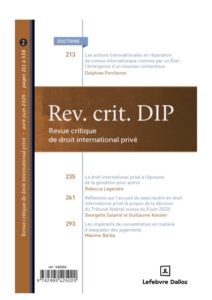 Written by Hadrien Pauchard (assistant researcher and doctoral student at Sciences Po Law School)
The second issue of the Revue Critique de droit international privé of 2025 has just been released. It contains four articles, seven case notes and numerous book reviews. In line with the Revue Critique’s recent policy, the doctrinal part will soon be made available in English on the editor’s website (for registered users and institutions). Read more