


Views
Second Act in Dutch TikTok class action on privacy violation: court assesses Third Party Funding Agreements
Written by Eduardo Silva de Freitas (Erasmus University Rotterdam), Xandra Kramer (Erasmus University Rotterdam/Utrecht University) & Jos Hoevenaars (Erasmus University Rotterdam), members of the Vici project Affordable Access to Justice, financed by the Dutch Research Council (NWO), www.euciviljustice.eu.
Introduction
Third Party Litigation Funding (TPLF) has been one of the key topics of discussion in European civil litigation over the past years, and has been the topic of earlier posts on this forum. Especially in the international practice of collective actions, TPLF has gained popularity for its ability to provide the financial means needed for these typically complex and very costly procedures. The Netherlands is a jurisdiction generally considered one of the frontrunners in having a well-developed framework for collective actions and settlements, particularly since the Mass Damage Settlement in Collective Actions Act (WAMCA) became applicable on 1 January 2020 (see also our earlier blogpost). A recent report commissioned by the Dutch Ministry of Justice and Security found that most collective actions seeking damages brought under the (WAMCA) have an international dimension, and that all of these claims for damages are brought with the help of TPLF.
Is this a Conflicts Case?
In Sharp v Autorité des marchés financiers, 2023 SCC 29 (available here) the Supreme Court of Canada has held that a Quebec administrative tribunal, the Financial Markets Administrative Tribunal, can hear a proceeding brought by the administrative agency that regulates Quebec’s financial sector, the Autorité des marchés financiers, against four defendants who reside in British Columbia. The AMF alleged in the proceedings that the defendants had contravened the Quebec Securities Act.
The courts below, including a majority of the Quebec Court of Appeal, focused the analysis on s. 93 of the Act respecting the Autorité des marchés financiers, CQLR, c. A-33.2, which grants the FMAT jurisdiction to make determinations under the Securities Act. They interpreted and applied this provision in light of Unifund Assurance Co. v Insurance Corp. of British Columbia, 2003 SCC 40, a leading decision on the scope of application of provincial law, which held that a provincial regulatory scheme constitutionally applies to an out-of-province defendant when there is a “real and substantial connection”, also described as a “sufficient connection”, between the province and the defendant. This test was met on the facts [see para 22] and so the FMAT had jurisdiction. This analysis is not generally understood as being within the field of conflict of laws. Indeed, the majority of the Court of Appeal “saw no conflict of jurisdiction or any conflict of laws that would require the application of private international law rules to this case” [see para 29].
How to Criticize U.S. Extraterritorial Jurisdiction (Part II)
Written by Bill Dodge, the John D. Ayer Chair in Business Law and Martin Luther King Jr. Professor of Law at UC Davis School of Law.
There are better and worse ways to criticize U.S. extraterritorial jurisdiction. In Part I of this post, I discussed some shortcomings of a February 2023 report by China’s Ministry of Foreign Affairs, “The U.S. Willful Practice of Long-arm Jurisdiction and its Perils.” I pointed out that the report’s use of the phrase “long-arm jurisdiction” confuses extraterritorial jurisdiction with personal jurisdiction. I noted that China applies its own laws extraterritorially on the same bases that it criticizes the United States for using. I argued that the report ignores significant constraints that U.S. courts impose on the extraterritorial application of U.S. laws. And I suggested that China had chosen to emphasize weak examples of U.S. extraterritoriality, such as the bribery prosecution of Frédéric Pierucci, which was not even extraterritorial.
In this post, I suggest some better ways of criticizing U.S. extraterritorial jurisdiction. Specifically, I discuss three cases in which the extraterritorial application of U.S. law appears to violate customary international law rules on jurisdiction to prescribe: (1) the indictment of Huawei executive Wanzhou Meng; (2) the application of U.S. sanctions based solely on clearing dollar transactions through U.S. banks; and (3) the application of U.S. export controls to foreign companies abroad based on “Foreign Direct Product” Rules. The Ministry of Foreign Affairs report complains a lot about U.S. sanctions, but not about the kind of sanctions that most clearly violates international law. The report says much less about export controls and nothing about Meng’s indictment, which is odd given the tensions that both have caused between China and the United States. Read more
News

Call for Papers: 4th APILA Conference, Doshisha University (Kyoto, Japan), 13–14 December 2025
The fourth annual APILA Conference will take place in person at Doshisha University in Kyoto (Japan) on Saturday 13 (Day 1) and Sunday 14 (Day 2) December 2025. The APILA Conference will be in the form of two days of roundtable discussions in English. Persons whose abstracts have been selected (see next paragraph) will deliver oral presentations in turn on Days 1 and 2. Each presentation will run for about 10 minutes and be followed by a discussion of about 10 to 15 minutes in which participants will have the opportunity to comment on the presentation. The objective of the APILA Conference is to assist presenters to refine prospective research papers with a view to eventual publication. Read more
Rivista di diritto internazionale privato e processuale (RDIPP) No 2/2025: Abstracts
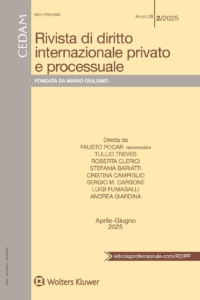 With a slight delay – entirely due to myself – I am pleased to announce the release of the second 2025 issue of the Rivista di diritto internazionale privato e processuale (RDIPP, published by CEDAM). This issue features:
Francesco Pesce, Associate Professor at the University of Genoa, Il riconoscimento delle decisioni straniere in materia civile tra previsioni sulla competenza funzionale del giudice interno e comunicazioni alla Commissione europea (Recognition of Foreign Decisions in Civil Matters between Provisions on the Functional Jurisdiction of National Courts and Communications to the European Commission; in Italian) Read more
Virtual Workshop (in English) on September 2, 2025: Eva Lein on “PIL and dispute resolution in times of crisis”

On Tuesday, September 2, 2025, the Hamburg Max Planck Institute will host its monthly virtual workshop Current Research in Private International Law at 11:00 a.m. – 12:30 p.m. (CEST). Professor Eva Lein (Lausanne University) will speak, in English, about the topic
“PIL and dispute resolution in times of crisis”
In times of polycrisis, the law is put to the challenge. In international commercial transactions the question is how law can safeguard commercial activity, avoid a plethora of disputes, and encourage a pragmatic legal environment conducive to global economic recovery. This contribution discusses how dispute settlement mechanisms and private international law can be used to responsibly manage disputes in this context and to appropriately respond to future crises.
The presentation will be followed by open discussion. All are welcome. More information and sign-up here.
If you want to be invited to these events in the future, please write to veranstaltungen@mpipriv.de.