Views

A Judgment is a Judgment? How (and Where) to Enforce Third-State Judgments in the EU After Brexit
In the wake of the CJEU’s controversial judgment in H Limited (Case C-568/22), which appeared to open a wide backdoor into the European Area of Justice through an English enforcement judgments (surprisingly considered a ‘judgment’ in the sense of Art. 2(a), 39 Brussels Ia by the Court), international law firms had been quick to celebrate the creation of ‘a new enforcement mechanism‘ for non-EU judgments.
As the UK had already completed its withdrawal from the European Union when the decision was rendered, the specific mechanism that the Court seemed to have sanctioned was, of course, short-lived. But crafty judgment creditors may quickly have started to look elsewhere.
In a paper that has just been published in a special issue of the Journal of Private International Law dedicated to the work of Trevor Hartley, I try to identify the jurisdictions to which they might look. Read more
Conference report ‘European Account Preservation Order: Practical Challenges and Prospects for Reform’ (University of Luxembourg, 3 December 2024)
This report was written by Carlos Santaló Goris, postdoctoral researcher at the University of Luxembourg
Recent developments on the application of the EAPO Regulation
On 3 December 2024, the conference ‘European Account Preservation Order: Practical Challenges and Prospects for Reform’ took place at the University of Luxembourg, organized by Prof. Gilles Cuniberti (University of Luxembourg). The conference also served as an occasion to present the book ‘European Account Preservation Order – A Multi-jurisdictional Guide with Commentary’, published by Bruylant/Larcier. The book was co-edited by Dr. Nicolas Kyriakides (University of Nicosia), Dr. Heikki A. Huhtamäki (Huhtamäki Brothers Attorneys Ltd), and Dr. Nicholas Mouttotos (University of Bremen), and offers a comprehensive overview on the application of the European Account Preservation Order (‘EAPO’) at the national level. It contains a report for each Member State where the EAPO Regulation applies, addressing specific aspects of the EAPO procedure that depend on domestic law.
The conference was structured into two panel discussions. The first panel focused on the specific issues regarding the application of the EAPO Regulation identified by practitioners with first-hand experience with this instrument. The second panel discussion explored the potential reform of the EAPO Regulation and which specific changes should be implemented to improve its application. This report aims to offer an overview of the main highlights and outputs of the presentations and discussions of the conference. Read more
The Art. 2(b) CISG Conundrum: Are Tender Contracts Under the Ambit of an Auction?
Introduction
It is beyond dispute that The Convention of International Sales of Goods, 1980 (CISG) has facilitated international trade disputes. However, Courts and tribunals continue to apply their minds in adjudicating the applicability of CISG before advancing into substantive issues. This exercise is not very prolific as it prolongs proceedings. Chapter 1 of the convention lays down the scope and extent of the CISG. Amongst other things, the CISG application does not apply to contracts formed by, inter-alia, auctions under Art. 2(b) of CISG. The word auction itself is nowhere defined in the convention.
News
New Book: La circolazione dello statuto personale / La circulation du statut personnel
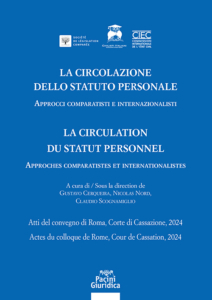 A new collective volume entitled “La circolazione dello statuto personale / La circulation du statut personnel” has recently been published by Pacini Giuridica. Edited by Gustavo Cerqueira (Nice), Nicolas Nord (Strasbourg) and Claudio Scognamiglio (Rome), the book brings together the proceedings of an international conference held on 19 January 2024 in Rome, in the prestigious Giallombardo Hall of the Italian Court of Cassation. Read more
Dutch Journal of PIL (NIPR) – issue 2025/3
The latest issue of the Dutch Journal on Private International Law (NIPR) has been published. It contains the following contributions.
NIPR 2025, Issue 3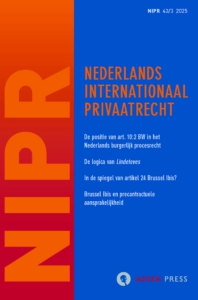
Editorial
Mathijs ten Wolde / p. 421
Articles
Steven Stuij, De positie van art. 10:2 BW in het Nederlands burgerlijk procesrecht / p. 423-444
Abstract
Article 10:2 of the Dutch Civil Code stipulates that the rules of private international law as well as the applicable law designated by those rules are to be applied ex officio. There has been a debate as to the positioning of this provision in relation to other rules of civil procedure on party autonomy as a result of two cases of the Dutch Supreme Court (‘Hoge Raad’). This contribution will address Read more
Public consultation on a possible new HCCH convention
Just 10 days left to participate in the public consultation on the Draft Text of a possible new HCCH convention on parallel proceedings and related actions!
The public consultation, launched on 18 November 2025, will close on 26 January 2026 at 9.00 a.m. CET. Experts, practitioners and judges from diverse legal traditions with experience in cross-border litigation and private international law more broadly are encouraged to participate in the consultation.
In 2021, the HCCH established a Working Group on matters related to jurisdiction in transnational civil or commercial litigation (WG), comprised of over 60 subject-matter experts from across the globe. The WG, after nine meetings, has developed a Draft Text containing provisions aimed at addressing parallel proceedings and related actions taking place in multiple States, acknowledging the primary roles of both jurisdictional rules and the doctrine of forum non conveniens. The objective of this future instrument would be to enhance legal certainty, predictability, and access to justice by reducing litigation costs and mitigating inconsistent judgments in transnational litigation in civil or commercial matters.
The public consultation seeks feedback on whether the Draft Text would, in practice, assist in addressing such matters and how the provisions in the Draft Text could be improved. The consultation is supported by a Consultation Paper comprising an Executive Summary, a detailed explanation of the key provisions and the operation of the Draft Text, and specific questions.
Responses received from this consultation will be submitted to all HCCH Members for consideration in advance of the next meeting of the Council on General Affairs and Policy (CGAP), the governing body of the HCCH, in March 2026, at which the Members of the HCCH will decide on the next steps for the project.
For more information on the public consultation, please visit: https://www.hcch.net/en/projects/legislative-projects/jurisdiction/public-consultation
This post is published by the Permanent Bureau of the Hague Conference of Private International Law (HCCH).