


Views
Paris, the Jurisdiction of Choice?
 On January 17th, the President of the Paris Commercial Court (Tribunal de commerce) inaugurated a new international division.
The new division, which is in fact the 3rd division of the court (3ème Chambre), is to be staffed with nine judges who speak foreign languages, and will therefore be able to assess evidence written in a foreign language. For now, the languages will be English, German and Spanish, as one juge speaking Spanish and two speaking German are currently on the court.
In an interview to the Fondation de droit continental (Civil law initiative), the President of the Court explained that the point was to make French justice more competitive and attract international cases. It also made clear that France was following Germany’s lead, where several international divisions were established in 2009 in Hamburg and Cologne.
French Commercial Courts
It should be pointed out to readers unfamiliar with the French legal system that French commercial courts are not staffed with professional judges, but with members of the business community working part-time at the court (and for free). In Paris, however, many of these judges work in the legal department of their company, and are thus fine lawyers.
Also, French commercial courts (and French civil courts generally) virtually never hear witnesses, so the issue of the language in which they may address the court does not arise.
Some issues
So, the new international division will be able to read documents in several foreign languages. However, nothing suggests that parties or lawyers will be able either to speak, or to write pleadings, in any other language than French. Lawyers arguing these cases will still need to file their pleadings in French, and thus to translate them in English beforehand for their clients. Furthermore, the interview of the Court’s President seems to suggest that using a foreign language will not be a right for the parties. Quite to the contrary, it seems that it will not be possible if one of the parties disagrees, and demands documents be translated in French.
Will that be enough to attract additional commercial cases to Paris?
I wonder whether introducing class actions in French civil procedure would have been more efficient in this respect.
For the full interview of the Court’s President, see after the jump.
News
Symposium for Trevor Hartley at LSE on 27 October 2023
Written by Ugljesa Grusic, Associate Professor at University College London, Faculty of Laws
Jacco Bomhoff (LSE), Ugljesa Grusic and Manuel Penades (KCL) are pleased to announce that the LSE Law School will host a symposium to celebrate the scholarly work of emeritus professor Trevor C Hartley.
Trevor has long been one of the world’s most distinguished scholars of Conflict of Laws (Private International Law), continuing a tradition started at the LSE by Professor Otto Kahn-Freund. For many decades, he has been at the forefront of developments in the field. As a prominent critic, notably of the Court of Justice’s efforts to unify European private international law. But also as an active participant in projects of legislation and modernization. And as author of authoritative treatises and clear and accessible student textbooks.
Book Launch: International Child Abduction, Mayela Celis (Madrid: Dykinson, 2023) on 5 October 2023 (in Spanish)
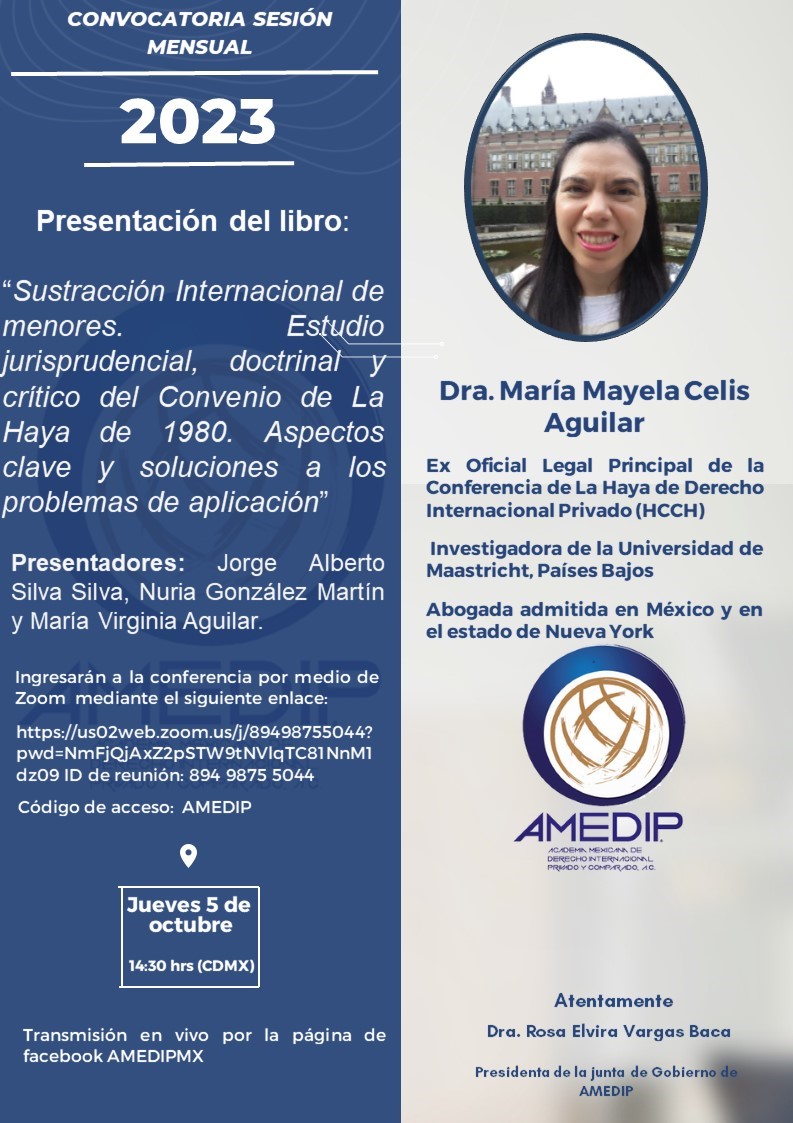
The Mexican Academy of Private International and Comparative Law (AMEDIP) is holding a webinar on 5 October 2023 at 2:30 pm (Mexico City time), 10:30 pm (Europe, CEST time) to launch the book entitled:
International Child Abduction: jurisprudential, doctrinal and critical study of the 1980 Child Abduction Convention. Key concepts and solutions to application problems (Madrid: Dykinson, 2023) 604 pp.
For more information about the book, see our previous post here.
The book will be presented by the author and the following AMEDIP members: Professors Jorge Alberto Silva Silva and Nuria González Martín, as well as the family law attorney María Virginia Aguilar.
The webinar will be held in Spanish and the details are:
Link: https://us02web.zoom.us/j/89498755044?pwd=NmFjQjAxZ2pSTW9tNVlqTC81NnM1dz09
Meeting ID: 894 9875 5044
Password: AMEDIP
Participation is free of charge.
This event will also be streamed live: https://www.facebook.com/AmedipMX
Symposium on Reparation for “Crimes of the Past” in Strasbourg (Oct. 19–20)
Written by Dr. Delphine Porcheron, Associate Professor at the University of Strasbourg Law Faculty
On October 19 and 20, the University of Strasbourg is organizing a symposium on Reparation for “Crimes of the Past”.
Mass crimes, deportations, spoliations, colonial exploitation, slavery… The “crimes of the past” are first known to us as historical facts. Their protagonists have mostly disappeared; they have been documented by historians; almost all of them are mentioned in school textbooks. They have become part of our collective memory as disastrous episodes of a bygone past.