


Views
The 2nd Dialogue on International Family Law
On 10 and 11 May 2019, the 2nd Dialogue on International Family Law took place at the University of Marburg (Germany). The dialogue serves as a forum for the exchange between high-level practitioners and academics active in the field of international family law; it is organised on an annual basis by Professors Christine Budzikiewicz (Marburg) and Bettina Heiderhoff (Münster), Dr. Frank Klinkhammer, a judge at the German Federal Supreme Court and an honorary professor in Marburg, and Dr. Kerstin Niethammer-Jürgens, a renowned family lawyer in Potsdam/Berlin. This year’s meeting focused on the well-being of the child in international family law, the pending revision of the Brussels IIbis Regulation and conflict of laws with regard to matrimonial property.
The conference was opened by Professor Rüdiger Ernst, a judge at the Kammergericht (Court of Appeals of Berlin), who described and analysed the various standards regarding the procedure to hear a child in international cases, with a special focus on the current state of play concerning the Brussels IIbis Regulation. The second presentation on the well-being of the child in the procedural law of the EU (the Brussels IIbis and the Maintenance Regulation) was given by Bettina Heiderhoff, who, in light of an intense scrutiny of the case-law, posed the critical question as to whether judges actually give weight to the well-being of the child in determining jurisdiction or whether they merely pay lip-service to this overarching goal. In particular, Heiderhoff focused on the question to which degree concerns for the well-being of children had an influence on determining their habitual residence. The second panel was started by Professor Anatol Dutta (University of Munich), who dealt with issues of lis pendens and annex jurisdiction in international family procedures – apparently, this is another area where more coherence between the various European regulations would be highly desirable. Then, Dr. Andrea Schulz (European Commission) analysed the new system of enforcement of judgments in the framework of the revised Brussels IIbis Regulation, which, by abolishing exequatur, shows a discernible influence of the paradigm shift already achieved by Brussels Ibis. At the moment, the English text is being finalised; it is to be expected that the revised version will be adopted by the Council of Ministers at the end of June 2019.
On the second day of the conference, Professor Dirk Looschelders (University of Düsseldorf) gave a presentation on the substantive scope of the Matrimonial Property Regulation (and the Regulation on Property Aspects of Registered Partnerships). The fact that there is no common European definition of the concept of “marriage” leads to numerous difficulties of characterisation; moreover, European courts will have to develop autonomous criteria to draw the line between matrimonial property regimes and adjacent legal areas (contracts, partnerships) not governed by the Regulation. Subsequently, Dr. Jens Scherpe (University of Cambridge) talked about forum shopping before English courts in matrimonial property cases. He focused on determining jurisdiction, calculating alimony and maintenance under English law and the thorny issue of under which circumstances English courts will accept matrimonial contracts as binding. Finally, Frank Klinkhammer gave a survey on recent case-law of the Federal Supreme Court in cases involving international agreements on surrogacy, in particular regarding the Ukraine. In a recent decision of 20 March 2019 (XII ZB 530/17), the Court had decided that a child who, after being born by a Ukrainian surrogate mother, was then brought to Germany as planned by all parties did not have its first habitual residence in the Ukraine, but in Germany, which, in effect, leads to consequence that the German designated mother has no other option but to adopt the child if she wishes to establish a family relationship. This led to an intense discussion about the principle of recognition and the determination of habitual residence (again). The conference proceedings will be published by Nomos. The next dialogue will take place on 24-25 April 2020 in Münster.
Patience is a virtue – The third party effects of assignments in European Private International Law
Written by Leonhard Huebner, Institute for Comparative Law, Conflict of Laws and International Business Law (Heidelberg University)
The third-party effects of the assignment are one of the “most discussed questions of international contract law” as it concerns the “most important gap of the Rome I Regulation”. This gap is regrettable not only for dogmatic reasons, but above all for practical reasons. The factoring industry has provided more than 217 billion euros of working capital to finance more than 200,000 companies in the EU in 2017 alone. After a long struggle in March of 2018, the European Commission, therefore, published a corresponding draft regulation (COM(2018)0096; in the following Draft Regulation). Based on a recent article (ZEuP 2019, 41) the following post explores whether the Draft Regulation creates the necessary legal certainty in this economically important area of law and thus contributes to the further development of European private international law (see also this post by Robert Freitag). Read more
Belgian Court of Cassation and Ryanair’s forum clauses
On 8 February 2019 the Belgain Court of Cassation decided the case Happy Flights v Ryanair. The Dutch version of the decision is available here.
At issue was the validity of the clause in Ryanair’s general terms and conditions that the Irish courts have jurisdiction over disputes. The Court of Cassation quashed the decision of the Commercial Court of Brussels, which had considered only the formal validity of the choice-of-court clause.
The Court of Cassation confirmed that the consumer protection provisions of Brussels Ia do not apply (the contracts concern transport). It further found that according to Art. 25(1) of Brussels Ia the substantive validity of the clause (in a non-negotiated contract) was subject to Irish law (specifically the Irish implementation in Act 27/1995 of Directive 93/13/EEG on unfair terms in consumer contracts). The Court did not explicitly refer to Irish private international law (according to Consideration 20 of Brussels Ia), but directly to Act 27/1995.
It sent the case back to the Commercial Court of Leuven for a new assessment.
News
From Theory to Practice in Private International Law: Gedächtnisschrift for Professor Jonathan Fitchen
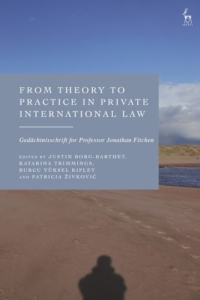 Written by Justin Borg-Barthet, Katarina Trimmings, Burcu Yüksel Ripley and Patricia Živkovic
Note: This post is also available via the blog of the European Association of Private International Law.
When our colleague and friend Prof Jonathan Fitchen passed away on 22nd January 2021, we were comforted in our grief by an outpouring of messages of condolence from private international lawyers around the world. We had known, of course, of the impact and importance of Jonathan’s work to the world of private international law scholarship. His monograph on authentic instruments, for example, will remain an essential reference on that subject for many years to come. Jonathan’s impact on the world of private international law scholars was, to a degree, less obvious. He was an unassuming man. He did not seek to command the attention of every gathering he attended, and he might have been surprised to realise how often he did just that. He was tremendously well-liked and well-respected for his wit, his self-deprecating sense of humour, and his empathy.
Virtual Workshop (in English) on March 5: Marta Pertegás Sender on Current Developments in Cross-Border Enforcement of Patent Rights: Revisiting Territoriality and Reflexive Effect?

On Tuesday, March 5, 2024, the Hamburg Max Planck Institute will host its 42nd monthly virtual workshop Current Research in Private International Law at 11:00-12:30 (CET). Marta Pertegás Sender (Maastricht University and University of Antwerp) will speak, in English, about the topic
Current Developments in Cross-Border Enforcement of Patent Rights: Revisiting Territoriality and Reflexive Effect?
The CJEU preliminary ruling in BSH Hausgeräte Case C-339/22 is eagerly awaited by those involved or interested in cross-border enforcement of patent rights. The forthcoming judgment may have broader repercussions for the position of territoriality in international litigation on intellectual property rights or for the private international law of property more generally.
EAPIL Wroclaw Conference 2024: Private International Law and Global Crises
 We are please to announce that registration for the next bi-annual conference of the European Association of Private International Law (EAPIL) is now open!
The conference will take place in Wroclaw (Poland) from 6 to 8 June 2024 and will be devoted to “Private International Law and Global Crises”. Topics to be discussed will include the interplay of private international law and 1) war and armed conflicts, 2) the rule of law, 3) climate change and 4) global supply chains. Speakers will be:
- Raffaele Sabato (European Court of Human Rights)
- Vincent Kronenberger (Court of Justice of the European Union)
- Andreas Stein (European Commission)
- Patrick Kinsch (University of Luxembourg)
- Veronica Ruiz Abou-Nigm (University of Edinburgh)
- Iryna Dikovska (Taras Shevchenko National University Kyiv)
- Tamasz Szabados (ELTE Eötvös Loránd University)
- Alex Mills (University College London)
- Matthias Weller (University of Bonn)
- Eduardo Alvarez Armas (Universidad Pontificia Comillas)
- Olivera Boskovic (Université Paris Cité)
- Rui Dias (University of Coimbra)
- Klaas Eller (University of Amsterdam)
- Laura Carpaneto (University of Genova)
To register for the conference please click here.
For questions, please get in touch with the local organizer, Agnieszka-Frackowiak-Adamska, at 2024.EAPIL.Wroclaw@uwr.edu.pl.