


Views
Common law recognition of foreign declarations of parentage
This note addresses the question whether there is a common law basis for the recognition of foreign declarations of parentage. It appears that this issue has not received much attention in common law jurisdictions, but it was the subject of a relatively recent Privy Council decision (C v C [2019] UKPC 40).
The issue arises where a foreign court or judicial authority has previously determined that a person is, or is not, a child’s parent, and the question of parentage then resurfaces in the forum (for example, in the context of parentage proceedings or maintenance proceedings). If there is no basis for recognition of the foreign declaration, the forum court will have to consider the issue de novo (usually by applying the law of the forum: see, eg, Status of Children Act 1969 (NZ)). This would increase the risk of “limping” parent-child relationships (that is, relationships that are recognised in some countries but not in others) – a risk that is especially problematic in the context of children born by way of surrogacy or assisted human reproduction technology.
The following example illustrates the problem. A baby is born in a surrogacy-friendly country to a surrogate mother domiciled and resident in that country, as the result of a surrogacy arrangement entered into with intending parents who are habitually resident in New Zealand. The courts of the foreign country declare that the intending parents are the legal parents of the child. Under New Zealand law, however, the surrogacy arrangement would have no legal effect, and the surrogate mother and her partner would be treated as the child’s legal parents upon the child’s birth. Unless the foreign judgment is capable of recognition in New Zealand, the only way for the intending parents to become the child’s legal parents in New Zealand is to apply for adoption (see, eg, Re Cobain [2015] NZFC 4072, Re Clifford [2016] NZFC 1666, Re Henwood [2015] NZFC 1541, Re Reynard [2014] NZFC 7652, Re Kennedy [2014] NZFLR 367, Re W [2019] NZFC 2482, Re C [2019] NZFC 1629).
So what is the relevance of a foreign declaration on parentage in common law courts? In C v C [2019] UKPC 40, [2019] WLR(D) 622, the Privy Council decided that there was a basis in the common law for recognising such declarations, pursuant to the so-called Travers v Holley principle. This principle, which has traditionally been applied in the context of divorce and adoption, calls for recognition of foreign judgments on the basis of “jurisdictional reciprocity” (at [44]). The Privy Council applied the principle to recognise a declaration of parentage made in Latvia, in relation to a child domiciled and habitually resident in Latvia, for the purposes of maintenance proceedings in the forum court of Jersey. Lord Wilson emphasised that, although foreign judgments may, in some cases, be refused on grounds of public policy, recognition will not be refused lightly: “a court’s recognition of a foreign order under private international law does not depend on any arrogant attempt on that court’s part to mark the foreign court’s homework” (at [58]).
As a matter of policy, my first impression is that the Privy Council’s decision is to be welcomed. Common law jurisdictions have traditionally taken a conservative, relatively “closed” approach to the recognition of foreign laws and judgments on parentage (see Hague Conference on Private International Law A Study of Legal Parentage and the Issues Arising from International Surrogacy Arrangements (Prelim Doc No 3C, 2014)). Such an approach has become increasingly indefensible in a world that is witnessing unprecedented levels of cross-border mobility and migration. The conflict of laws should, as a matter of priority, avoid limping parent-child relationships: for example, a child who was declared by the courts of their place of birth to be the child of the intending parents, but who is nevertheless treated as the surrogate mother’s child under New Zealand law. The ability to recognise foreign judgments on parentage may not amount to much progress, given that it can apply only where the foreign court has, in fact, made a declaration of parentage: it would have no application where the relevant parent-child relationship simply arises by operation of law or through an administrative act (such as entry of the intending parents in the birth register). There is no doubt that an international solution must be found to the problem as a whole. But it is surely better than nothing.
Another question is what to make of the Privy Council’s reliance on the Travers v Holley principle. Based on the decision in Travers v Holley [1953] P 246 (CA), the principle enables recognition of foreign judgments by virtue of reciprocity: the forum court will recognise a foreign judgment if the forum court itself would have had jurisdiction to grant the judgment had the facts been reversed (ie had the forum court been faced with the equivalent situation as the foreign court). In the context of divorce, the principle has since been subsumed within a wider principle of “real and substantial connection” (Indyka v Indyka [1969] 1 AC 33 (HL)). In the context of adoption, the principle has been applied to recognise “the status of adoption duly constituted … in another country in similar circumstances as we claim for ourselves” (Re Valentine’s Settlement [1965] Ch 831 (CA) at 842).
Perhaps it is not a big step from adoption to parentage more generally. The Privy Council recognised that the latter primarily represents “a conclusion of biological fact”, while adoption “stamps a person with a changed legal effect” (at [39]). But the Privy Council did not seem to consider that this distinction should warrant a different approach in principle. In C v C, the issue of parentage involved a relatively straightforward question of paternity. Had the case involved a question of surrogacy or human assisted reproduction, the answer might well have been different. There is an argument that a parent-child relationship created under foreign law can only be recognised in the forum if the foreign law is substantially similar to forum law. Thus, in the context of adoption, it has been asked whether the concept of adoption in the foreign country “substantially conform[s] to the English concept” (Re T & M (Adoption) [2010] EWHC 964, [2011] 1 FLR 1487 at [13]). This requirement might not be made out where, for example, the law of the forum does not recognise parentage by way of surrogacy (as is the case in New Zealand).
The Privy Council cautioned that the Board did not receive full argument on the issue and that the reader “must bear the lack of it in mind” (at [34]). It seems especially important, then, for conflict of laws scholars to give the issue further consideration. This note may serve as a careful first step – I would be interested to hear other views. Perhaps the most encouraging aspect of the Board’s reasoning, in my mind, is its openness to recognition. The Board’s starting point was that the declaration could be recognised. Arguably, this was because counsel seemed to have largely conceded the point. But to the extent that it cuts through an assumption that questions of parentage are generally left to the law of the forum, it nevertheless strikes me as significant – even more so since the UK Supreme Court’s previous refusal to extend the Travers v Holley principle beyond the sphere of family law (Rubin v Eurofinance SA [2012] UKSC 46, [2012] 3 WLR 1019 at [110], [127]).
Recognition in the UK of a marriage celebrated in Somaliland
Can a foreign marriage be recognised in the UK if the State where it was celebrated is not recognised as a State? This was the question which the High Court of Justice (Family Division) had to answer in MM v NA: [2020] EWHC 93 (Fam).
The Court distilled two questions: was the marriage validly celebrated and if so, can it be recognised in the UK? If the answers to both questions were affirmative, the court could give a declaratory order; if one of them were negative, the parties could celebrate a new marriage in the UK.
In assessing the first question, the court considered issues of formal and essential validity. It took account of the various systems of law in Somaliland: formal law (including the Somali civil code, which is still in force in Somaliland on the basis of its continuation under the Somaliland constitution), customary law and Islamic law. In matters of marriage, divorce and inheritance, the latter applies. On the basis of the facts, the Court came to the conclusion that the parties were validly married according to the law of Somaliland.
Although this would normaly be the end of the matter, the Court had to consider what to do with a valid marriage emanating from a State not recognised by the UK (the second question). The Court referred to the one-voice principle, implying that the judiciary cannot recognise acts by a State while the executive branch of the UK refuses to recognise the State. It then considered exceptions and referred to cases concerning the post-civil war US, post-World War II Eastern Germany, the Turkish Republic of Northern Cyprus, Ciskei (one of the ‘States’ created by Apartheid-era South Africa), and Southern Rhodesia.
It also referred to the ICJ Advisory Opinion of 21 June 1971 on the continued presence of South Africa in Namiba, particularly its §125, which states:
“while official acts performed by the Government of South Africa on behalf of or concerning Namibia after the termination of the Mandate are illegal and invalid, this invalidity cannot be extended to those acts, such as, for instance, the registration of births, deaths and marriages, the effects of which can be ignored only to the detriment of the inhabitants of the Territory.”
The Court found that an exception to the one-voice doctrine is acceptable in matters of private rights. The Court also explained that it had conferred with the Foreign and Commonwealth Office of the UK Government, who would not object to the recognition of a Somaliland marriage even though that State is not recognised.
It thus gave the declaration of recognition of the marriage.
(Thanks to Prakash Shah for the tip.)
Brexit & Lugano
Written by Jonathan Fitchen
The UK’s intention to attempt to accede to the 2007 Lugano Convention is apparently proceeding apace. Though the events leading up to Friday 31st January, when the UK left the EU, rather overshadowed this fact, the UK Government had already announced that its intention to accede by a posting on 28th January 2020 that may be found here https://www.gov.uk/government/news/support-for-the-uks-intent-to-accede-to-the-lugano-convention-2007 As will be remembered, the 2007 Lugano Convention is open to non-EU third States if the consent of all the existing Convention parties can be first secured. The UK Gov posting records that the UK has secured statements in support of it joining the 2007 Convention from the Swiss, the Norwegians and Iceland. So now all that is required is to secure the consent of the EU to this course of action. Assuming that such consent can be secured, the UK Gov posting records that it is the intention of the UK Government to accede to the 2007 Convention at the end of the transition period (currently scheduled / assumed for 23.00 GMT on 31st December 2020).
News
The DRIG Prize for Best Article in International Dispute Resolution
The Dispute Resolution Interest Group of the American Society of International Law (ASIL) is pleased to announce the third edition of the DRIG Prize for Best Article in International Dispute Resolution. The Prize will be awarded to the author(s) of the article published in 2023 that the Selection Committee considers to be outstanding in the field of international dispute resolution. DRIG is currently accepting submissions for the Prize.
Out Now: Aristova, Tort Litigation against Transnational Corporations. The Challenge of Jurisdiction in English Courts
Ekaterina Aristova (Bonavero Institute of Human Rights, University of Oxford) is the author of the ‘Tort Litigation against Transnational Corporations: The Challenge of Jurisdiction in English Courts’ (OUP 2024), which has just been published in the Oxford Private International Law series. She has kindly shared the following summary with us:
The book examines the approach of the English courts to the question of jurisdiction in civil liability claims brought against English-based parent companies and their foreign subsidiaries as co-defendants (e.g., Lubbe v Cape, Lungowe v Vedanta, Okpabi v Shell, etc.). While the book is written from the perspective of English law, the book also draws on examples of similar cases in Australia, Canada, EU Member States, and the US to broaden the discussion.
The assertion of jurisdiction in parent company liability claims based on a nexus with the forum state presents a challenge to the courts. The territorial focus of the adjudicative jurisdiction is often contrary to the transnational nature of cross-border business activities. Transnational corporations (TNCs) have the flexibility to spread operations over multiple jurisdictions and create a legal separation between the subsidiary’s activities and the home state of the parent company. Courts rely on various private international law rules and doctrines to resolve the question of jurisdiction in parent company liability claims, including forum non conveniens doctrine in common law legal systems, the mandatory rule of domicile under EU law, and the presumption against extraterritoriality in US jurisprudence. The broad disparities in the issues of civil jurisdiction among domestic legal regimes and the considerable controversy surrounding the exercise of extraterritorial regulation over corporate operations often lead to the creation of a ‘jurisdictional veil’ for the parent company and a significant degree of autonomy, largely free from the control of any national jurisdiction.
To address this puzzle, this book seeks to answer three questions: 1) To what extent can English courts, under existing rules, exercise jurisdiction over English parent companies and their foreign subsidiaries as co-defendants? 2) Is England a suitable forum for deciding parent company liability claims? 3) Should the jurisdictional competence of the English courts be broadened through a new connecting factor derived from the ‘economic enterprise’ theory?
The book aims to offer a new angle to the discourse by placing the discussion of parent company liability claims in the context of the topical debate about the changing role of private international law in a globalised world. The transnational adjudication of disputes, cross-border activities of non-state actors and expansion of private law-making challenge several conventional assumptions of the discipline of private international law, including its focus on territoriality and geographical connecting factors and its capacity to interact with public mechanisms. Home state courts have become the fora for struggles between TNCs and vulnerable communities from the host states, raising complex questions about (il)legitimate forum shopping, the appropriate forum, and the limits of judicial discretion. Parent company liability claims impact how we think about private international law and its function, and the reader is invited to explore these challenging dynamics.
The Bonavero Institute of Human Rights in Oxford will celebrate the publication of the book by hosting a (hybrid) book launch and wine reception on 5 June 2024.
Registration Now Open: The Hague Academy of International Law’s Winter Courses 2025
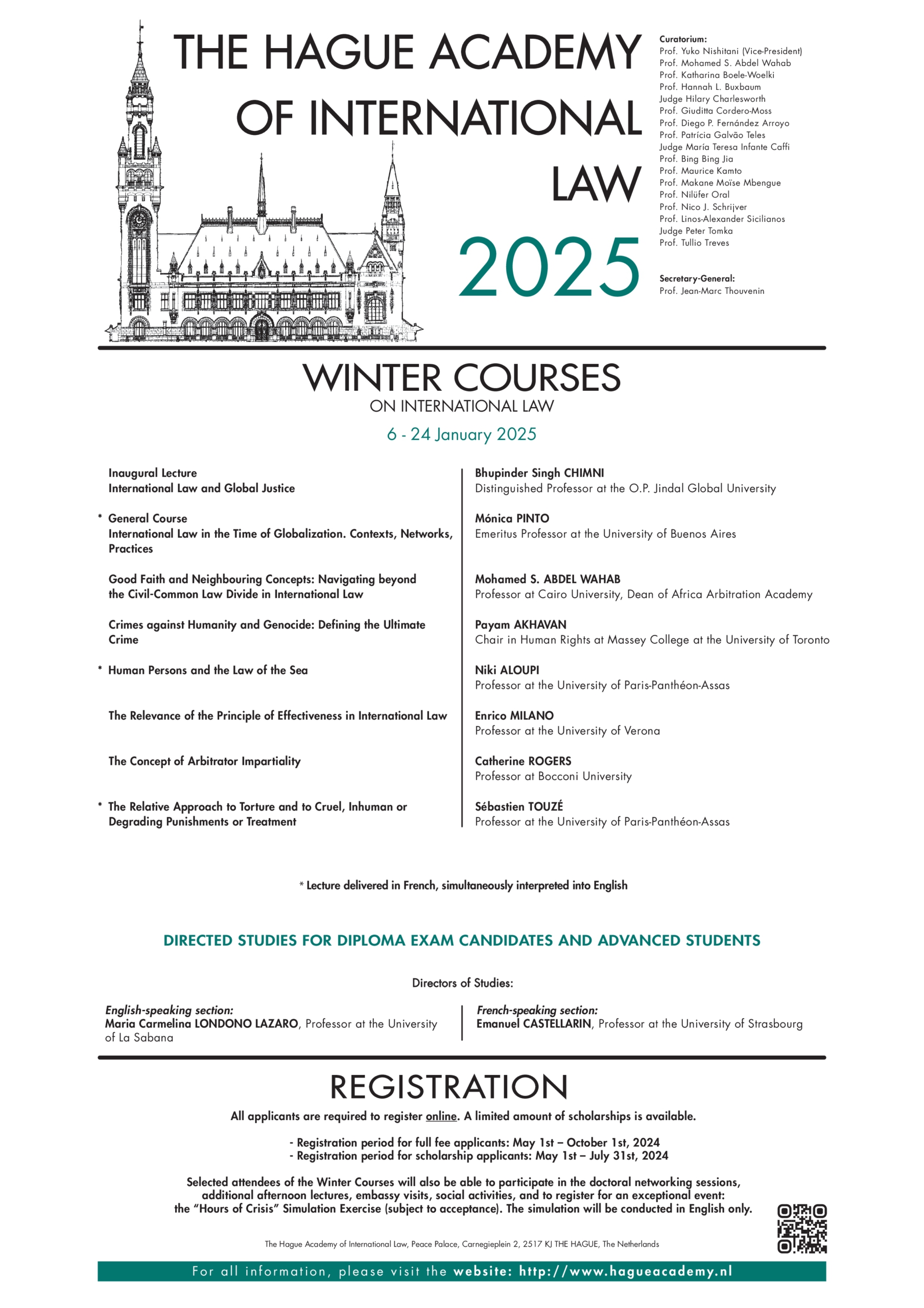
Registration for the 2025 programme of The Hague Academy of International Law’s renowned Winter Courses on International Law (6-24 January 2025) is now open. In contrast to the summer courses, this program combines aspects of both Public and Private International Law and therefore provides for a particularly valuable academic experience.
Following the Inauguaral Lecture by Bhupinder Singh Chimni (O.P. Jindal Global University), this year’s General Course in Private International Law will focus on “International Law in the Times of Globalization: Contexts, Networks, Practices” and will be delivered by Mónica Pinto (University of Buenos Aires). Furthermore, Special Courses will be offered in English by Mohamed S. Abdel Wahab (Cairo University), Payam Akhavan (University of Toronto), Enrico Milano (University of Verona) and Catherine Rogers (Bocconi University), while Niki Aloupi and Sébastien Touzé (Paris-Panthéon-Assas) will deliver their presentations in French. As always, all lectures will be simultaneously interpreted into English or French and vice versa. If you are interested in alternative dispute resolution, the lecture on “The Concept of Arbitrator Impartiality” seems particularly interesting.
Advanced Students, especially those who are ambitious to sit for the prestigious Diploma Exam, are highly encouraged to apply for the Academy’s Directed Studies as well. The French edition of these interactive afternoon seminars will be directed by Emanuel Castellarin (University of Strasbourg), while English-speaking candidates are taught by María Carmelina Londoño Lázaro (University of La Sabana).
Registration is open from 1 May 2024 to 1 October 2024 via the institution’s own Online Registration Form . Students who whish to apply for the Academy’s scholarship opportunities need to submit their application by 31 July 2024. For further information on the HAIL 2024 Winter courses and the Academy in general, please consult the HAIL Homepage or refer to the attached PDF Programme.