


Views
Corporate responsibility and private (international) law
Written by Giesela Rühl, University of Jena/Humboldt-University of Berlin
Note: This blogpost is part of a series on „Corporate social responsibility and international law“ that presents the main findings of all contributions published in August Reinisch, Stephan Hobe, Eva-Maria Kieninger & Anne Peters (eds), Unternehmensverantwortung und Internationales Recht, C.F. Müller, 2020.
1. Corporate social responsibility has been the subject of lively debates in private international law for many years. These debates revolve around the question of whether companies domiciled in countries of the Global North can be held liable for human rights violations committed by foreign subsidiaries or suppliers in countries of the Global South (so-called supply chain liability).
2. According to the majority view in the public international law literature, companies are not, at least not directly bound by human rights. Although numerous international law instruments, including the UN’s 2011 Guidelines for Business and Human Rights (Ruggie Principles), also address companies, liability for human rights violations is, therefore, a matter of domestic law.
3. The domestic law applicable to liability for human rights violations must be determined in accordance with the provisions of (European) private international law. Direct recourse to the lex fori, in contrast, is not possible. The legal situation in Europe is, therefore, different from the United States where actions which are brought on the basis of the Alien Tort Claims Act (ATCA) are governed by US-American federal (common) law.
4. Claims for human rights violations committed abroad will usually be claims in tort. Under (European) private international law it is, therefore, the law of the place where the damage occurs (Article 4(1) Rome II Regulation) and, hence, foreign law which governs these claims. Exceptions apply only within narrow limits, in particular if domestic laws can be classified as overriding mandatory provisions (Article 16 Rome II Regulation) or if application of foreign law violates the ordre public (Article 26 Rome II Regulation).
5. In addition to tort law, claims for human rights violations may also be based on company law, namely when directors are directly held liable for torts committed by a foreign subsidiary. According to the relevant private international law provisions of the Member States these claims are governed by the law of the (administrative or statutory) seat of the foreign subsidiary. As a consequence, claims in company law are also subject to foreign law.
6. The fact that (European) private international law submits liability for human rights violations to foreign law is very often criticized in the private international law literature. Claiming that foreign law does not sufficiently protect the victims of human rights violations, a number of scholars, therefore, attempt to subject liability claims de lege lata to the domestic law of the (European) parent or buyer company.
7. These attempts, however, raise a number of concerns: first, under traditional (European) private international law, substantive law considerations do not inform the determination of the applicable law. Second, the wish to apply the domestic law of a European country is mostly driven by the wish to avoid poorly functioning court systems and lower regulatory standards in countries of the Global South. Neither of these aspects, however, has anything to do with the applicable tort or company law. Regulatory standards, for example, are part of public law and, therefore, excluded from the reach of private international law. Finally, the assumption that the domestic law of the (European) parent or buyer company provides more or better protection to the victims of human rights violations does not hold true de lege lata. Since parent and buyer companies are legally independent from their foreign subsidiaries and suppliers, parent and buyer companies are only in exceptional cases liable to the victims of human rights violations committed abroad by their foreign subsidiaries or suppliers (legal entity principle or principle of entity liability).
8. The difficulties to hold (European) parent and buyer companies de lege lata liable for human rights violations committed by their foreign subsidiaries or suppliers raises the question of whether domestic laws should be reformed and their application ensured via the rules of private international law? Should domestic legislatures, for example, introduce an internationally mandatory human rights due diligence obligation and hold companies liable for violations? Proposals to this end are currently discussed in Germany and in Switzerland. In France, in contrast, they are already a reality. Here, the Law on the monitoring obligations of parent and buyer companies (Loi de vigilance) of 2017 imposes human rights due diligence obligations on bigger French companies and allows victims to sue for damages under the French Civil Code. The situation is similar in England. According to a Supreme Court decision of 2019 English parent companies may, under certain conditions, be held accountable for human rights violations committed by their foreign subsidiaries.
9. The introduction of an internationally mandatory human rights due diligence obligation at the level of national law certainly holds a number of advantages. In particular, it may encourage companies to take measures to prevent human rights violations through their foreign subsidiaries and suppliers. However, it is all but clear whether, under the conditions of globalization, any such obligation will actually contribute to improving the human rights situation in the countries of the Global South. This is because it will induce at least some companies to take strategic measures to avoid the costs associated with compliance. In addition, it will give a competitive advantage to companies which are domiciled in countries that do not impose comparable obligations on their companies.
10. Any human rights due diligence obligations should, therefore, not (only) be established at the national level, but also at the European or – even better – at the international level. In addition, accompanying measures should ensure that the same rules of play apply to all companies operating in the same market. And, finally, it should be clearly communicated that all these measures will increase prices for many products sold in Europe. In an open debate it will then have to be determined how much the Global North is willing to invest in better protection of human rights in the Global South.
Full (German) version: Giesela Rühl, Unternehmensverantwortung und (Internationales) Privatrecht, in: August Reinisch, Stephan Hobe, Eva-Maria Kieninger & Anne Peters (eds), Unternehmensverantwortung und Internationales Recht, C.F. Müller, 2020, pp. 89 et seq.
Jurisdiction unbound: extraterritorial measures to ensure corporate responsibility
Written by Nico Krisch, Graduate Institute for International and Development Studies, Geneva
Note: This blogpost is part of a series on „Corporate social responsibility and international law“ that presents the main findings of all contributions published in August Reinisch, Stephan Hobe, Eva-Maria Kieninger & Anne Peters (eds), Unternehmensverantwortung und Internationales Recht, C.F. Müller, 2020.
1. The conceptual framework of jurisdictional boundaries in international law continues to be dominated by the principle of territoriality and its exceptions, even if calls for a reorientation have grown in recent years.
2. The principle of territoriality leads today to far wider jurisdictional claims than in the past, and its limits are being redefined through ‘territorial extensions’ in a number of areas.
3. These extensions are rarely questioned by states, and clear and consistent jurisdictional boundaries remain hard to define. Contestation arises primarily when states seek to use extraterritorial measures to counteract important policy choices of other states.
4. The result is a far-reaching overlap of different jurisdictional spheres which, if seen in conjunction with the multiple forms of transnational regulation existing today, leads to a multi-layered ‘jurisdictional assemblage’.
5. So far, there are no accepted rules governing the relationship of competing jurisdictional spheres in this assemblage. The effective exercise of jurisdiction depends, in large part, on the political and economic power of a country in a given issue area and market.
6. The wider options for action that result from this territorial extension allow for more effective responses to existing societal challenges, especially with a view to the provision of (national and global) public goods, albeit in a limited way.
7. The new jurisdictional regime accentuates hierarchies between countries, interferes with the autonomy of weaker states, and subverts the principle of sovereign equality. Yet under certain circumstances, it also allows actors in weaker states to compensate for their otherwise limited ability to hold multinational companies to account.
8. Existing procedural and substantive proposals only have limited promise for alleviating the tensions resulting from the power imbalance in the exercise of jurisdiction.
9. The territorial principle in the law of jurisdiction has always been sufficiently limited not to overly impede powerful states’ pursuit of their interests.
10. Territoriality today appears less as a principle of effective limitations than as the basis of different strategies and tactics through which states seek to hold mobile actors to account and through which they pursue their political aims in a global context.
Full (German) version: Nico Krisch, Entgrenzte Jurisdiktion: Die extraterritoriale Durchsetzung von Unternehmensverantwortung, in: August Reinisch, Stephan Hobe, Eva-Maria Kieninger & Anne Peters (eds), Unternehmensverantwortung und Internationales Recht, C.F. Müller, 2020, pp. 11 et seq.
Jurisdiction for claims against transnational companies for human rights violations
Written by Anatol Dutta, University of Munich
Note: This blogpost is part of a series on „Corporate social responsibility and international law“ that presents the main findings of the contributions published in August Reinisch, Stephan Hobe, Eva-Maria Kieninger & Anne Peters (eds), Unternehmensverantwortung und Internationales Recht, C.F. Müller, 2020.
1. The question of the reach of courts’ jurisdiction is highly significant for claims against transnational enterprises based on human rights violations or environmental damages abroad. It does not only determine the applicable law but also the access to a particular justice system.
2. Universal jurisdiction of national courts for human rights and environmental damages claims against enterprises cannot be established, neither on the basis of existing law nor from a legal policy perspective. Rather, such claims have to be handled under the traditional jurisdictional mechanisms.
3. From a global perspective, a remarkable shift regarding jurisdiction can be noted: Whereas the courts in the United States are increasingly limiting access to their justice system in cases with foreign elements, jurisdictional limits are no significant hurdle for human rights and environmental damages claims in the European Union.
4. Domestic enterprises can be sued at their seat. Yet, the forum non conveniens doctrine allows US courts – and perhaps soon English courts as well – to decline jurisdiction, also for human rights and environmental damages claims.
5. Yet, human rights and environmental damages claims against foreign enterprises can also only be brought under certain circumstances in the EU.
6. Claims against foreign enterprises for human rights violations and environmental damages abroad can only rarely be brought before domestic courts based on special jurisdiction related to specific subject matters, for example the jurisdiction for tort claims at the place where the harmful event occurred.
7. If human rights and environmental damages claims are simultaneously directed against a domestic enterprise, for example a mother company or a buyer company in the EU, at least partially, foreign subsidiaries and suppliers can be sued on the basis of special jurisdiction over multiple defendants which can be used strategically.
a) If foreign enterprises have their seat in a third State outside the European Union, the jurisdiction of the domestic courts over the foreign co-defendant is governed by the national law of the forum Member State.
b) However, the current trend to establish a separate liability of domestic enterprises, for example, by extending human rights and environment-related duties of care for the supply chain, could endanger this special jurisdiction over multiple defendants, which, on the other hand, could lose significance.
8. Extending the general jurisdiction at the domicile of the defendant by relying on a personal criterion different to the seat of the defendant enterprise is not a viable solution.
a) Today US courts refuse to exercise jurisdiction based solely on the foreign enterprise ‘doing business’ within the territory. In some EU Member States, for claims against foreign enterprises at least with a seat in a third State, exorbitant jurisdiction can be established, for example, based on assets of the foreign defendant enterprise within the territory.
b) At the most from a policy perspective, for claims against foreign subsidiaries of a domestic enterprise the introduction of an enterprise jurisdiction could be considered.
9. For claims against foreign enterprises jurisdiction of the domestic courts can often only be based on a forum necessitatis if proceedings cannot reasonably and effectively be brought or conducted abroad; the hurdles for such an exceptional jurisdiction are, however, high.
10. To hear human rights and environmental damages claims against enterprises lies within the powers of the domestic courts.
a) Foreign enterprises do not enjoy State immunity even if they violate human rights or damage the environment abroad in collaboration with foreign States.
b) The power to adjudicate is also not limited by the fact that a decision of the court on human rights and environmental damages claims potentially has implications on the foreign policy relations of the forum State.
c) The domestic courts are often even not barred from deciding on human rights and environmental damages claims of foreign States against enterprises.
Full (German) version: Anatol Dutta, Internationale Zuständigkeit für privatrechtliche Klagen gegen transnational tätige Unternehmen wegen der Verletzung von Menschenrechten und von Normen zum Schutz der natürlichen Lebensgrundlagen im Ausland, in: August Reinisch, Stephan Hobe, Eva-Maria Kieninger & Anne Peters (eds), Unternehmensverantwortung und Internationales Recht, C.F. Müller, 2020, pp. 39 et seq.
News
The Hague Academy of International Law Centre for Studies and Research 2025: “Artificial Intelligence and International Law”
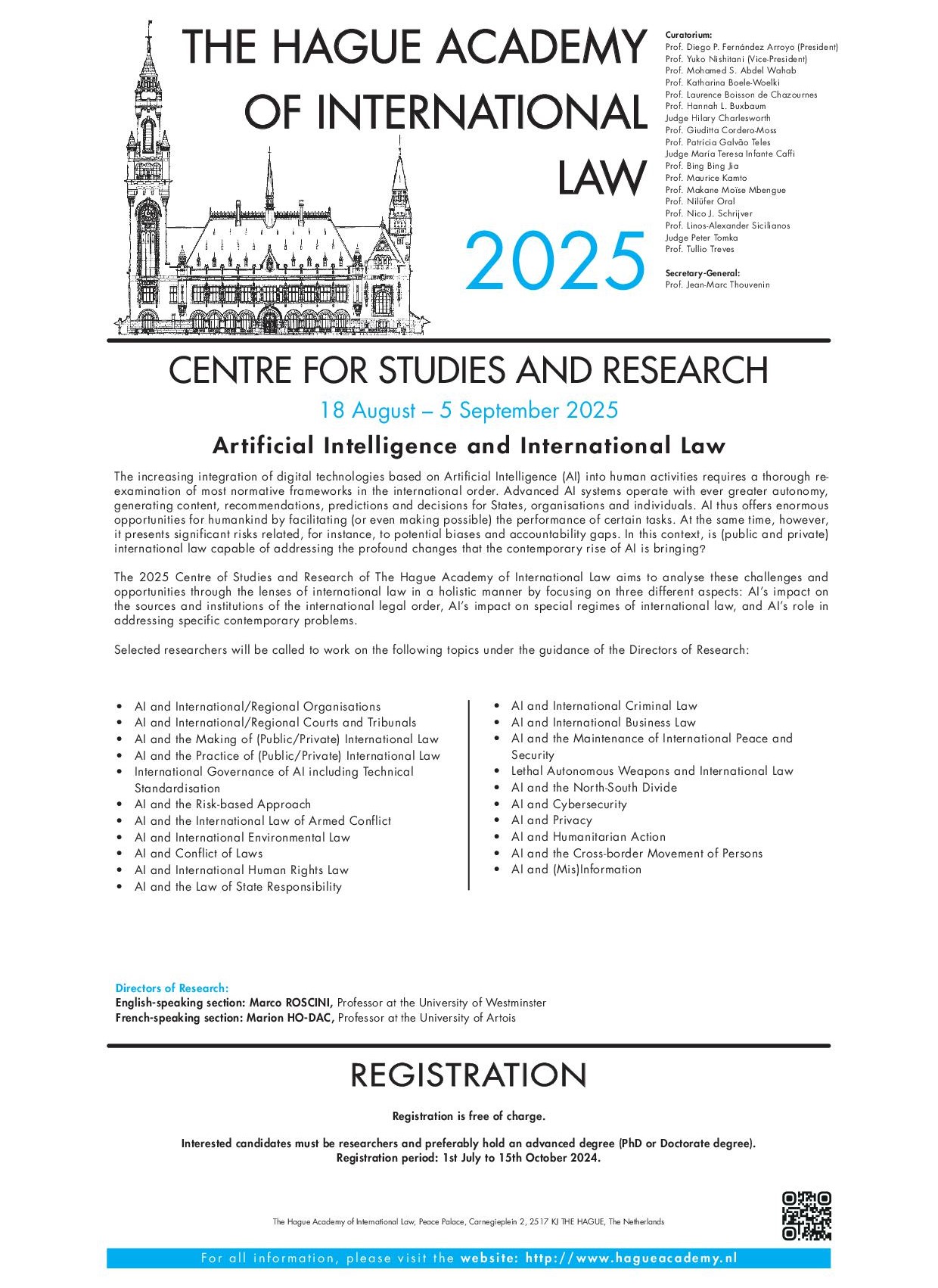
As recently highlighted by contributions on this blog, new technologies have a significant impact on the development of the law. Hence, the Curatorium of the Hague Academy of International Law has chosen for the the 2025 edition of the Centre for Studies and Research (18 August – 5 September 2025) to focus on the emerging topic of “Artificial Intelligence and International Law“. This year, the selected researchers will be work under the guidance of the Directors of Research, Marion Ho-Dac (Université d’Artois) for the French-speaking section as well as Marco Roscini (University of Westminster) for the English-speaking section.
Interested candidates must be researchers and preferably hold an advanced degree (PhD or Doctorate degree). Registration for the 2025 Centre is open from 1 July to 15 October 2024 via the institution’s own Online Registration Form.
The Academy describes the scope of its 2025 Programme as follows (emphasis added to highlight passages of specific interest to col.net readers):
The increasing integration of digital technologies based on Artificial Intelligence (AI) into human activities requires a thorough re-examination of most normative frameworks in the international order. Advanced AI systems operate with ever greater autonomy, generating content, recommendations, predictions and decisions for States, organisations and individuals. AI thus offers enormous opportunities for humankind by facilitating (or even making possible) the performance of certain tasks. At the same time, however, it presents significant risks related, for instance, to potential biases and accountability gaps. In this context, is (public and private) international law capable of addressing the profound changes that the contemporary rise of AI is bringing?
The Centre of Studies and Research 2025 of The Hague Academy of International Law aims to analyse these challenges and opportunities through the lenses of international law in a holistic manner by focusing on three different aspects: AI’s impact on the sources and institutions of the international legal order, AI’s impact on special regimes of international law, and AI’s role in addressing specific contemporary problems.
Selected researchers will be called to work on the following topics under the guidance of the Directors of Research:
- AI and International/Regional Organisations
- AI and International/Regional Courts and Tribunals
- AI and the Making of (Public/Private) International Law
- AI and the Practice of (Public/Private) International Law
- International Governance of AI including Technical Standardisation
- AI and the Risk-based Approach
- AI and the International Law of Armed Conflict
- AI and International Environmental Law
- AI and Conflict of Laws
- AI and International Human Rights Law
- AI and the Law of State Responsibility
- AI and International Criminal Law
- AI and International Business Law
- AI and the Maintenance of International Peace and Security
- Lethal Autonomous Weapons and International Law
- AI and the North-South Divide
- AI and Cybersecurity
- AI and Privacy
- AI and Humanitarian Action
- AI and the Cross-border Movement of Persons
- AI and (Mis)Information
For further information on the HAIL 2025 Centre and the Academy in general, please consult the HAIL Homepage or refer to the attached PDF Programme.
Two Interesting Recent Articles related to Private International Law
Williams C Iheme, “The Overdependence of African Courts and Businesses on English Law and Forum:
The Negative Repercussions on the Development of African Legal and Economic Systems” (2024) 15 Pravni Zapisi, pp. 151-190
The uncritical transplantation of English law by Anglophone-African legislators and judges, and their failure to sufficiently adapt English legal concepts to suit the idiosyncratic socioeconomic conditions in Africa, arguably contribute to the perpetuation of English law’s hegemony therein. It is argued that the overdependence on English law and courts by African businesses in resolving contractual disputes
is not necessarily due to any alleged stellar qualities of the former, but largely due to the over-marketing of the English legal system’s competence by its apologists. The analysis uses piquant examples to elicit some adverse effects of using/overreliance on the English law and forum by African businesses in resolving contractual disputes.
To reposition from the lengthened shadow of English law, Anglophone African legislators, judges and legal scholars, must craft autochthonous legal processes that suit Africa’s tastes and socioeconomic milieu.
Georgia Antonopoulou, “Forum Marketing in International Commercial Courts?” (2024) Oxford Journal of Legal Studies
Forum selling is a legal term used to describe the practices of courts and judges, geared towards attracting cases, such as increasing the predictability of judgments or speeding up trials. However, do courts also go beyond forum selling to attract cases? Taking international commercial courts as its focus, this article explores how these courts market themselves to attract cases and coins the term ‘forum marketing’. It demonstrates that the courts’ recent establishment, coupled with their voluntary jurisdiction, creates a compelling context, which encourages them to engage in forum marketing. The article argues that forum marketing is not merely a byproduct of the competition in commercial dispute resolution, but a powerful mechanism with deeply persuasive, normative and, effectively, structuring properties. Forum marketing is central to disseminating and reinforcing a pro-business approach in civil justice, consequently setting the stage for procedural inequality and a one per cent procedure.
Newest Commentaries and Newsletter on Private International Law (Vol. 7, Issue 1)
We are pleased to present the newest Commentaries on Private International Law (Vol. 7, Issue 1), the newsletter of the American Society of International Law (ASIL) Private International Law Interest Group (PILIG).