
Book Review: Choice of Forum Clauses in Asia (Lemuel L Lopez)


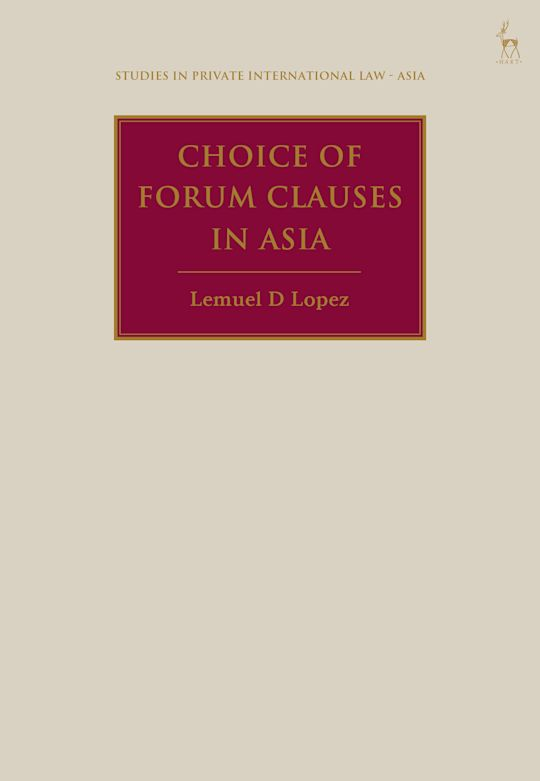
Choice of forum clauses are an important means of managing litigation risk in international commercial contracts. Their effectiveness, however, depends on how courts understand and enforce the parties’ agreement. This well-researched book offers a substantial comparative examination of that problem across seven Asian jurisdictions: Singapore, Hong Kong, Malaysia, the Philippines, China, Indonesia and Japan. Presented as the first work devoted to this particular comparative inquiry, it makes a valuable contribution to Asian private international law and offers insights that will interest readers working on choice of forum agreements elsewhere.
The selection of jurisdictions gives the study considerable comparative breadth. Singapore, Hong Kong and Malaysia represent common law systems strongly influenced by English law. The Philippines provides a mixed legal tradition shaped by American and Spanish influences, while China, Indonesia and Japan represent civil law traditions, with Dutch law having exerted a particularly significant influence on Indonesia. By bringing these systems together, the author examines how shared problems are addressed through different legal concepts and procedural arrangements.
The book’s analytical framework, introduced at the outset, comprises six connected questions: the characterisation of choice of forum clauses; party autonomy; the procedures available for enforcement; judicial discretion in granting relief; the applicable law; and the overriding effect of forum state and international interests (p 1). This framework is one of the book’s principal strengths. It connects questions that are often examined separately and demonstrates why the practical effectiveness of a clause cannot be assessed solely by reference to its contractual wording. The central argument is persuasive: choice of forum clauses can help manage the risks associated with international commercial transactions, but their effectiveness requires careful drafting and coherent judicial treatment.
Chapter 2 provides the conceptual foundation by examining competing understandings of the nature of choice of forum clauses. It explores the tension between their contractual or substantive character, commonly associated with traditional common law approaches, and their procedural or public character, associated with civil law approaches. The author appears to favour an approach that recognises both dimensions. I agree with this position. A choice of forum agreement records a private commitment, but its enforcement also affects the exercise of judicial authority. An account that accommodates both features provides a convincing basis for understanding the questions addressed throughout the book.
The chapter also considers the relationship between choice of forum clauses and arbitration agreements, their effects on non-parties, and their interaction with other contractual provisions. The comparison with arbitration is useful because both mechanisms enable parties to organise the resolution of future disputes. The author distinguishes the dual public and private character of choice of forum clauses from the contractual nature of arbitration agreements, thereby clarifying the conceptual basis of the book’s subsequent analysis.
Chapter 3 develops the discussion of party autonomy by distinguishing the parties’ freedom to determine the contents of their clause from their freedom to control the conduct of litigation. This distinction is helpful: agreement on a forum does not necessarily give parties unrestricted control over the court’s response. The treatment of the ouster rule illustrates the tension between private agreement and judicial authority. The book describes the movement away from the traditional objection that parties cannot oust the jurisdiction of common law courts, while showing the continuing influence of that objection in the Philippines. Its discussion of the Hague Choice of Court Convention 2005 places these domestic approaches within a broader framework for giving effect to party autonomy.
Chapter 4 examines the relief and remedies available in Singapore, Hong Kong, Malaysia and the Philippines. The comparative account reveals important differences within jurisdictions influenced by the common law. Singapore emerges as particularly receptive to contractual enforcement and party autonomy, whereas the Philippine treatment of choice of forum agreements as venue stipulations, together with the continuing influence of the ouster rule, limits their effect. Malaysia places greater emphasis on judicial discretion. The chapter also examines anti-suit injunctions and the recognition and enforcement of foreign judgments associated with the enforcement or breach of choice of forum agreements.
The Singapore discussion is especially instructive. The Singapore International Commercial Court and the operation of the Hague Choice of Court Convention demonstrate the jurisdiction’s commitment to facilitating international commercial dispute resolution. Yet the coexistence of different enforcement regimes also creates complexity. Parties may encounter different approaches depending on the court concerned, the applicability of the Convention, the exclusive or non-exclusive character of the clause, and the involvement of third parties. Singapore’s experience therefore illustrates a recurring theme of the book: strong support for party autonomy must be accompanied by rules whose practical operation parties can understand and predict.
Chapter 5 considers judicial discretion, including England’s judicial influence of The Eleftheria and Spiliada on the treatment of exclusive and non-exclusive jurisdiction clauses in Singapore, Hong Kong and Malaysia. Its examination of whether those clauses should be subjected to similar tests raises an important question about the relationship between contractual commitment and the assessment of the appropriate forum. The discussion helps explain why a court’s stated commitment to party autonomy does not, by itself, determine the outcome of an enforcement application.
Chapter 6 examines the relationship between choice of forum clauses and choice of law, focusing on existence, validity and interpretation. The account of Singapore, Hong Kong and Malaysia shows the influence of English common law approaches, including reliance on the law governing the main contract and the reservation of certain questions to the law of the forum. The operation of the Hague Choice of Court Convention in Singapore introduces a different reference to the law of the chosen court for substantive validity.
The discussion of exclusivity is also valuable. The cases examined suggest that, outside the relevant Convention framework, courts in Singapore, Hong Kong and Malaysia approach exclusivity principally as a question of contractual interpretation rather than through a general presumption. This finding reinforces the practical importance of clear drafting. Parties who intend to confer exclusive jurisdiction should express that intention in terms that minimise uncertainty about the scope and effect of their agreement.
Chapter 7 broadens the analysis by considering forum state and international community interests. Mandatory rules, public policy, comity and related concepts may affect the existence, validity and interpretation of clauses, the availability of relief, and the recognition and enforcement of resulting judgments. The attention given to weaker parties is particularly welcome. Asymmetric agreements, standard-form contracts and consumer transactions reveal why formal consent may not provide a sufficient justification for enforcement in every case. This chapter strengthens the book’s account of party autonomy by examining the interests that may legitimately qualify its operation.
Chapter 8 applies the preceding framework to China, Indonesia and Japan. Its discussion demonstrates both the usefulness and the limits of broad classifications into common law and civil law traditions. The Chinese treatment of disputes involving Hong Kong, Macau and Taiwan introduces distinctive questions concerning conflicts between legal systems. The discussion of forum non conveniens, anti-suit injunctions and asymmetric jurisdiction agreements further reveals how familiar mechanisms may acquire different functions within a particular legal system. In particular, the book contrasts the emphasis on efficiency in the Chinese approach to forum non conveniens with the attention to justice in the English approach.
The Indonesian analysis identifies difficulties arising from the conflation of choice of law and choice of court, including reliance on a foreign choice of law clause as a basis for declining jurisdiction. This is a useful illustration of the practical consequences of failing to distinguish two different exercises of party autonomy. The Japanese discussion addresses the special circumstances test, the presumption of exclusivity, the treatment of asymmetric clauses, and rules protecting consumers and employees. Together, these accounts show that support for choice of forum agreements operates within procedural and regulatory arrangements that vary considerably across the jurisdictions examined.
Interestingly, the book reveals differing approaches to asymmetric jurisdiction agreements in the civil law jurisdictions examined. Chinese courts enforce such agreements, while a Japanese court has treated an asymmetric jurisdiction clause as exclusive. The Japanese approach nevertheless operates within a framework that includes the special circumstances test and protections for weaker parties, particularly consumers and employees. These findings suggest that asymmetry does not, by itself, necessarily prevent enforcement in China or Japan.
The final chapter draws the comparative findings together effectively. Characterisation shapes the legal tools available; party autonomy guides judicial approaches; forum procedure determines the means of enforcement; and discretion remains an important element of the court’s response. The applicable law also matters, although the allocation of questions of existence, validity and interpretation differs between systems. Finally, forum state and international interests may override both private agreement and the otherwise applicable law. These findings support the book’s emphasis on careful drafting, predictable judicial analysis and procedural reform. They also provide a basis for considering wider participation in the Hague Choice of Court Convention and the Hague Judgments Convention 2019.
A modest criticism concerns the presentation of the findings. The chapters generally begin with clear and helpful introductions, but more consistent concluding sections would have made it easier to identify and compare their principal lessons. In a study of this breadth, short chapter conclusions could also have helped readers retain the relationship between the detailed national analysis and the book’s overarching framework. The strong final chapter substantially compensates for this omission.
Overall, this is an impressive and richly analysed comparative study. Its contribution lies in bringing contractual commitment, procedural rules, judicial discretion and public interests into a sustained examination of choice of forum clauses across diverse Asian legal systems. It will be valuable to scholars and practitioners of Asian private international law, while also providing a useful framework for comparative work beyond the region. I will certainly return to it, particularly when examining choice of forum agreements in African jurisdictions.
Leave a Reply
Want to join the discussion?Feel free to contribute!