
Mediating Across Borders: A Guide to Cross-Border Family Dispute Resolution by Costanza Honorati and Ester di Napoli


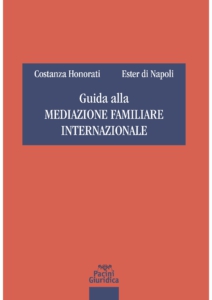 In response to the growing complexity of cross-border family disputes – driven by increasing mobility and evolving family configurations – the recently published Guida alla mediazione familiare internazionale in materia di responsabilita genitoriale e sottrazione internazionale di minori, authored by Costanza Honorati and Ester di Napoli (Pacini Editore, 2025; available online in open access, in Italian), offers a rigorous and thematically cohesive guide to the law and practice of cross-border family mediation. Grounded in both European and multilateral legal instruments, the volume brings together doctrinal precision, procedural clarity, and practical insight, establishing itself as an essential reference for legal practitioners, judges, mediators, and scholars navigating the intricate terrain of cross-border family justice.
The volume opens with a foundational reflection on the evolving legal and social configurations of cross-border families in crisis (Chapter 1: La mediazione familiare nel contesto transfrontaliero: uno sguardo d’insieme, by Ester di Napoli). This Chapter offers a conceptual and normative overview of family mediation in a transnational context, exposing its principles, objectives, and the interplay between substantive family law and instruments of judicial cooperation. By engaging with key legal sources – from the Council of Europe, the European Union, and the Hague Conference on Private International Law – the Author provides a robust framework for understanding the legal underpinnings of cross-border family mediation.
A significant contribution of the work lies in its detailed treatment of mediation procedures in cases involving parental responsibility and cross-border child abduction (Chapter 2: Il procedimento di mediazione familiare nei casi di responsabilità genitoriale e di sottrazione internazionale, by Ester di Napoli and Costanza Honorati). The Authors examine diverse models of mediation, the temporal and geographical contours of the process, and the variety of actors involved. Particular emphasis is placed on the procedural integration of mediation within the architecture of pending judicial proceedings, revealing how alternative dispute resolution can be effectively harnessed even in the midst of litigation. The Chapter also devotes considerable attention to the child’s role in mediation, affirming the centrality of the child’s right to be heard and to be appropriately informed. This rights-based approach is not merely rhetorical: it is embedded in the procedural design and underlined by practical guidance. Yet, the Authors do not lose sight of the ethical and legal limits of mediation. This section also develops a substantiated analysis of the challenges posed by domestic violence, emphasising the need for rigorous screening mechanisms and a nuanced understanding of power asymmetries within family relationships. Building on this, the book offers a granular analysis of mediation in the context of cross-border child abduction, with particular focus on tight procedural timelines, the dialectic between return proceedings and negotiated solutions, and the use of “package agreements” to resolve multifaceted family disputes.
The final part of the volume (Chapter 3: La circolazione dell’accordo di mediazione familiare negli Stati UE, by Costanza Honorati) offers a carefully reasoned examination of the recognition, enforcement, and circulation of mediated agreements within the European Union. Drawing on the Brussels II-ter Regulation, the 1996 Hague Convention, and relevant national instruments, the Chapter provides an authoritative interpretation of the legal frameworks governing cross-border effectiveness. At the heart of the analysis lies the complex transformation of mediated settlements into binding and enforceable decisions, including the conceptual and procedural distinctions between “agreements” and “decisions” under EU law. This section exemplifies the volume’s commitment not only to legal clarity but to practical operability, offering pathways for turning negotiated consensus into enforceable outcomes across jurisdictions.
In sum, Guida alla mediazione familiare internazionale in materia di responsabilità genitoriale e sottrazione internazionale di minori is far more than a practical manual: it is an invitation to reflect on the evolving normative landscape of cross-border family dispute resolution – one that increasingly privileges dialogue, cooperation, and child-centred justice. Through its intellectual coherence, doctrinal depth, and clear policy relevance, the volume offers both a roadmap and a critical commentary on the current and future architecture of cross-border family mediation within Europe and beyond.