Private International Law and Sustainable Development in Asia at Wuhan University – Report


By Zixuan Yang, a PhD student at Max Planck Institute for Comparative and International Private Law in Hamburg, Germany.
The Conference on Private International Law and Sustainable Development in Asia was successfully held at Wuhan University School of Law on 23rd November 2024. This international symposium was organized by Wuhan University Academy of International Law and Global Governance, Wuhan University School of Law and China Society of Private International Law. Following a Call for Papers of the Chinese Journal of Transnational Law (CJTL), the symposium provided an ideal platform for participants to critically and constructively engage with the functions, methodologies and techniques of private international law in relation to sustainable development from the Asian perspective. Distinguished legal experts and scholars from Japan, India, Vietnam, Singapore, Hong Kong SAR, Macao SAR, Taiwan, Mainland China, Germany and the Netherlands delivered presentations and participated in discussions on-site and online.
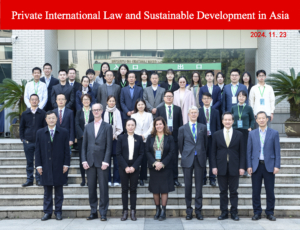
After Professor Zheng Tang opened the conference, vice President of the China Law Society, President of the China Society of International Law and President of the China Society of Private International Law, offered a welcome. This was followed by a joint keynote speech from Professor Ralf Michaels (Max Planck Institute for Comparative and International Private Law, Hamburg), Professor Verónica Ruiz Abou-Nigm (University of Edinburgh), and Hans van Loon (former Secretary-General of the Hague Conference on Private International Law) on Private International Law and SDGs 2030. Together with Zheng Tang, they will serve as special editors of an issue in CJTL that brings the papers together.
The Conference itself was divided into five panels.
The first panel on Family/Equality was chaired by Ralf Michaels. Prof. Rong-Chwan Chen (National Taipei University) elaborated on Taiwan’s Path toward gender equality in private international law in the light of the recognizability of three judgements involving same sex marriage in Taiwan, including the role of ordre public, renvoi and local household registration. Stellina Jolly and Prakriti Malla (South Asian University) raised several key questions regarding the incorporation of gender considerations into the Hague Convention on the Civil Aspects of International Child Abduction in view of international child abduction jurisprudence in India and Nepal.
The second panel on Migration was chaired by Hans van Loon. In light of the phenomena of intra-regional temporary migration in Asia, Prof. Yuko Nishitani (Kyoto University) addressed different methods of recognition to guarantee the continuity, stability and certainty of migrants’ name and family status. Zixuan Yang (Max Planck Institute for Comparative and International Private Law) clarified the conceptual contexts of legal identity in Asian jurisdictions and discussed specific issues of cross-border recognition of personal status in the Greater Bay Area.
Professor Ignacio de la Rasilla (Wuhan University) chaired the third panel on the Role of the State. Dr Ke Mu (Ocean University of China) analyzed the role of state-owned enterprise in international commercial and investment activities and raised the question whether the commitment to sustainability could be equivalent to the sovereign function. Mr Zihao Fan (Peking University) explored the roles of cities in transnational access to justice and the sustainable value through the systematic design of mainland China’s foreign-related jurisdictional regime as well as its special jurisdictional rules on cities’ level. Finally, Mr Jiabao Zhou (University of Amsterdam) suggested a potential role of private international law in the implementation of China’s foreign policy under China’s Foreign Relations Law, which arguably involves sustainable development as an essential value.
The fourth panel, chaired by Verónica Ruiz Abou-Nigm, focused on Environment/Climate Change. Profs. Adeline Chong and Stefanie Schacherer (Singapore Management University) gave a comprehensive and systematic analyses of the private international law issues in the regional legal framework for governance of the cross-border haze pollution in Southeast Asia. Profs. Nguyen Thi Hong Trinh (Hue University) and Bùi Thi Quynh Trang (Thuongmai University) explored the current situation and future prospects of climate change litigation from the perspective of Vietnamese law. Prof. Anselmo Reyes (International Judge at the Singapore International Commercial Court) gave a report entitled The Impartial Judge, Climate Change and the Conflict of Laws, with a focus on the question of how judges could get prepared in the face of increasing climate change litigations.
The last panel on The International Framework was chaired by Zheng Tang (Wuhan University). Dr Gérardine Goh Escolar (HCCH), in a prerecorded presentation, highlighted the efforts of the Hague Conference on Private International Law to provide legal certainty for stakeholders in the digital global economy and the global circular economy, and stressed the need to establish a sound procedural and substantive legal framework and international cooperation. Dr Ning Zhao (HCCH) emphasised the importance of Hague Conventions in simplifying administrative procedures and stressed the role of information technology in improving efficiency and reducing formalities in the cross-border transactions; her presentation was also prerecorded. Finally (and in person), (Wuhan University) gave a report entitled Regulating Global Anti-Competitive Conduct and the Role of Private International Law: Lessons from China. He pointed out the practical challenges of private enforcement of competition law in China and argued for enhanced efforts in both institution and capacity building.
Zheng Tang brought the event to a successful conclusion. As the Editor-in-Chief of the Chinese Journal of Transnational Law, she expressed her hope for more cooperation and exchanges between the journal and the conference participants in the future. The conference was followed by a lovely tour of the beautiful campus at Wuhan University.

(Photo by Wentao XU)