
Rivista di diritto internazionale privato e processuale (RDIPP) No 1/2023: Abstracts


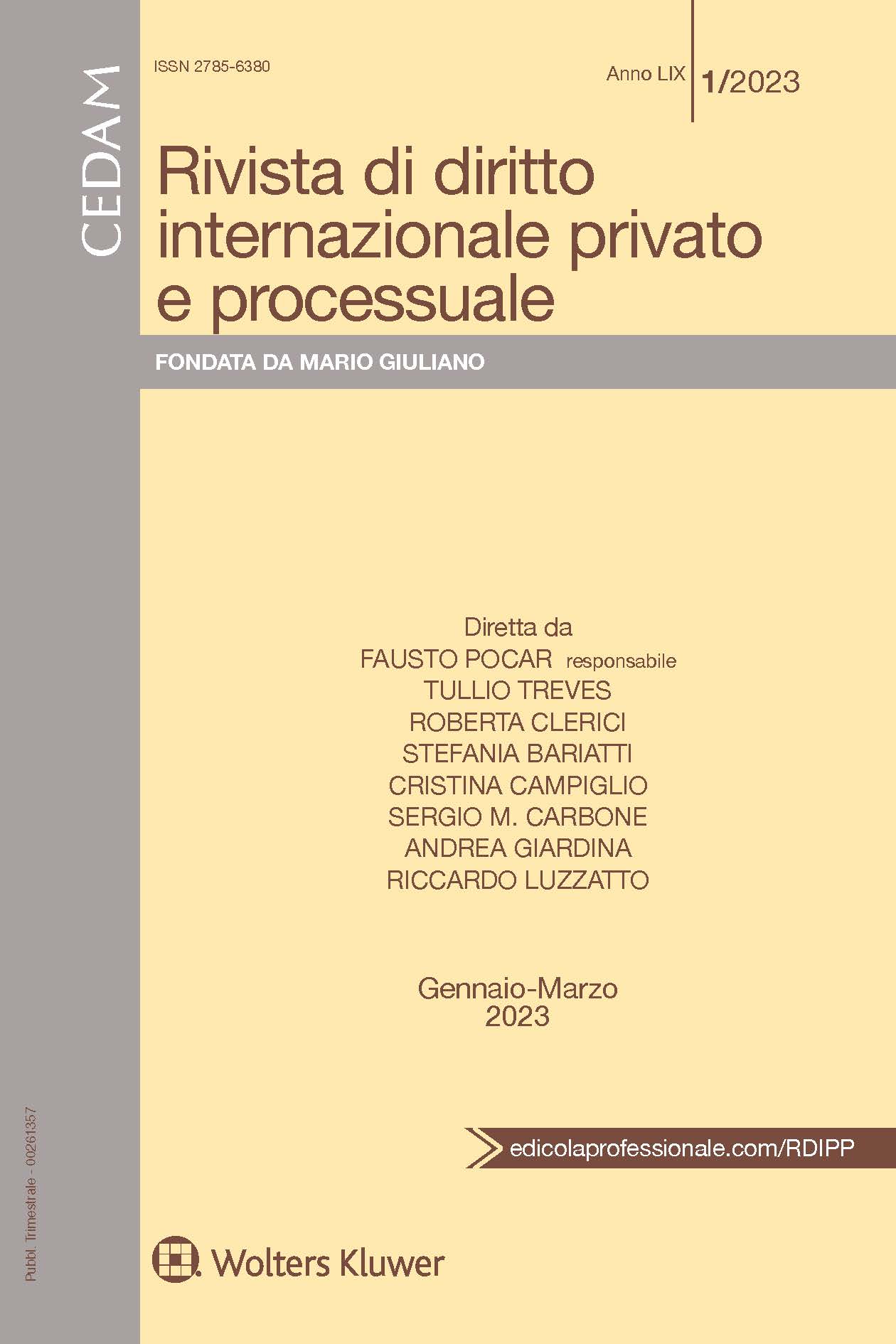 The first issue of 2023 of the Rivista di diritto internazionale privato e processuale (RDIPP, published by CEDAM) was just released. It features:
Francesco Salerno, (formerly) Professor at the University of Ferrara, L’impatto della procedura di interpretazione pregiudiziale sul diritto internazionale privato nazionale (The Impact of the Preliminary Rulings of the Court of Justice on National Private International Law; in Italian)
The European Court of Justice’s uniform interpretation of private international law concerns mainly – albeit not only – the EU Regulations adopted pursuant to Article 81 TFEU: in the context of this activity, the Court also takes into account the distinctive features of EU Member States. The increasing number of autonomous notions developed by the Court greatly enhanced the consistency and the effectiveness of the European rules. Against this background, the Italian judicial authorities implemented such a case-law even when it ran counter well-established domestic legal principles. Moreover, the European institutions rarely questioned the case-law of the Court of Justice, but when they did so, they adopted new rules of private international law in order to “correct” a well-settled jurisprudential trend of the Court.
Cristina Campiglio, Professor at the University of Pavia, La condizione femminile tra presente e futuro: prospettive internazionalprivatistiche (The Status of Women between Present and Future: Private International Law Perspectives; in Italian)
One of the Goals of the U.N. 2030 Agenda for Sustainable Development is gender equality (Goal 5), which can also be achieved through the elimination of “all harmful practices, such as child, early and forced marriage” (Target No 3) and the protection of women reproductive rights (Target No 6). This article addresses these two issues in a conflict-of-laws perspective, identifying the legal mechanisms through which legal systems counter the phenomenon of early marriages celebrated abroad and tackle the latest challenges related to the so-called reproductive tourism. After analyzing the role played by public policy exceptions and by the principle of the best interest of the child, it summarizes the Court of Justice’s case-law on the recognition of family situations across borders. In fact, the recognition of the possession of an EU status – meeting the social need to have a personal status which accompanies individuals anywhere within the EU area – is gaining ground. Such status is a personal identity merely functional to the exercise of EU citizens’ freedom of movement (Article 3(2) TEU, Article 21 TFEU and Article 45 EU Charter of Fundamental Rights). The result is the possession, by EU citizens, of a split personal identity – one functional to circulation, while the other one to its full extent – whose compatibility with the EU Charter of Fundamental Rights principles and with the ECHR may be called into question.
The following comment is also featured:
Marco Farina, Adjunct Professor at the University ‘La Sapienza’ in Rome, I procedimenti per il riconoscimento e l’esecuzione delle decisioni straniere nella recente riforma del processo civile in Italia (Proceedings for the Recognition and Enforcement of Foreign Judgments in the Recent Italian Reform of Civil Procedure; in Italian)
In this article, the Author comments on the new Article 30-bis of Legislative Decree No 150/2011, introduced by Legislative Decree No 149/2022 reforming Italian civil procedure and aimed at regulating “proceedings for the recognition and enforcement of foreign judgments provided for by European Union law and international conventions”. The Author analyses the new provision, focusing on the different procedural rules applicable, depending on the relevant EU Regulation or international convention concerned, to the proceedings that the EU Regulations listed in Article 30-bis of Legislative Decree No 150/2011 provide for obtaining the recognition and enforcement of the judgments rendered in a Member State other than the one in which they were rendered. In commenting on this new provision, the Author offers a reasoned overview of the problems generated by it with the relative possible solutions.
Finally, this issue features the following book review by Francesca C. Villata, Professor at the University of Milan: Pascal DE VAREILLES-SOMMIÈRES, Sarah LAVAL, Droit international privé, Dalloz, Paris (11th ed., 2023) pp. XVI-1359.