
Conflict of Laws
  • About
  • Editorial board
  • Subscription
  • Submission
  • Materials
  • Contact
  • Click to open the search input field Click to open the search input field Search
  • Menu Menu

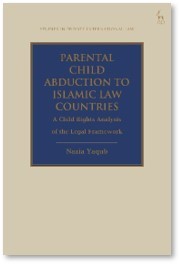
Parental Child Abduction to Islamic Countries by Nazia Yaqub

November 30, 2022/in News/by Thalia Kruger
image_pdfimage_print

This book by Nazia Yaqub is an addition to the Hart series, in which several books on international child abduction have been published. The author investigates Islamic law, discussing where relevant the history and the different schools, and the specific legal rules of the selected States that have not acceded to the Hague Child Abduction Convention (1980), as well as Morocco, which has acceded. She also examines whether the ratification of the Hague Child Abduction Convention by more States with Islamic legal systems would offer an improvement to the protection of children’s rights. The author analyses the child’s right to have their best interests taken as a primary consideration, the child’s right to be given the opportunity to be heard, and the child’s right to non-discrimination. The analysis places not only Islamic law under scrutiny but also the Hague Convention.

Besides using policy documents and international literature, she has also interviewed persons who were involved in child abductions.

The difficult discussion about the best interests of the child, including the issues that arise in this regard under the Hague Child Abduction Convention and the law in the Islamic States is presented in a nuanced way, keeping to the central theme of children’s rights. The detailed and rigorous analysis explores Islamic law, utilises case studies garnered from the empirical research and the Hague Convention. The book also sets out various models of child participation and shows how this right is only partially respected in Islamic law States and by the Hague Convention. It is argued that a child-centred approach requires separate representation for children.

The book also discusses non-discrimination, considering not only children’s rights but also other human rights instruments, especially concerning the rights of women (and girls). The author does not only consider discrimination to which children are subjected but also discrimination of mothers that directly influence children. This leads to an interesting and important analysis regarding the cultural nature of children’s rights and the reality of the relation nature of children’s rights with their mother/primary carer. Considerable thought is given to the ground for refusal in Article 20 of the Hague Child Abduction Convention. What also emerges through the analysis is the changing gendered dimension of parental abductions and the problematic issue of abduction by primary carers.

Nazia Yaqub is a lecturer in law at Leeds Beckett University, UK.


Oct 2022   |   9781509939114   |   304pp   |   Hbk   |    RRP: £85 / $115

Discount Price: £68 / $92

Order online at www.bloomsbury.com  – use the code GLR AP3UK for UK orders and GLR AP3US for US orders to get 20% off!

Share this entry
  • Share on Facebook
  • Share on X
  • Share on WhatsApp
  • Share on Pinterest
  • Share on LinkedIn
  • Share on Tumblr
  • Share on Vk
  • Share on Reddit
  • Share by Mail
https://conflictoflaws.net/News/2020/08/CoL_Banner-1.png 0 0 Thalia Kruger https://conflictoflaws.net/News/2020/08/CoL_Banner-1.png Thalia Kruger2022-11-30 16:00:482022-11-25 16:22:18Parental Child Abduction to Islamic Countries by Nazia Yaqub
Categories

  • Views
  • News

Most Recent Posts

  • Recognition of Italian Extrajudicial Divorces in Tunisia — Between Methodological Uncertainty and the Need to Preserve Continuity of Personal Status Across Borders August 9, 2026
  • Private International Law and European Society August 4, 2026
  • The New Zealand Supreme Court’s judgment in Kea Investments Ltd v Wikeley on anti-enforcement relief August 3, 2026
  • Beyond Domicile: The BHP Litigation and the Functional Interconnection of Public and Private International Law August 3, 2026
  • Conflicts of jurisdiction in Senegal: lesson from the Senegalese Supreme Court on Lis Pendens and the Exequatur of foreign judgments July 27, 2026
  • Adoption in the proposal for a European Parenthood Regulation July 21, 2026
  • Copyright, Targeting and Geo-Blocking: The CJEU Stirs the Pot July 15, 2026
  • A Follow-Up: The German Judges Association’s Response to the HCCH Draft Text of a Future Convention on Parallel Proceedings and Related Actions July 15, 2026
  • Private International Law Dimensions of Singapore’s New Legislation to Combat Online Harms July 14, 2026
  • The 1961 HCCH Apostille Convention: Why All African Countries Should Ratify It? — Insights from Judicial Practice in Africa July 14, 2026
  • The enforcement of an advance on costs for substitute performance at the expense of a Russian debtor in German-French legal relations July 2, 2026
  • “Yes, in principle, but not quite there yet…” – Some Observations on the Public Consultation on the HCCH Draft Text of a Future Convention on Parallel Proceedings and Related Actions June 29, 2026
  • Judgment Mobility Rules in India’s Private International Law Regime: No place for a revision au fond? June 26, 2026
  • Nothing to See Here: The CJEU’s Decision in Case C-232/25 Idzinski June 18, 2026
  • Refusal to Enforce in Egypt of a Californian (U.S.) Judgment for Lack of Reciprocity: What Has Gotten into the Egyptian Supreme Court? June 15, 2026
Link to: 70th Anniversary of the UIHJ Link to: 70th Anniversary of the UIHJ 70th Anniversary of the UIHJ Link to: GEDIP’s Reccommendation on the Proposal for a Directive on Corporate Sustainability Due Diligence Link to: GEDIP’s Reccommendation on the Proposal for a Directive on Corporate Sustainability Due Diligence GEDIP’s Reccommendation on the Proposal for a Directive on Corporate Sustainability...
Scroll to top Scroll to top Scroll to top