(I am grateful to Prof. Francesca Villata – University of Milan – for the following presentation of the latest issue of the RDIPP)
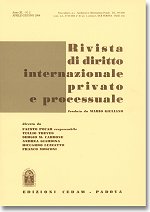 The fourth issue of 2015 of the Rivista di diritto internazionale privato e processuale (RDIPP, published by CEDAM) was just released.
This issue of the Rivista features the texts – updated and integrated with a comprehensive bibliography – of the speeches delivered during the conference “For a New Private International Law” that was hosted at the University of Milan in 2014 to celebrate the Rivista’s fiftieth anniversary.
The speeches have been published in four sections, in the order in which they were delivered.
The first section, on “Fundamentals of Law No 218/1995 and General Questions of Private International Law”, features the following contributions:
Fausto Pocar, Professor Emeritus at the University of Milan, ‘La Rivista e l’evoluzione del diritto internazionale privato in Italia e in Europa’ (The Rivista and the Evolution of Private International Law in Italy and Europe; in Italian).
Fifty years after the foundation of the Rivista, this article portrays the reasons that led to the publication of this journal and its core features, in particular its unfettered nature and the breadth of its thought with respect to the definition of private international law. In this regard the Rivista – by promptly drawing attention to the significant contribution provided by the law of the European Union in the area of jurisdiction and conflict of laws – succeeded in anticipating the subsequent developments, which resulted in the impressive legislation of the European Union in the field of private international law since the entry into force of the Treaty of Amsterdam in 1999. These developments have significantly affected the Italian domestic legislation as laid down in Law No 218 of 1995. As a result of such impact, the Italian system of private international law shall undergo a further revision in order to harmonize it with the European legislative acts, as well as with recent international conventions adopted in the framework of the Hague Conference on Private International Law, to which the European Union – a Member of the Conference – is party.
Roberto Baratta, Professor at the Scuola Nazionale dell’Amministrazione, ‘Note sull’evoluzione del diritto internazionale privato in chiave europea’ (Remarks on the Evolution of Private International Law in a European Perspective; in Italian).
National sovereignties have been eroded in the last decades. Domestic systems of conflict of laws are no exceptions. While contributing with some remarks on certain evolving processes that are affecting the private international law systems, this paper notes that within the EU – however fragmentary its legislation in the field of civil justice may be – the erosion of national competences follows as a matter of course. It then argues that the EU points to setting up a common space in which inter alia fundamental rights and mutual recognition play a major role. Thus, a supranational system of private international law is gradually being forged with the aim to ensure the continuity of legal relationships duly created in a Member State. As a result, domestic systems of private international law are deemed to become complementary in character. Their conceptualization as a kind of inter-local rules, the application of which cannot raise obstacles to the continuity principle, appears logically conceivable.
Marc Fallon, Professor at the Catholic University of Louvain, ‘La révision de loi italienne de droit international privé au regard du droit comparé et européen des conflits de lois’ (The Recast of the Italian Private International Law with Regard to Comparative and European Conflict of Laws; in French).
The comparison of the present state of Italian choice-of law rules with the overall revision process at stake abroad and with the new European Union policy in civil matters shows the need for a profound recast, in particular in family law matters. First, several European and international instruments have precedence over national rules, namely in the field of parental responsibility, divorce, maintenance obligations, succession, and shortly matrimonial property. Due to their universal application, these instruments leave no place to national choice-of law rules in the subject matters falling into their scope. Second, a recast of the Italian rules on private international law would give the opportunity to adapt some current rules to new values and objectives. For example, the Kegel’s ladder giving priority to nationality as a connecting factor should be inverted, giving priority to habitual residence. To achieve such result, a small group of scholars representative of the main ·streams in Italian private international law should prepare a draft and persuade political stakeholders that updating national law promotes legal certainty and a positive image of society. The European context of the approximation of choice-of-law rules should not withhold them from starting such project, so long as the Union delays the adoption of a globalized private international law code. On the other hand, one must be aware of the changing nature of law in modern society, and accept that enacting new rules requires a continuous reappraisal process.
Hans van Loon, Former Secretary General of the Hague Conference on Private International Law, ‘The Transnational Context: Impact of the Global Hague and Regional European Instruments’ (in English).
As a result of the growing impact of global and EU choice of law instruments, modern private international law statutes in Europe increasingly tend to have a “layered” structure, with norms derived from (1) global (Hague) and (2) regional (EU) instruments, completed by supplementary, or residual (3) domestic private international law rules. Law No 218/1995 already gives prominence to international conventions (Article 2), to which the new law should obviously add EU regulations. Consideration might be given to the inclusion by reference in the new law of three Hague Conventions not yet ratified by Italy (on the Recognition of the Validity of Marriages, Protection of Adults and Access to Justice). This would enhance certainty, predictability and respect for private rights in cross-border situations. The new law should maintain the method of incorporation by reference to regional and global instruments. Currently such references are few in number, but in the new law they are bound to expand considerably. This article discusses how the reference method could best be applied to, on the one hand, instruments on applicable law, and, on the other, instruments on jurisdiction, recognition and enforcement of decisions as well as administrative cooperation. As globalization and regional integration unfold, Italy will be facing many more foreign decisions and situations created abroad than foreseen in the 1995 Law. Articles 64 and following probably go a long way to respond to this challenge in respect of foreign decisions. In respect of foreign legal situations – not established or confirmed by a judicial or administrative decision – Article 13 of the Law No 218/1995 on renvoi may have been thought of a way of facilitating the task of the Italian authorities and of bringing international harmony. But, partly as a result of the growing weight of international and regional instruments which generally reject renvoi, this technique tends to become an anomaly in modern private international law codes. Instead, other ways of introducing the flexibility needed might be considered, such as Article 19 of the Belgian Code on Private International Law, or Article 9 Book 10 of the Dutch Civil Code.
The second section, on “Personal Status”, features the following contributions:
Roberta Clerici, Professor at the University of Milan,’Quale futuro per le norme della legge di riforma relative allo statuto personale?’(Which Future for the Provisions on Personal Status of the Italian Law Reforming the Private International Law System?; in Italian).
Since its first year of publication, the Rivista has devoted ample space to the personal status of the individual (including the right to a name), family matters, maintenance obligations and successions. In fact, both the relevant international treaties and the Italian provisions, including of course those laid down in Law No 218 of 31 May 1995 reforming the Italian private international law system – which has introduced significant modifications especially in the aforementioned areas of the law – were examined and commented. However, the regulations of the European Union and the international conventions that entered into force after the adoption of the Italian law reforming private international law designate habitual residence as the principal connecting factor. One may therefore wonder whether nationality, which is the connecting factor laid down in most of the provisions in Law No 218/1995, should not be replaced with that of habitual residence. An additional question stems from the “incorporation” in Law No 218/1995 of the 1961 Hague Convention concerning the powers of authorities and the law applicable in respect of the protection of infants (Article 42 of Law No 218/1995) and of the 1973 Hague Convention on maintenance obligations (Article 45 of Law No 218/1995), which have been replaced by the 1996 Hague Convention and the 2007 Protocol, respectively. With respect to the 1961 Hague Convention, a legislative proposal is currently being discussed, however it raises some questions concerning interpretation. The same proposal puts forth a general provision on the replacement of the “nationalized” Conventions with the new Conventions ratified by the European Union. However, quite surprisingly, the proposal does not mention the regulations of the European Union that have replaced other conventions that are referred to in Law No 218/1995.
Alegría Borrás, Professor Emeritus at the University of Barcelona,’La necessità di applicare strumenti convenzionali e dell’Unione europea: l’ambito della persona, della famiglia e delle successioni. La situazione spagnola e quella italiana a confronto’ (The Need to Apply International and European Union Instruments: Persons, Family, and Successions. A Comparison between the Italian and Spanish Systems; in Italian).
This article examines the characteristics and evolution of the Spanish system of private international law in questions related to persons, family and successions taking into account the need to apply European Union instruments and international Conventions. The main points addressed in this article are related to the absence of a law of private international law and the fact that Spain has a non-unified legal system.
Luigi Fumagalli, Professor at the University of Milan, ‘Il sistema italiano di diritto internazionale privato e processuale e il regolamento (UE) n. 650/2012 sulle successioni : spazi residui per la legge interna?’ (The Italian System of Private International and Procedural Law and Regulation (EU) No 650/2013 on Successions: Is There Any Room Left for the Italian Domestic Provisions?; in Italian).
Regulation No 650/2012 has a pervasive scope of application, as it governs, in an integrated manner, all traditional fields of private international law: jurisdiction, governing law, recognition and enforcement of foreign judgments. As a result, the entry into force of the Regulation leaves little, if any, room for the application of domestic legislation, and chiefly of the provisions of Law No 218/1995, in the same areas. With respect to jurisdiction, in fact, an examination of the rules in the Regulation shows that they apply every time a dispute in a succession matter is brought before a court in a Member State: no room therefore remains for internal rules, which, as opposed to the situation occurring with respect to Regulation No 1215/2012, cannot ground the exercise of jurisdiction in the circumstances in which the Regulation does not apply: not even the Italian rule on lis pendens seems to apply to coordinate the exercise of Italian jurisdiction with the jurisdiction of non-Member State. The same happens with respect to the conflict-of law rules set by the Regulation, since they have a universal scope of application. The only remaining area in which internal rules may apply is therefore that concerning the recognition and enforcement of decisions rendered in non-Member States. The opportunity for a revision of internal rules is therefore mentioned.
Costanza Honorati, Professor at the University of Milan–Bicocca, ‘Norme di applicazione necessaria e responsabilità parentale del padre non sposato’ (Overriding Mandatory Rules and Parental Responsibility of the Unwed Father; in Italian).
The recently enacted Italian Law on the Status Filiationis (Law No 219/2012 and subsequent Legislative Decree No 154/2013) inserts a new PIL rule stating that the principle of shared parental responsibility is mandatory in nature (Article 36-bis). While in the Italian legal system such principle is rooted in the principle of non discrimination among parents, the situation appears to be more controversial in other legal systems, especially in regards of the unmarried father. Several decisions of the ECtHR (from Balbotin to Sporer) have indeed declared the legitimacy of the different treatment for the unmarried father, as long as he has the possibility to claim such right before a judicial court. In the light of the same value underlying these different approach to parental responsibility – to be found in the aim to pursue the best interest of the child in each given case – the present paper questions the opportunity of the new Article 36-bis of the Italian PIL and reflects on the effects of the subsequent Italian ratification of the 1996 Hague Convention.
Carlo Rimini, Professor at the University of Milan, ‘La rifrazione del conflitto familiare attraverso il prisma del diritto internazionale privato europeo’ (The Refraction of Family Conflict through the Prism of the European Private International Law; in Italian).
The prism built up by the European Regulations relating to family law has the effect to refract the family conflict in several different aspects that are supposed to be dealt before different courts and with different laws. As a matter of facts, the rules concerning jurisdiction and applicable law do not have the aim to concentrate (or to try to concentrate) the whole conflict arising from the family’s crisis in the hands of a single judge who applies a single law. This choice has large costs both for the parties who needs to have lawyers in each jurisdiction involved, and for the efficiency of the legal system. Moreover, it often leads to an irrational and unfair solution of the family conflict. This is especially evident dealing about the patrimonial effects of the family’s breaking.
Ilaria Viarengo, Professor at the University of Milan, ‘Sulla disciplina degli obblighi alimentari nella famiglia e dei rapporti patrimoniali tra coniugi’ (On the Regulation of Family Maintenance Obligations and Matrimonial Property; in Italian).
This article examines the provisions of the Italian Private International Law Act (Law 31 May 1995 No 218) on maintenance obligations and matrimonial property regimes. It analyses these provisions in the prospect of a possible reform of Law No 218/1995. With particular regard to maintenance obligations, currently regulated by a common harmonized system of conflicts of law rules, this article underlines how Article 43 of Law No 218/1995, which refers to the 1973 Hague Convention, appears to be no longer relevant. With respect to matrimonial property, a new EU regulation is forthcoming, which will replace the current Article 30 of Law No 218/1995. In this regard, this article examines the amendments deemed to be necessary in the Italian law in the view of the new Regulation, focusing in particular on the need to protect the interests of third parties.
Franco Mosconi, Professor Emeritus at the University of Pavia, ‘Qualche considerazione in tema di matrimonio’ (Some Remarks on Marriage; in Italian).
Assuming that no revolutionary change is foreseen in the approach of the Italian legal system regarding same sex marriages – also in light of the case law of the Corte Costituzionale and the European Court of Human Rights – this paper considers several issues bound to arise from foreign same sex marriages. The paper also criticizes the excessive competitive character of some States’ legislation in favour of same sex marriages.
The third section, on “Companies, contractual and non-contractual obligations”, features the following contributions:
Riccardo Luzzatto, Professor Emeritus at the University of Milan, ‘Introduzione alla sessione: Società, obbligazioni contrattuali ed extracontrattuali’ (Opening Remarks: Companies, Contractual and Non-Contractual Obligations; in Italian).
The fiftieth anniversary of the Rivista provides an important opportunity to share some thoughts to the current status of the law in this complex sector of the conflict of laws, with particular regard to the prevailing situation in Italy. Actually, this anniversary prompts to consider the present status of the law in comparison with that existing at the time when the Rivista was first published, i.e. fifty years ago. From this point of view it is certainly appropriate to qualify the changes occurred in this period as a true conflict-of laws revolution, borrowing an expression frequently used with reference to the United States. The Italian revolution originates from two different factors: the adoption in 1995 of a new Act on private international law and the massive intervention of European Community law into this sector of the legal systems of the Member States. The problems faced by the lawmaker, the judge and any other interpreter are as a consequence rather complex. The national, domestic character of the rules of private international law has not been cancelled by the new powers conferred to the EU institutions by the Treaty of Amsterdam, thus obliging to carefully review and determine the relationship and reciprocal interferences of national and supranational sources in any given field where European common rules have been enacted. This is a necessary, but complex exercise that cannot be avoided, and can bring to very different results depending on the specific features of the legal institutions under consideration. Two interesting and significant examples are offered by the subject matters considered in this Session, i.e. the law of companies and other legal entities on the one part, and the law of obligations, both contractual and non-contractual, on the other.
Ruggiero Cafari Panico, Professor at the University of Milan, ‘Società, obbligazioni contrattuali ed extracontrattuali. Osmosi fra i sistemi, questioni interpretative e prospettive di riforma della legge n. 218/1995’ (Companies, Contractual and Non-Contractual Obligations. Osmosis between Systems, Questions of Interpretation, and Prospect of a Recast of Law No 218/1995; in Italian).
This paper focuses on the need for reform of the Italian private international law rules in order to adapt them to the principles of the European internal market. The continuous development of judicial cooperation in civil matters having cross-border implications has progressively reduced the scope of application of national conflict of law rules and deeply influenced the domestic regulation of matters not yet harmonized. This process of osmosis is not free from difficulties. The application of the criteria indicated in European private international law regulations to cases not pertinent to the internal market may be questionable. Similar concepts, when used in different European instruments, may lead to different results in connection with the choice of applicable law and of appropriate jurisdiction. Achieving a parallel ius and forum, although desirable, especially in employment relationships, may thus be difficult. All this has to be taken into account in any reform of the Italian private international law rules, which should be consistent with the proper functioning of the internal market.
Cristina Campiglio, Professor at the University of Pavia, ‘La legge applicabile alle obbligazioni extracontrattuali (con particolare riguardo alla violazione della privacy)’ (The Law Applicable to Non-Contractual Obligations (with Particular Regard to Violations of Privacy); in Italian).
Among the areas where EU private international law has curtailed the scope of application of the Italian Statute on Private International Law of 31 May 1995 No 218 is the area of non-contractual obligations (Regulation (EC) No 864/2007 on the law applicable to non-contractual obligations, Rome II). However, while Article 63 of Law No 218/1995 on product liability has been repealed by Article 5 of the Rome II Regulation, Articles 58 and 59 of Law No 218/1995 – on non-contractual obligations arising out of unilateral promise and under bills of exchange, cheques and promissory notes, respectively – are to be considered still in force, and Articles 60 and 61 of Law No 21811995 – on representation and ex lege obligation – preserve a limited scope of application. In this context, the fate of Article 62 of Law No 218/1995 on torts, which is also applicable to obligations arising out of violations of rights relating to personality, is rather dubious; while, indeed the Regulation expressly excludes these obligations from its scope, de iure condendo it may be envisaged that Article 62 of Law No 218/1995 be adapted to the EU principles and to the case law of the Court of Justice relating to (jurisdiction in case of) violations of rights relating to personality which have been carried out through the mass media, including online defamation.
Domenico Damascelli, Associate Professor at the University of Salento, ‘Il trasferimento della sede sociale da e per l’estero con mutamento della legge applicabile’ (The Transfer of a Company’s Seat Abroad and from Abroad with the Change of the Applicable Law; in Italian).
After having distinguished the case where the applicable law changes as a result of the transfer abroad of the company seat from that in which such change does not take place (either as a result of the shareholders’ will or as a consequence of the conflict of law rules of the State of origin and/or the State of destination), this article analyzes this issue from the standpoint of EU Private International Law – considering, in particular, the case law of the Court of Justice – and it puts forth a series of suggestions to reform the Italian conflict of law and substantive law rules to make the cross-border mobility of Italian companies more efficient.
Paola Ivaldi, Professor at the University of Genoa, ‘Illeciti marittimi e diritto internazionale privato: per una norma ad hoc nella legge n. 218/1995?’ (Maritime Torts and Private International Law: Does Law No 218/95 Need Ad Hoc Provisions?; in Italian).
Due to their intrinsically international character and very frequent cross-border implications, maritime torts typically involve private international law matters. Therefore, with regard to cases and issues falling outside the scope of application of the relevant uniform law Conventions, the problem arises of determining the applicable law according to the conflict-of law rules – which are mostly based on territorial connecting/actors – laid down, at EU level, in the Rome II Regulation (Regulation (EC) No 864/2007). The implementation of such rules, however, is sometimes critical, in particular in presence of “external torts” (i.e., torts which produce damage either on several ships or outside a ship) occurring on the High Seas; with respect to these cases, some national legislations (e.g., the Dutch civil code) have introduced ad hoc rules providing/or the application of the lex fori. In the light of the above, the present contribution assesses the opportunity to adopt the same solution on the occasion of the envisaged revision of the 1995 Italian legislation on private international law (Law No 218/1995), concluding, however, that such integration ab externo of the Regulation is not ultimately required.
Peter Kindler, Professor at the University of Munich, ‘L’amministrazione centrale come criterio di collegamento del diritto internazionale privato delle società’ (The Place of Administration as Connecting Factor in Conflict of Laws in Company Matters; in Italian).
This article reviews and analyses the case law of the Court of Justice of the European Union since the Cadbury Schweppes case (2006) and the principles laid down in secondary European legislation with specific reference to Regulation (EU) 2015/848 of 20 May 2015 on insolvency proceedings. The author proposes to use the Centre of main interests (COMI) of the company as a connecting factor not only in the field of European insolvency law (Articles 3 and 7 of Regulation No 2015/848), but also in a future Regulation on the law applicable to companies and other bodies. Since the COMI is identical to the company’s central administration (recital 30 of Regulation No 2015/848), this term should be used by such a Regulation. The Author rejects the incorporation theory (Griindungstheorie) and favours the real seat theory (Sitztheorie), instead. In his view, thus, the substantive corporate law of the country applies where most of the company’s creditors and the bulk of the company’s assets are located. At the same time, regulatory arbitrage opportunities are restricted.
Finally, the fourth section, on “International Civil Procedure Law”, features the following contributions:
Sergio M. Carbone, Professor Emeritus at the University of Genoa, ‘Introduzione alla sessione: il diritto processuale civile internazionale’ (Opening Remarks: International Civil Procedural Law; in Italian).
This article has been conceived and prepared with a view to providing an overview of the specific features which have characterized the first fifty years of our Rivista: such features were namely devoted to fostering the development of the Italian system on the resolution of cross-border disputes and the recognition of foreign judgments so as to avoid possible differentiations in their treatment in respect of the corresponding national situation.
Mario Dusi, Attorney at Law in Milan and Munich, ‘La verifica della giurisdizione all’atto dell’emissione di decreto ingiuntivo: regolamenti comunitari, norme di diritto internazionale privato italiano e necessità di riforma del codice di procedura civile italiano?’ (The Assessment of Jurisdiction while Issuing a Payment Order: EC Regulations, Italian Private International Law Provisions, and the Need to Amend the Italian Civil Procedure Code?; in Italian).
With the entry into force of Legislative Decree No 231 of 9 October 2002, Italian companies can finally apply for an injunction order against their contractual partners in Europe, who are defaulting their payment obligations. Such provision however did not specify that the court before which the application is filed must assess the existence (or nonexistence) of the prerequisites related to its international jurisdiction, pursuant to various applicable regulations, including the Italian Private International Law No 218/1995, which is the object of this important conference dedicated to the fiftieth anniversary of the Rivista di diritto internazionale privato e processuale. Before starting an ordinary court proceeding in Italy against a foreign party, in particular a European party, all regulations establishing the Italian jurisdiction must be analyzed, starting from the application of EU Regulation No 44/2001, now replaced by EU Regulation No 1215/2012, continuing with Article 3 of the above mentioned Italian law. These two Regulations notoriously state in Article 26 (of EU Regulation No 44/2001) that “Where a defendant domiciled in one Member State is sued in a court of another Member State and does not enter an appearance, the court shall declare of its own motion that it has no jurisdiction unless its jurisdiction is derived from the provisions of this Regulation”. Article 28 of EU Regulation No 1215/2012, currently applicable to these cases, states that the verification ex officio of the jurisdiction applies not only when the defendant decides not to appear in Court, but also to injunction proceedings, although this is not expressly mentioned in the provision. Therefore, in the event of non-appearance in court, or of injunction proceedings, as well as in some ordinary cases, the court must verify on its own initiative whether or not it has international jurisdiction and possibly declare ex officio its lack of jurisdiction; otherwise the injunction order will be declared invalid (see the Italian Supreme Court judgment No 10011/2001). According to the Italian Code of Civil Procedure, the application for an injunction order should expressly indicate the reason why such Court is considered to be competent (Article 637 Italian Code of Civil Procedure). If the Italian legislator wanted to prescribe more precisely all necessary requirements for the file of an application for an injunction order, it could refer to EU Regulation No 1896/2006, namely Articles 7 and 8, on the obligation of the court to “examine” all conditions, before issuing the injunction order. Basically, in order to promote the implementation of a United European Jurisdiction, we need to either establish a greater focus on judges while issuing injunction orders, or promulgate a clear internal rule, which imposes the above verifications on Italian judges.
Alberto Malatesta, Professor at the University Cattaneo-LIUC, ‘L’Article 7 della legge n. 218/1995 dopo il regolamento Bruxelles I-bis: quale ruolo in futuro?’ (Article 7 of Law No 218/1995 after Regulation Brussels I-a: Which Future Role?; in Italian).
This Article deals with the residual scope of Article 7 of Law No 218/1995 on lis pendens after the adoption, in recent past years, of numerous EU acts. In fact, the national provisions of Member States have progressively reduced their importance especially after the entry into force of the Brussels I-a Regulation, whose Articles 33 and 34 provide for rules applicabile to proceedings pending before judges of third States. The Author first examines such new regime and its underliyng reasons, secondly its impact on Article 7 of Law No 218/1995, and finally discusses the option of a future revison of the same rule, in line with the content of the European rule.
Francesco Salerno, Professor at the University of Ferrara, ‘L’incidenza del regolamento (UE) n. 1215/2012 sulle norme comuni in tema di giurisdizione e di efficacia delle sentenze straniere’ (The Impact of Regulation (EU) No 1215/2012 on the Italian Provisions on Jurisdiction and Recognition and Enforcement of Foreign Judgments; in Italian).
This paper examines the impact of Regulation (EU) No 1215/2012 (Brussels I Recast) on the Italian rules governing international litigation, as embodied in the Statute of 1995 that reformed the Italian system of private international law. As regards jurisdiction, almost no consequences derive from the Regulation. Article 3(2) of the 1995 Statute does make a reference to uniform European provisions in this area (so as to extend their applicability beyond their intended scope) but it still refers, for this purpose, to the 1968 Brussels Convention. The Author contends that if a legislative reform of the Statute provided for a forum of necessity, this would ultimately give a suitable basis to the trend of Italian courts in favour of a broad interpretation of the heads of jurisdiction resulting from the said reference, no matter whether such broad interpretation departs from the usual interpretation of the corresponding heads of jurisdiction laid down in the Convention. By contrast, the Regulation has a mixed bearing on the domestic regime for the recognition and enforcement of judgments. On the one hand, differently from national rules, the European rules now allow foreign judgments to be enforced internally merely by operation of law. On the other hand, the Regulation, if compared with domestic rules, provides more broadly for the opportunity of scrutinising whether individual judgments are entitled to recognition or not.
Lidia Sandrini, Research Fellow at the University of Milan, ‘L’Article 10 della legge n. 218/1995 nel contesto del sistema italiano di diritto internazionale privato e della cooperazione giudiziaria civile dell’Unione’ (Article 10 of Law No 218/1995 in the Framework of the Italian System of Private International Law and of the Judicial Cooperation in Civil Matters in the European Union; in Italian).
This article addresses Article 10 of Italian Law No 218 of 1995 on private international law. It is submitted that the provision governing jurisdiction with regard to the situation in which Italian judges lack jurisdiction on the merits represents a crucial mechanism in the application of the relevant rules on provisional and protective measures provided for by the EU regulations on jurisdiction and enforcement of judgments. Nevertheless, the practice reveals some difficulties as to the interpretation of the specific connecting factor provided for by the Italian rule. The analysis of the jurisprudence makes it clear that this unsatisfactory situation is due to the drafting, which does not reflect the variety of the instruments in connection with which the rule has to be applied and to the number of modifications of the domestic procedural rules that have been enacted after its entrance into force. In light of that, this article aims to contribute to the debate on the need of a reform of the Italian system of private international law by suggesting the introduction of some more detailed solutions with regard both to the jurisdictional criteria and to the characterization of provisional measures. These suggestions are primarily intended to ensure the consistency of the solutions in the European judicial area, in light of the jurisprudence of the Court of Justice, but also to preserve the coherence of the Italian system of private international law.
Francesca C. Villata, Associate Professor at the University of Milan, ‘Sulla legge applicabile alla validità sostanziale degli accordi di scelta del foro: appunti per una revisione dell’Articolo 4 della legge n. 218/1995’ (On the Law Governing the Substantial Validity of Jurisdiction Clauses: Remarks with a View to a Recast of Article 4 of Law No 218/1995; in Italian).
This article tackles the question whether the wording of Article 4 of Law No 218 of 1995 and, even more, its critical exegesis are (to date) adequate (a) with respect to the transformed legislative context of the European Union (which refers to such domestic legislation when the court seised is Italian), and (b) even more, to meet the needs of practitioners. Furthermore, this article aims to assess whether the solution adopted under the Brussels I-bis Regulation and the 2005 Hague Convention on Choice of Court Agreements – which both identify the law that governs the substantive validity of the choice of court agreements in the law of the State allegedly designated (including its conflict-of-law provisions) – may (or should) prompt an overall recast of the Italian law or, rather, require a more detailed provision which shall coordinate with the provisions on lis pendens.
Indexes and archives of RDIPP since its establishment (1965) are available on the website of the Rivista di diritto internazionale privato e processuale. This issue is available for download on the publisher’s website.
 European Private International Law serves the European idea of an area of freedom, security and justice. For that task, it seems crucial that the legal actors of European Private International Law address its fundamentals. The fundamentals – or fundamental questions – of European Private International Law are manifold. Some of them are discussed in this volume. They concern the political framework within which European Law operates, the challenges of modern concepts of “family” or the relationship of Private International Law and Religious Law. Last not least, European Private International Law needs to ascertain the regulatory function of central Conflict of Laws concepts such as the idea of connecting factors, party autonomy, ordre public and renvoi.