【Out Now】Silberman’s Hague Academy General Course: The Counter-Revolution in U.S. Private International Law: From Standards to Rules?
For anyone who begins studying private international law – particularly from a civil law perspective – one of the first concepts encountered, after Savigny’s ‘Copernican Revolution’, is the American ‘Choice-of-Law Revolution’. Since the late 1950s, American courts and scholars have progressively abandoned the rigid territorial methodology embodied in the First Restatement of Conflict of Laws in favour of more flexible approaches based on standards and policy-oriented analyses. The pioneering contributions of Brainerd Currie, David Cavers, Robert Leflar, and William Baxter, among others, fundamentally reshaped American conflicts law and made the United States a laboratory of modern choice-of-law theory.
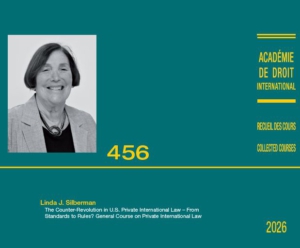
In this context, the publication of Professor Linda J. Silberman’s General Course on Private International Law in the prestigious Collected Courses of the Hague Academy of International Law (Volume 456), under the thought-provoking title The Counter-Revolution in U.S. Private International Law: From Standards to Rules?, is a significant event.
Professor Silberman hardly needs any introduction to readers interested in private international law. Emerita Professor at New York University School of Law, she is one of the leading authorities in the field, whose scholarship has profoundly influenced the development of U.S. private international law, particularly in the areas of conflict of laws, transnational litigation, international civil procedure, and the recognition and enforcement of foreign judgments. She has also played a major role in several American Law Institute Restatement projects, served as Reporter for the proposed federal statute on the recognition and enforcement of foreign judgments, and has been closely involved in the work of the U.S. State Department and the Hague Conference on Private International Law.
Professor Silberman’s General Course revisits this well-known narrative from a fresh perspective. Rather than focusing on the revolution itself, she examines whether American private international law is now witnessing a ‘counter-revolution’. Her central thesis is that, after several decades dominated by flexible standards and multifactor balancing, a discernible movement towards more rule-based solutions has emerged in a number of areas of U.S. private international law.
The breadth of the course is particularly noteworthy. Beyond choice of law, Professor Silberman explores the standards-vs-rules debate across a wide range of topics, including party autonomy in contracts, the extraterritorial application of U.S. statutes, judicial jurisdiction, adjudicatory comity (forum non conveniens, lis pendens, and international abstention), human rights litigation, transnational discovery, treaty interpretation, and the recognition and enforcement of foreign judgments. The table of contents alone demonstrates the ambitious scope of her work and its attempt to identify a common methodological trend across the different branches of American private international law. The publication of this General Course is therefore a significant event for both American and comparative private international law, as it does not only provide a comprehensive account of the evolution of U.S. private international law over the past six decades, but also offers an original framework through which to understand its most recent developments.
The general outline of the volume is structured as follows
Biographical Note
Principal Publications
Preface and Acknowledgments
Chapter I. Introduction to the U.S. Legal System and to the Nomenclature of Standards and Rules
Chapter II. The Counter-Revolution from Standards to Rules in Choice of Law: The Example from Torts and the Third Restatement of Conflicts
Chapter III. Party Autonomy in Contracts: From Standards to Rules and the Third Restatement of Conflict of Laws
Chapter IV. Extraterritorial Reach of U.S. Statutes: From Standards to Rules
Chapter V. Judicial Jurisdiction in the Supreme Court: The Move Toward a More Rule-Based Regime
Chapter VI. The Role of Adjudicatory Comity—Forum Non Conveniens, Lis Pendens, and International Abstention—in the Rules vs. Standards Debate
Chapter VII. Human Rights Violations: Suits Against Private Parties in the Age of Statutes
Chapter VIII. Discovery and Judicial Assistance in Transnational Litigation and Arbitration: Of Rules and Standards
Chapter IX. Wherefore Rules and Standards in Treaty Interpretation: The Hague Abduction Convention Example
Chapter X. “Standards” vs. “Rules” in the U.S. Recognition and Enforcement of Foreign Country Judgments: Prospects for the Future
Epilogue: A Summary
Bibliography