【Out now】Li and Ma on Private international Law in Taiwan
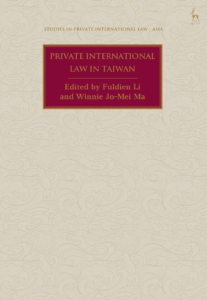
Very few legal systems in the world exhibit the distinctive features and peculiarities of Taiwanese private international law. Situated in an unusual international position, Taiwan—formerly known in the West as Formosa, a name reportedly given to the island by Portuguese sailors in 1544—lies at the crossroads of regional powers and competing geopolitical interests. Its particular international status has profoundly shaped the development of its legal system, giving rise to a private international law framework that is as distinctive as it is complex.
Although Taiwanese private international law has attracted some attention in English-language scholarship, notably through the work of Prof. Rong-Chwan Chen (see Rong-Chwan Chen, Private International Law in Taiwan (Kluwer Law International, 2021)), as well as through various chapters addressing specific aspects of Taiwanese PIL in other legal publications, works devoted specifically to this subject remain relatively limited. It is therefore particularly welcome that this fascinating and relatively underexplored legal system has received further attention in the recently published Private International Law in Taiwan, edited by Fuldien Li and Winnie Jo-Mei Ma and published by Hart Publishing. The book is part of Hart’s outstanding and steadily growing Studies in Private International Law – Asia series. It is the eighth volume in the series devoted to the private international law of a particular jurisdiction, following those on Indonesia, China, Japan, India, Hong Kong, Cambodia and the Philippines.
Like its predecessors, the book covers a broad range of topics, from international jurisdiction and choice of law to the recognition and enforcement of foreign judgments, international commercial arbitration and the harmonisation of private international law. It thus provides a valuable reference for anyone interested in understanding the distinctive features of Taiwanese private international law and its place in the wider landscape of the discipline.
The book’s description reads as follows:
This is the leading reference on Taiwan’s private international law in English.
The chapters systematically cover the whole of Taiwan’s private international law, including designated chapters on the law of obligations, property, family law, corporations and insolvency, together with separate chapters on international commercial arbitration and investment treaty arbitration.
Taiwan’s legal framework is a hybrid civil law system that evolved from the Chinese legal tradition and the adoption of the modern Roman system, as well as increasing influences from common law jurisdictions and international law. Its unique status and prominence in international trade and investment provide unique opportunities for aligning with, and contributing to, regional and international harmonisation of private international law. Through a combination of civil law and common law approaches and perspectives, the book provides a balanced and nuanced presentation of Taiwan’s private international law that will appeal to practitioners and scholars worldwide.
The table of contents is structured as follows:
PART I – INTRODUCTION
- The Subject Matter of Private International Law (Rong-Chwan Chen)
- Sources of Private International Law (Rong-Chwan Chen)
- History of Private International Law in Taiwan (Fuldien Li)
- Preliminary Matters (Chun-Liang Lai & Yao-Ming Hsu)
- Connecting Factors (Chun-Liang Lai)
- Substance and Procedure (Chun-Liang Lai)
- Proof of Foreign Law and Other Evidentiary Matters (Chun-Liang Lai)
- Mandatory Rules and Ordre Public (Yao-Ming Hsu & Kuang-Ping Wu)
PART II – JURISDICTION
- Jurisdiction (Andrew C Hsu)
- Jurisdiction in Shipping Claims (Andrew C Hsu)
- Immunity from Jurisdiction (Yao-Ming Hsu)
PART III – CHOICE OF LAW
- Law of Persons (Chun-Liang Lai)
- Law of Obligations (Kuang-Ping Wu & Chun-Liang Lai)
- Law of Property (Kuang-Ping Wu)
- Family Law (Chun-Liang Lai & Hou-Cheng Lee)
- Law of Succession (Chun-Liang Lai)
- Law of Corporations and Insolvency (Yen-Te Wu)
- Law of Bankruptcy (Hou-Cheng Lee)
PART IV – RECOGNITION AND ENFORCEMENT OF FOREIGN JUDGMENTS
- Recognition of Foreign Judgments (Chun-Liang Lai)
- Enforcement of Foreign Judgments (Chun-Liang Lai)
PART V – ARBITRATION
- International Commercial Arbitration (Fuldien Li & Winnie Jo-Mei Ma)
- Investment Treaty Arbitration (Yen-Te Wu)
PART VI – THE HARMONISATION OF PRIVATE INTERNATIONAL LAW
- Taiwan’s Involvement in the Harmonisation of Private International Law (Chun-Liang Lai)
- The Future of Private International Law in Taiwan (Chun-Liang Lai)
Bibliography
Glossary
Index