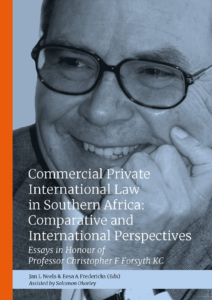
【Out Now – Open Access】Commercial Private International Law in Southern Africa: Comparative and International Perspectives: Essays in Honour of Professor Christopher F Forsyth KC
Professor Christopher F. Forsyth is undoubtedly one of the leading figures in private international law in Africa, particularly in Southern Africa, where his scholarship has had a profound and lasting influence. His seminal work, Private International Law – The Modern Roman-Dutch Law Including the Jurisdiction of the High Courts (5th ed., Juta, 2012), is not only an indispensable reference for scholars and researchers, but also an authoritative work before Southern African courts, where it is frequently cited with approval.
It is therefore a great pleasure to bring to readers’ attention the publication of the Festschrift in honour of Professor Forsyth, celebrating his remarkable scholarly legacy: Commercial Private International Law in Southern Africa – Comparative and International Perspectives: Essays in Honour of Professor Christopher F. Forsyth KC, edited under the able guidance of Professor Jan L. Neels and Professor Easa A. Fredericks, with the assistance of Dr Solomon Okorley. Thanks to the generosity of the editors and the approval of the publisher, UJ Press, the volume is available in open access, making this outstanding collection of essays freely accessible to readers around the world.
The book’s blurb reads as follows:
This book contains a collection of essays in honour of Professor Christopher F Forsyth KC, emeritus Sir David Williams Professor of Public Law, sometime Professor of Private International Law, and Life Fellow of Robinson College, University of Cambridge.
The essays focus on Professor Forsyth’s contribution to the development of commercial private international law in Southern Africa, particularly through his monograph Private International Law. The Modern Roman-Dutch Law (five editions between 1981 and 2012). This standard text is authoritative in Botswana, Eswatini, Lesotho, Namibia, South Africa, Sri Lanka and Zimbabwe.
The essays are written from a variety of comparative and international perspectives, but all focus on the further development of commercial private international law in the Southern African region. The authors are from Austria, Belgium, Botswana, Canada, China, the Democratic Republic of the Congo, Germany, Ghana, Japan, Malawi, Mauritius, the Netherlands, New Zealand, Nigeria, Portugal, South Africa, Switzerland, Tunisia, the United Kingdom and the United States of America.
One aspect of Professor Forsyth’s scholarship that I have found particularly stimulating is his emphasis on the “comparative ethos”, including his observation that English courts do not engage sufficiently in what he called “comparison as virtue” (CF Forsyth, “The Value of the Comparative Ethos to the Judicial Process in the Conflict of Laws”, in C. Visser (ed.), Essays in Honour of Ellison Kahn (Juta, 1989), 154). Equally noteworthy is his emphasis on the theoretical foundations of private international law and his commitment to pursuing the objective of decisional harmony, an objective that, regrettably, seems to have been relegated to the background in more recent years. This is particularly reflected in his frequent citation of a remarkable passage from Professor Otto Kahn-Freund’s General Problems of Private International Law (1976), 323–324 (also published in Collected Courses of the Hague Academy of International Law, 1974-III, 469–470), a passage that appears to serve as a reminder of one of the primary objectives of private international law:
“The pursuit of harmony is the principal task of those who make it their concern to think about private international law …. An immense intellectual effort has been invested in this discipline for many centuries. If any result commensurate with this effort is ever to be achieved, a clear vision of the ideal of harmony must be combined with an equally clear insight into the social facts which will ever prevent it from being attained. Only those advance society – this is a commonplace – who combine the qualities of Don Quixote with those of Sancho Panza. Many will never be able to see more than a tilt at windmills …. Sometimes they may even be right. But one hopes that there will always at least be some who can see that these hazards are giants of injustice, and who will, as best they can, try to overcome them.”
Readers will also greatly enjoy the heartfelt tributes paid to Professor Forsyth in Part I (Laudatio) and Part II (Personal Reflections). These chapters highlight many dimensions of his outstanding contribution to legal scholarship while sharing personal anecdotes that reflect not only his enduring academic legacy but also his warmth, generosity, and cheerful personality.
The table of contents include the following:
Preface
Redson Edward Kapindu
Part I: Laudatio
The Contribution of Professor Christopher F Forsyth KC to the Development of Southern African Private International Law: A career in a world of influence rather than power
Jan L Neels, Eesa A Fredericks
Part II: Personal Reflections
Tribute to Christopher Forsyth
Tom Bennett
Gulliver’s (Conflicts of Law) Travels: The Act of State Doctrine as a Source of Private International Law in Canada and South Africa
George Douvelos
A Time to Remember
Rajendra Parsad Gunputh
“Our England is a Garden”: Some Reflections on Christopher Forbes Forsyth in Cambridge
Ivan Hare KC
Christopher Forsyth’s Links to an African University
Letlhokwa George Mpedi
Personal Tribute to Christopher Forsyth
Nicola Peart
Christopher Forsyth: A Good Friend and a Man of Many Talents
J T Pretorius
A Diceyan Contribution to Scholarship across Fields and Continents: A Personal Tribute to the Work of Christopher Forsyth
Geo Quinot
Reflections on the Conceptual Reasoning of Christopher Forsyth
Johann Schiller
Christopher Forsyth: An Outsider’s View
James Weinstein
An Unforgettable and Beautiful Memory of Professor Forsyth
Weidong Zhu
Part III: Academic Essays
Party Autonomy in South African Private International Law: A Comparison with Article 2 of the Hague Principles on Choice of Law in International Commercial Contracts
Faadhil Adams
Expanding Jurisdiction for Fundamental Rights Violations by Businesses: South African Law and the Role of an International Treaty
David Bilchitz
Tacit Choice of Law in International Commercial Contracts: The Position in Ghanaian, Kenyan, Nigerian and South African Private International Law
Garth J Bouwers
The African Principles and Mauritian Private International Law: What Lessons to be Learned?
Robin Cupido
The Law Applicable to Arbitrability in Lusophone Legal Systems
Rui Dias
Developing the Forum Non Conveniens Doctrine in South African Law: A Comparative Perspective
Sieg Eiselen
The African Principles on the Law Applicable to International Commercial Contracts: Proposal to Include a Provision on the Ex Officio Application of the Foreign Law
Beligh Elbalti
Enforcing Trade-Related Contractual Claims in South Africa
Gerhard Erasmus
Contractual Capacity in South African Private International Law
Eesa A Fredericks
Mixed Dispute Resolution Clauses in International Commercial Transactions
Daniel Girsberger
From Louisiana, to India, to Africa: The Strange Journey of India’s Foreign Judgments Rules
Christopher Jenkins
Reforming Party Autonomy in African Private International Law: The Need for Clear and Effective Exceptions
John Kiggundu
Jurisdiction in International Civil Cases: How Many Links are Enough?
Thalia Kruger
The IncotermsR 2020 by the International Chamber of Commerce (ICC): Evolution and Practical Application with Specific Reference to Containerisation
Michael G Martinek, Eesa A Fredericks
Unmitigated Exorbitance of Assumed Jurisdiction under Malawian Private International Law
Richard Mlambe
Direct International Jurisdiction under OHADA Law
Justin Monsenepwo
Novel Aspects of the Proposed African Principles on the Law Applicable to International Commercial Contracts
Jan L Neels
Commercial Private International Law in Mozambique, Angola and Beyond: The Portuguese-Speaking States in Southern Africa Compared to Brazil
Carl Friedrich Nordmeier
The Sheriffs and Civil Processes Act Does Not Apply to the National Industrial Court of Nigeria
Chukwuma Samuel Adesina Okoli
Reforming Private International Law in African Countries: Looking Inward and Outward
Richard Frimpong Oppong
Arbitration, Court Adjudication or Via Media?: The Eruption of Hybrid Bodies for the Resolution of International Commercial Disputes – A Path for Southern Africa?
Marta Pertegas Sender
Prospects and Options for Recovery of “Heritage Art” in the Oeuvre of Irma Stern
Christa Roodt
Forum Selection Clauses and the Waning Legacy of The Eleftheria
Genevieve Saumier
Online Defamation in the Conflict of Laws
Sierd J Schaafsma
The Spiliada in South Africa: Sailing into the Future
Elsabe Schoeman
The New South African International Arbitration Act: Signalling the End of the Road for the Protection of Businesses Act?
Marlene Wethmar-Lemmer
Part IV: In Memoriam Professor Christian Schulze
Jan L Neels, Eesa A Fredericks
Part V: African Principles on the Law Applicable to International Commercial Contracts
African Principles on the Law Applicable to International Commercial Contracts
Jan L Neels
Arabic Translation of the African Principles on the Law Applicable to International Commercial Contracts
Jan L Neels, translated by Beligh Elbalti
Arabic Translation of the African Principles on the Law Applicable to International Commercial Contracts (with references)
Jan L Neels, translated by Beligh Elbalti
Part VI: List of Publications by Prof C F Forsyth
Compiled by Jan L Neels, Solomon Okorley
Photo Section